11 April 2026

'Extraordinary value for money': War Memorial's big new spaces start telling their stories of service and sacrifice

| By Ian Bushnell
Join the conversation
29

Executive project manager Wayne Hitches, director Matt Anderson and director of gallery development Bliss Jenson in the new atrium at the Australian War Memorial. Photos: Ian Bushnell.

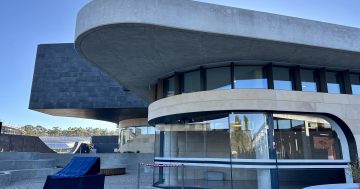
It cost more than half a billion dollars, but the man behind the controversial redevelopment of the Australian War Memorial has challenged critics to take a look for themselves at the new galleries that attracted 5000 visitors over Easter.

Ahead of Anzac Day, executive project manager Wayne Hitches was speaking at a media tour of the new atrium and galleries, now home to some of the Memorial’s biggest objects, previously stored at its Mitchell annex.

Mr Hitches believed the outcome was extraordinary value for money, and for him the high point of a long career in construction.

“Yes, half a billion dollars is a lot of money, but when you look at what we’ve been able to do, the four projects and what we’ve been able to deliver, I would challenge anyone to come and have a look at how we’ve done it,” he said.

“It is, I think, extraordinary value for money, and I think we’ll see that proved out as people come to visit.”

Mr Hitches moved into the public service to deliver this building, and didn’t think there would be another to top it.

“This might have to see me out,” he said.

READ ALSO Memorial build on budget, on schedule and winning friends

The new light-bathed atrium houses a Black Hawk helicopter, an Australian Light Armoured Vehicle, an F-111 fighter-bomber, and the bridge of the HMAS Brisbane, which served in Vietnam.

New galleries include the Middle East, featuring a Super Hornet warplane and a Chinook helicopter, and the story of Australian Peacekeeping. The new Anzac Hall houses Bomber Command’s G for George Lancaster bomber and other World War II pieces.

The Afghanistan Gallery is still being built and is expected to be completed in May, displaying objects such as battle-damaged Bushmasters and drones.

Mr Hitches said bringing some of these large objects out of storage and into the Memorial involved slow overnight journeys, sometimes towed backwards, before being lifted into place.

He said the visitor response had been fantastic. “I think people feel the power of the place as they come in,” Mr Hitches said.

While the sheer size of the objects is breathtaking, the Memorial emphasised the painstaking care taken in presenting the galleries and the stories of not just those who served but also of all people involved in these conflicts.

Director of gallery development Bliss Jenson said it was a challenge for her teams to tell these stories properly, not only those of veterans but also civilians and refugees.

While the voices of veterans were front and centre, the Memorial sought to present multiple perspectives, including those of the peace movement, to provide a complete picture.

“There are over 5000 engagements with people who have contributed their stories, their photographic collections, their personal memorabilia, stories of courage, stories of trauma, stories of growth, generally stories about humanity and what we can learn from the impact of war,” Ms Bliss said.

That also brought responsibility to appreciate the sensitivity of the material and the wellbeing of visitors.

This included providing safe or respite spaces for those affected by what they were experiencing.

“We’re conscious throughout the design process about how we organise the content,” Ms Bliss said.

She said curators had felt the weight from critics of achieving the right balance – getting it right for veterans and right for the community.

“We’re in the business of truth-telling,” Ms Bliss said.

Bashir Hanna and his “magic” lamp in the Hall of Reflection in the Middle East Gallery.

The Memorial also set up advisory groups from across veteran, First Nation, migrant and youth communities to guide how the galleries were presented and to ensure it was an inclusive experience.

An Iraqi community member provided one of the smallest objects on display, but also one of the most poignant, for the Hall of Reflection, where people’s recorded stories can be heard.

Sydney man Bashir Hanna brought an oil lamp with him to Australia in 1998, a symbol of hope from his war-torn country.

Bashir told him the lamp was like the magic lamp in the story of Aladdin, home to a genie who could grant wishes, and his wish was to leave war behind and come to Australia.

“It wasn’t an easy journey, but when I arrived in Australia, it was as if I was born again,” he said.

READ ALSO The War Memorial's spectacular copper roof will turn green, eventually ... but why the delay?

Bashir said being invited to serve on the advisory committee gave his community a voice and a chance to be included in this “wonderful iconic place”.

“We’re not only given the chance to live, but in fact to be part of the setting, to be included,” he said.

“These are very, very meaningful things for someone who lived in a war-torn country.”

Memorial Director Matt Anderson said he was very proud of what had been achieved over the past five years.

“This is what ambition looks like,” he said.

Mr Anderson said space had been created to tell the stories of 100,000 veterans from the past 40 years, many of which had never been told before.

“There are 1200 individuals whose stories are told in the galleries behind us who have previously never had a chance to share the stories of their service with the Australian people,” he said.

Free Daily Digest

Want the best Canberra news delivered daily? We package the most-read Canberra stories and send them to your inbox. Sign-up now for trusted local news that will never be behind a paywall.
Loading
By submitting your email address you are agreeing to Region Group's terms and conditions and privacy policy.

Join the conversation

29
All Comments
  • All Comments
  • Website Comments
LatestOldest

@JS9
The Australian War Memorial was always intended to be both a memorial and a museum.
From its very inception, the visionary behind the Memorial, official war correspondent Charles Bean, conceived of it as a “war memorial museum.” He believed that a shrine to the dead and a museum to explain their service were “philosophically and operationally inseparable.”

I’m pretty sure Charles Bean’s viewpoint didn’t extend to galleries sponsored by weapons manufacturers however….

A museum to explain their service is very different to what the AWM is today however.

Value for money and half a billion dollars for what the AWM has ‘delivered’ are not concepts that belong in the same sentence.

Margaret Freemantle4:28 pm 16 Apr 26

No matter how much spin, the amount of money can never,ever be justified.

Yes great. New shiny stuff we can’t afford while hundreds of elderly patients are stuck in hospitals because there are no aged care beds for them.

We do love our war gear and all the bang-bang stuff. Half a billion, well spent! So shiny!

Now, for the war buffs to pile on. Have some respect. You weren’t there, so you can’t comment. Show some pride in the uniform, you treasonous coward!

Look, most people who fought in war want to forget about it and move on with their lives, as the experience was so horrific. I know this from the many relatives and friends, both dead and alive, who fought overseas.

It’s the would-be-soldiers, the armchair generals, and the soldiers who boast about their battles that we need to worry about. In other words, the AWM’s target audience.

Yes. And you are spot on with your third paragraph.

Nailed it Jayce with a lot of that.

Michael Pope7:45 am 11 Apr 26

The judgement of value-for-money should be left to the taxpayers, whose money it was. The expansion was driven by the ego of Brendon Nelson and required the demolition of a perfectly fine, indeed award-winning, modern display space. As for the new exhibits – the wars and interventions that largely fill it, whilst recent, are not comparable in importance to the space they receive. And frankly pretty uninteresting in content.

Margaret Freemantle6:42 pm 11 Apr 26

And of no help whatsoever to the returned soldiers needing support.

It is an excellent renovation. Not just adding more gallery space, but fixing the original building’s foundations, improving the site’s energy efficiency, etc.

I just wish the critics could understand that this place is a memorial AND a museum. The current redevelopment is of the museum part. The memorial part remains unchanged.

Elvis Gunners9:01 am 12 Apr 26

EXACTLY. Haters gonna hate whatever we say though. If you don’t like it, no-one is making you go. History is important. Commemoration is important.

Glorifying war is not important however.

And it was never originally set up to be a ‘museum’ – it was truly meant to be a memorial.

They really missed a trick by not using that cash to set up a properly built museum space elsewhere – but alas, egos came into it.

Elvis Gunners7:30 am 14 Apr 26

JS9, I didn’t mention glorification of war and I never would. I’ve visited the AWM many times, and I’m a former ADF member. For many people I know, it’s a place of quiet reflection and remembrance. And a reminder of what ordinary people are prepared to do in the service of their country. You don’t have to like it, or agree, as that is your right in our democracy. But to insinuate that the War Memorial glorifies war is offensive.

Galleries sponsored by weapons manufacturers – does that really fit with remembrance?

New galleries crammed with every weapon of war they can fit, often not telling/adding anything from a ‘remembrance’ perspective at all at all?

Just two ways in which elements of the AWM as it stands are going well beyond simple remembrance.

I’m not saying it doesn’t do a good job on commemoration and remembrance.

Just that I think it also has gone too far in some aspects towards glorifying war, that is all.

The Hawks of the world have had too much influence in recent decades over the doves in the way the Memorial is run, and this latest expenditure reflects that.

If you are comfortable with those aspects, that is your call. Equally others are validly able to call it out for what they see that as.

Elvis Gunners9:48 am 15 Apr 26

Fair call.

Daily Digest

Want the best Canberra news delivered daily? Every day we package the most popular Region Canberra stories and send them straight to your inbox. Sign-up now for trusted local news that will never be behind a paywall.

By submitting your email address you are agreeing to Region Group's terms and conditions and privacy policy.