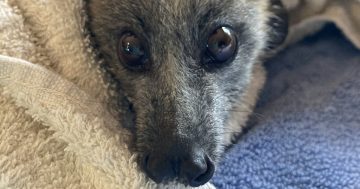


While they’re an important keystone species, flying foxes can have a hard time during their migration. Photo: Clare Wynter.
Stephen Bartos thinks humans have unfairly judged flying foxes.
“Hollywood has a lot to answer for … the idea that bats are vicious creatures that swoop down and drink your blood isn’t correct,” he said.
“Flying foxes are harmless vegetarians.”
A flying-fox coordinator with ACT Wildlife, Mr Bartos sees plenty of the mammals, and said that while they were often noisy, they had a key role in our environment.
He said they were even a keystone species (meaning they have a much larger impact on the environment than their numbers would indicate).
“They’re vitally important for the Australian ecosystem … They’re pollinators and seed dispersers,” Mr Bartos said.
“They do a whole range of unpaid ecological work.
“They pollinate some of the important gum trees in our forests. A lot of species of eucalypts won’t be able to survive without them.”
Warmer weather brings animals flying south, and for ACT Wildlife, they arrived right on schedule.
This year, the keen eyes of wildlife carers spotted them two days after Floriade wrapped up in mid-October.
“We have a suspicion that they might have been around earlier than that, but they don’t like Floriade — it’s too noisy and [has] flashing lights,” Mr Bartos said.
The latest count revealed about 2000 in Commonwealth Park as of early December, but that number is expected to grow throughout summer.
It’s the perfect spot for the mammal, with easy access to water and (relative) proximity to native plants in places such as Queanbeyan, Yass and Hall.
Mr Bartos said that overnight, they could fly up to 100 kilometres in search of food, before heading home before dawn.
“They spread out across the region, and they fly to find food,” he said.
“What flying foxes really prefer is coastal ranges near rivers. They’ve been losing a lot of their preferred habitat, which means they’ve been coming into cities.”
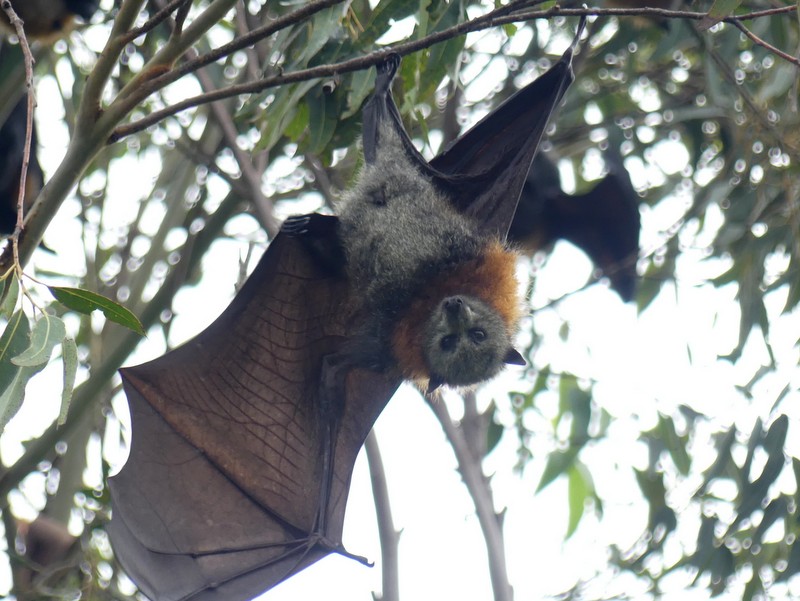
Flying foxes head south in the warmer months, before escaping winter and heading to northern Australia. Photo: Ian Fraser.
It was a different story across the border, as Eurobodalla Shire Council natural resources officer India Howlett said they had started arriving in coastal NSW earlier than usual.
Since they were first seen in October, more than 800 flying foxes have been detected across the region. (While their numbers have since stabilised, they tend to arrive in the region from early summer to mid-winter.)
Ms Howlett said their detection was a reminder that people needed to be careful.
“With fewer forest flowers currently blooming, we expect more of the bats to follow their nose into gardens seeking food,” she said.
“For residents protecting their fruit trees, it’s essential they use wildlife-friendly netting.”
The need for wildlife-safe netting was echoed by Mr Bartos, who described larger holes (through which people could fit their little finger) as “really bad news” for the animals, who become trapped in the material.
The ACT Government outlawed the nets with larger holes in 2024. Mr Bartos said that while it was an appreciated change, it was too early to see what impact it had had on this migratory season.
Mr Bartos urged people to call wildlife carers if they saw an injured flying fox, especially if it was on the ground.
“They don’t walk on the ground — if you see a flying fox on the ground, it’s in trouble … They can’t take off from the ground.”
He said that a mother might be dead but have a pup clinging to it — and this check was best left to the carers.
This migration season has also come with a strange trend, as ACT Wildlife carers have been looking after several pups whose mother has been electrocuted.
“It could be pure coincidence; it could be chance,” he said.
“There is no factor that we can see making it happen. It’s a bit of a mystery as to why.”
While few flying foxes carry a potentially fatal disease — Australian bat lyssavirus — it’s a risk to people handling the animals.
“It’s very rare. Fewer than 1 per cent of flying foxes have this disease … All of our rescuers and carers are vaccinated, so we’re fine, but members of the public aren’t,” Mr Bartos said.
If you find a flying fox in distress, you can call ACT Wildlife on 0432 300 033. In NSW, WIRES’ Far South East branch can be contacted on 1300 094 737, and Wildlife Rescue South Coast Inc on 0418 427 214.