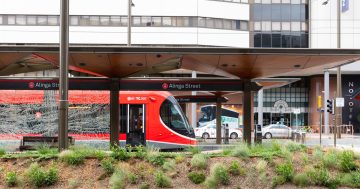
Catching light rail or the bus would reduce car use and allow people to stay later at venues, the AHA says. Photo: Jack McCracken.
Making public transport free and timetabling later services would help boost Canberra’s nightlife, according to the Australian Hotels Association.
The AHA ACT has submitted a lengthy submission with 28 recommendations to the Legislative Assembly committee inquiry into the night-time economy.
These include calls for more government help to get businesses through the light rail works program in the city, extending liquor licence discounts to larger venues with live music, and cutting red tape around where people can dance.
The submission says that despite modest increases in turnover and the number of establishments in recent years, the number of jobs had shrunk by about 8 per cent due to rising operating costs, entrenched labour shortages, escalating insurance premiums, and inflexible regulatory settings.
The fact that demand has remained high points to “systemic impediments”.
Making it easier for people to get to entertainment precincts and home again would help drive the night-time economy, the AHA says.
It urges the government to make public transport permanently free on Friday and Saturday nights from 6 pm to 4 am on key routes servicing entertainment precincts such as Civic, Braddon, Dickson, Manuka and Kingston.
Late-night public transport services should align with trading hours, operating until at least 2 am on Friday and Saturday in key precincts, and until 1 am on Thursday to Sunday on all routes serving entertainment zones, every half hour.
It wants a Night-Time Transport Advisory Group established, with representatives from Transport Canberra, AHA ACT, rideshare operators, and nightlife precinct managers, to assess transport performance and address any issues.
Additionally, rideshare vehicles should have access to all taxi ranks and bus zones in entertainment precincts from 10 pm onwards, with designated rideshare-only zones established in Civic, Braddon and Dickson, with clear signage and real-time digital wayfinding at all designated pick-up sites.
AHA ACT general manager Chris Gatfield said this would help convince people to make the journey into town or wherever, reduce car use and allow them to feel freer to stay longer.
“It doesn’t need to be at 5 am, but people would have the confidence to know that if they’re going out into the city on a Friday night and they intend to stay out after midnight, they can get home,” he said.
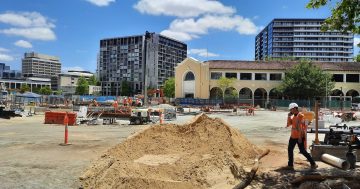
Mr Gatfield said venues along and near the new light rail alignment were struggling to survive and needed more help than what the government had so far offered.
The AHA wants a Light Rail Business Mitigation Program that provides targeted, time-limited financial assistance to businesses directly impacted by light rail construction.
This would be limited to businesses that can demonstrate a turnover reduction of 30 per cent or more compared to the pre-construction period and demonstrate measurable impacts on access, visibility and amenity.
Mr Gatfield said that footfall had slumped due to events outside their control, and without that footfall, turnover and cash flow suffer.
He said no-interest loans could be one of the measures.
“In winter, things get significantly tougher, so you wouldn’t want to see venue closures over the next six months,” he said.
“They have scratched their way through so far; they just need to be there at the end of the project.”

AHA ACT General Manager Chris Gatfield would like to see less red tape. Photo: Ian Bushnell.
The submission also recommends a two-hour trading extension for venues that program live entertainment on nights after 6 pm and expanding liquor licence discounts to venues with a capacity of over 350 that regularly have live shows.
Mr Gatfield said it made more sense for the liquor licence discounts now available to smaller venues to also be available to bigger venues that pay higher fees.
Mr Gatfield said they’d be able to program more live music more often to attract patrons and support bands.
“Everyone loves live music in a pub,” he said.
Another recommendation urges the abolition of “outdated and unnecessary” rules on dancefloors in licensed premises that the AHA says are cramping venues’ operations.
Mr Gatfield said the Commissioner for Fair Trading had an overarching power to determine what a dance floor is in Canberra, its design and what venues were allowed to put them there in terms of furnishings and furniture.
“I don’t think that it is the job of government to get involved,” he said.
“If the whole point of all the vibrancy reforms that the government have been engaging in is to increase the vibrancy of Canberra, having a bureaucrat sitting there going through plans and venues doesn’t seem to accord with a vibrant and 24-hour economy.”
The submission also called for an ACT Venue Investment and Infrastructure Grants Program to support noise reduction, compliance upgrades, safety improvements and programming capacity for live music and performance venues.
Other recommendations covered skills shortages, insurance, liquor licence reform, safeguards against vexatious noise complaints, precinct planning and increased penalties for assaulting staff.