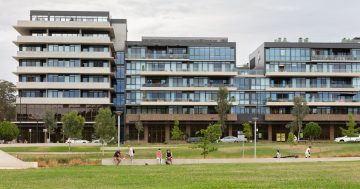
An inquiry into the strata industry has found owners are still paying more for insurance than they should. Photo: Michelle Kroll.
Owners in strata properties are still unwittingly paying more for insurance than they should, as some strata managers in the ACT continue to take opaque commissions from brokers.
A Legislative Assembly committee that inquired into the strata industry found that more transparency was needed in the payment of insurance company commissions to strata managers but stopped short of calling for a ban, something supported by both the industry body, the Strata Community Association, whose members are in the process of phasing out commissions and the Owners Corporation Network.
It recommended that the ACT Government mandate disclosure to owners corporations of any conflicts of interest and commissions received by strata managers and only consider phasing in a ban.
It also recommended that the government consider new laws to require strata managers to provide a written explanation of commission arrangements to owners corporations when seeking approval for insurance quotes.
But Region has learned only a handful of SCA members are not taking commissions and property owners were still paying through the nose, with a combination of commission and fee, sometimes amounting to 45 per cent of the cost of insurance, going to the strata manager.
In many cases the strata manager is also the insurance broker or connected to the insurance broker.
One owners’ corporation in a $72 million building was recently quoted $115,000 by the strata manager/preferred broker but an independent broker quoted $95,000, saving owners $20,000.
Founder and managing director of insurance advisory firm allinsure Peter Chamberlain said he had recent examples where three executive committees had received documents with the breakdown of the allocation of remuneration and all three had no understanding or idea of what it actually meant.
“So transparency is amazing, but transparency is only useful if you know what to expect or what the normal is and what’s not normal or what’s not OK,” he said.
“It’s a toothless tiger. It’s not achieving what it’s meant to achieve unless there’s some form of education.”

allinsure founder and managing director Peter Chamberlain said commissions should be banned. Photo: allinsure.
Mr Chamberlain said insurers should deal directly with the executive committee members not the strata manager so it was fully transparent and conflict-free.
He was still seeing inflated costs due to charges above industry standards, although this was coming down.
He said strata managers did have a role to play and he was not opposed to a small referral fee but there were too many conflict of interests with commissions and they should be banned.
“To assist the industry and to clean up the historic issues, a ban on commissions and referral fees is the most appropriate outcome,” he said.
“It’s not going to be a massive saving to all your different strata complexes.
“There’ll be some savings, absolutely, it’s just a case of getting back to being transparent, moral and ethical and charging money for the service you’re providing.”
ACT CSA executive committee member Chris Miller said members had agreed to a phase-out of commissions, in line with the NSW body, and were well on the way to achieve this by the end of the year.
Mr Miller said the whole industry was moving to phase out commissions out but there were exceptions.
He said his company, Vantage Strata, had become commission free from 1 July.
“The ACT has a unique set of conditions that allow us to really move on this – a small concentration of business owners in a small market and very good relations with stakeholder groups like the Owners’ Corporation Network and the legislators,” Mr Miller said.

ACT Strata Community Association’s Chris Miller says members were on track to be commission-free by the end of the year. Photo: Vantage Strata.
But he said there should be an even playing field and legislation was needed to create that.
“In absence of legislation you’re going to have the potential to have an unfair playing field, where managers on the face of it are charging less, but in fact they’re getting an alternative remuneration through insurance commissions and it is a fallacy frankly to think that the consumer will always recognise that and be able to make those connections,” Mr Miller said.
One of the major players in the ACT was Civium and it is on the record as being opposed to any ban, arguing that it would be a hit to revenue that would be passed on to consumers.
It argued in its submission to the inquiry that banning commissions would impact the viability of strata management companies, their ability to maintain services and result in an increase in fees for owners.
But Civium chair Doug O’Mara did tell the inquiry in July last year that he supported legislation requiring full disclosure of commissions, about which Civium was fully transparent.
Mr Miller said the committee had missed an opportunity and the SCA was preparing a response and would advocate for a ban.
“It’s pretty low hanging fruit and it’s a win for the legislators, I think it’ll be a win for the community and frankly in the long run I think it’s a win for the industry,” Mr Miller said.
ACT Owners Corporation Network president Gary Petherbridge told Region last year that commissions should go, even if it meant higher costs for property owners.
Mr Petherbridge said their removal would create complete transparency of charges and costs.
ACCC chair Gina Cass-Gottlieb has also called for all strata insurance commissions to be banned and condemned undisclosed arrangements as deceptive.
An ACT Government spokesperson said the government was now reviewing the inquiry report and preparing a response to all recommendations made by the committee.
The government’s response is due on or before 29 August.