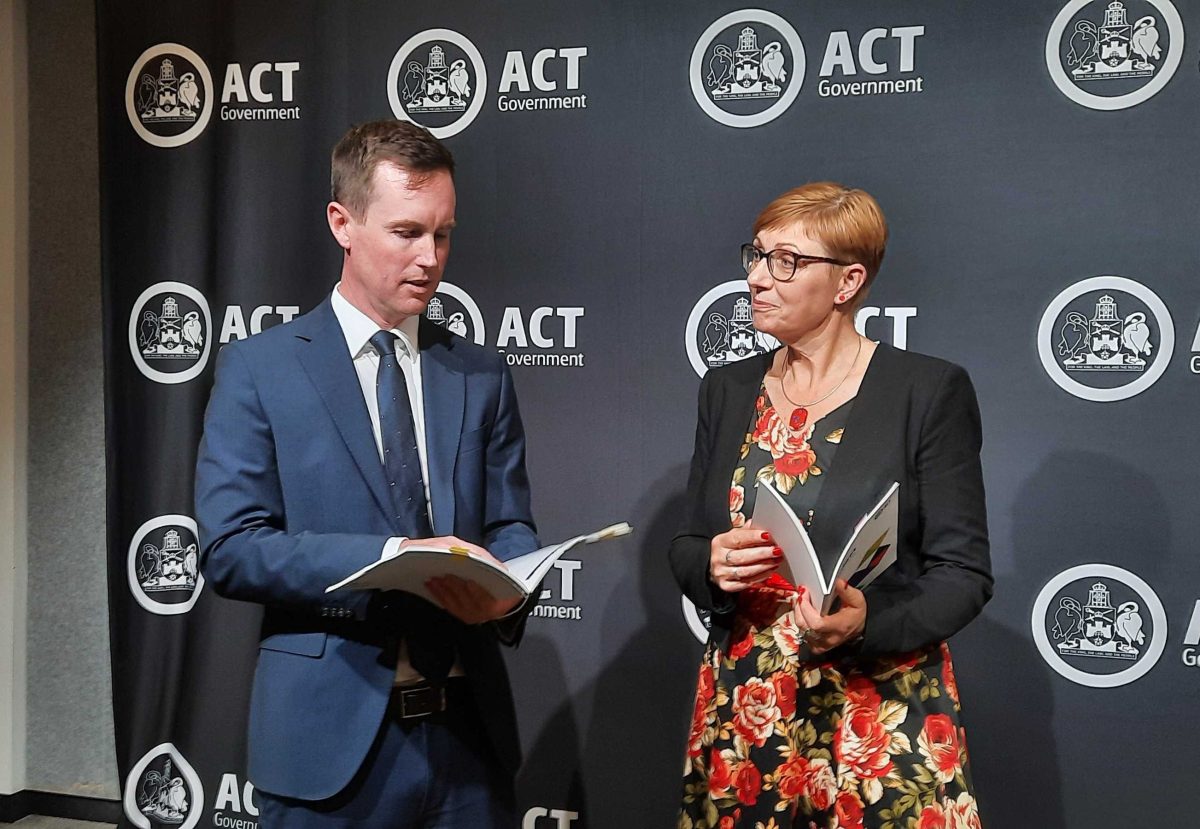
ACT Treasurer Chris steel and Finance Minister Rachel Stephen-Smith. Can they deliver? Unlikely, says Pegasus. Photo: Ian Bushnell.
An analysis of the 2026-27 ACT Budget has cast doubt on the ACT Government’s path back to surplus, citing a history of failing to deliver on its promises.
Pegasus Economics has tabled its draft review of the budget commissioned by the ACT Legislative Assembly’s Select Committee on Estimates 2026-2027.
It also says that without dramatic changes, the government’s 20-year tax reform program will miss its deadline for scrapping stamp duty.
It notes a long-term deterioration in the Territory’s balance sheet, challenges the government’s attempts to downplay the seriousness of its debt position, says the government continues to overspend, and notes that growing interest payments are an increasing burden on ACT taxpayers.
It also says that without dramatic changes, the government’s 20-year tax reform program will miss its deadline for scrapping stamp duty.
The budget says the 2025-26 deficit is $501.7 million, and will be $323.4 million in 2026-27, but would return to surplus in 2028-29 – one year later than previously forecast.
But the report says that if the ACT Budget did not include an estimate of expected returns from the Territory’s Superannuation Provision Account and used the same methodology as other states, the ACT deficit would be around $611.9 million in 2025-26 and would not return to surplus at any time in the forward estimates period.
It says successive budgets have promised improved fiscal positions in the forward years, only to set out progressively worse forecasts in subsequent budgets.
“This history raises questions about the ACT Government’s ability to deliver the promised return to surplus,” the report says.
The report echoes the finding of independent economist Saul Eslake that the ACT’s deteriorating financial position is due to deliberate policy decisions of the Barr Government.
“The deterioration in the 2026-27 budget forecast is primarily the result of policy decisions to increase expenditure,” it says.
Forecast expenses for 2026-27 of $10.2 billion are $554.4 million or 5.7 percent higher than the expected 2025-26 outcome and $394.4 million or 4.0 percent higher than forecast in last year’s budget.
Pegasus says the ACT repeatedly fails to meet its spending reduction targets.
“In the absence of concerted measures to restrain expenditure growth estimates, expenses in the forward years might be expected to be higher in future years than forecast in the current budget, both in absolute terms and as a proportion of GSP, unless the ACT Government has more success than it has achieved in the past, in restraining expenditure growth,” the report says.

There’s no guarantee that health spending can be contained. Photo: Claire Fenwicke.
It says that the budget itself warns of the risk of forecasts in the two biggest spending areas – health and education – being overshot.
New spending decisions and the interest expenses of increased borrowing are at the root of higher forecasts since the last budget and the 2025-26 Budget Review, Pegasus says.
Interest expenses are the fastest-growing area of public expenditure, with an annual average growth over the budget and forward years of 17.6 per cent, and are now forecast to reach $811 million in 2026-27 and $1217.5 million in 2029-30, or 11.1 per cent of total expenses, and about 1.5 per cent of GSP, representing a measurable and growing burden on the ACT taxpayer.
“The interest bill doubles between the 2025-26 outcome and the 2029-30 estimate,” the report says.
Net debt in 2029-30 is forecast to be about 50 per cent higher than the estimated debt in 2025-26 and eight times higher than in 2015-16. The ACT had no public debt as recently as 2011-12, Pegasus notes.
“High interest obligations divert funds that might otherwise be spent on health, education and other services,” Pegasus says.
“The interest bill also limits future budget flexibility.”
This leaves the ACT exposed to future shocks such as pandemics, natural disasters or global uncertainty.
“The billion dollars, or roughly a tenth of total expenses, that are being paid to banks and financial institutions might have otherwise been available to buffer the economy against future shocks or to spend on health, education and other services to benefit the community,” the report says.
Pegasus says the government’s oft-quoted favourable comparison of ACT’s net debt with that of other states and territories is not reassuring.
It is not as bad as Victoria and the Northern Territory, but is worse than NSW, Queensland, Tasmania and Western Australia.
Pegasus says the ACT now shares with Victoria and Tasmania the lowest S&P Global Ratings debt rating of Australian States and Territories.
“According to S&P Global Ratings, Australian States and Territory governments are posting some of the largest budget deficits among sub-national governments in the developed world,” it says.
“In 2024, Victoria was reported as being the fourth-most-indebted state government from advanced economies outside the US in absolute dollar terms.”
Pegasus also warns that the government is in danger of failing to meet its 2032-33 deadline for the eradication of stamp duty through its 20-year tax reform program because rate collections will not be enough to offset it.
It says that in 2029-30, the last year of the forward estimates, revenue from general rates collections would have to increase by just under 35 per cent to fully offset and replace the revenue collected from commercial and residential conveyance duties.
“On this basis, annual increases in general rates in the order of few percentage points above WPI (wage price index) is not likely to generate sufficient additional revenue to eliminate conveyance duties any time in the foreseeable future,” Pegasus says.
“Unless the ACT Government is going to announce some dramatic changes in forthcoming budgets in relation to both conveyance duties and general rates, then it is extremely unlikely the ACT Government will meet its original deadline of eliminating conveyance duties following 20 years of tax reform.”