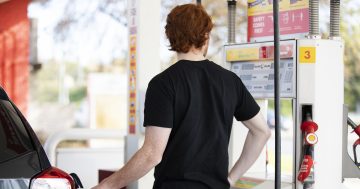
Fuel excise will be halved for three months to help mitigate the cost impacts of the Middle East war. Photo: David Murtagh.
The fuel excise will be halved for the next three months to help Australian motorists at the bowser, as prices soar due to the war in the Middle East.
The move will reduce the cost of petrol and diesel by 26.3 cents per litre.
The heavy-vehicle charge, which is currently 32.4 cents per litre, will also be reduced to zero for the same period – both starting on Wednesday (1 April).
Anthony Albanese said his Cabinet had agreed on the initiative on Monday morning (30 March).
“We’re making fuel cheaper today because we understand that Australians are under serious pressure,” the Prime Minister said.
The PM said he wanted to keep Australia moving and that holiday plans should not be affected by concerns over fuel supplies and prices.
“People should enjoy their Easter, and it’s important as well that we keep the economy going,” Mr Albanese said.
“Easter is an important time for tourism destinations, for jobs; they rely upon that. And I wish those people of faith as well a holy Easter. It’s an important time.”
Treasurer Jim Chalmers said halving the fuel excise and cutting the heavy-vehicle road user charge will cost the budget about $2.55 billion.
“The steps that we’re announcing are all about taking some of the sting out of these higher petrol and diesel prices,” he said.
“This is timely, this is targeted, this is responsible cost-of-living relief to help people get through a difficult period.”
National Cabinet – the Prime Minister, along with state and territory leaders – also met on Monday morning, the second time since the war began.
It adopted a National Fuel Security Plan to ensure a single, unified plan to tackle the crisis, rather than nine separate ones across jurisdictions.
The governments have been working on the plan over the weekend, with the states and territories meeting ahead of National Cabinet.
ACT Chief Minister Andrew Barr said premiers and chief ministers were unified in calling for strong Commonwealth leadership on the issue, a diesel‑focused national plan and improved data transparency.
“Fuel is continuing to arrive as expected and there is enough fuel for normal use. Prices are higher because of global events, not because we’re running out of fuel locally,” Mr Barr said.
“Diesel is being prioritised for public transport, emergency services and essential supply chains.”
The plan to emerge from National Cabinet outlines how all governments will work together to coordinate a consistent response across the Commonwealth, states and territories.
The Prime Minister praised the level of cooperation of those in National Cabinet.
“People were cooperative, people were collegiate. We worked very hard on this,” he said.
The plan is designed to keep the community and business updated and provide an early understanding of further fuel security measures that may be required.
It has four stages and levels of action: plan and prepare; keep Australia moving; take targeted action; and protect critical services for all Australians.
Mr Albanese said while National Cabinet is planning for targeted action, he hoped to avoid it if fuel suppliers and motorists do the right thing.
The government understands that people are really worried, but we have a plan to get through this,” the Prime Minister said.
“One of the things that we want to ensure is that it is one plan, not nine, across eight state and territory jurisdictions and from the Commonwealth.
“The plan outlines how governments will work together to keep Australia open and to keep our economy going. Early, voluntary action, coupled with new supply measures, will make a difference and make sure that fuel continues to get to those who need it most.”
The Treasurer emphasised that the Australian Competition and Consumer Commission will “come down like a tonne of bricks” on any fuel suppliers found to be engaging in price gouging and anti-competitive behaviour during the crisis.
The government also introduced its amendment bill to the Lower House to give it the power to underwrite fuel imports.
The bill should pass the House of Representatives on Monday evening, with Labor seeking its passage in the Senate by the end of this sitting week.
The Coalition has signalled its willingness to support the bill.
Energy Minister Chris Bowen said he was pleased with the progress being made to secure fuel supplies to Australia.
“Australians want to know what’s being done to secure our international supply of fuel and oil, and we’re very pleased with the progress that we’ve made,” he said.
“It’s [the bill] about pre-empting increasing risk in the market and ensuring that Australian firms can go out and compete with firms around the world to get that fuel for us.”