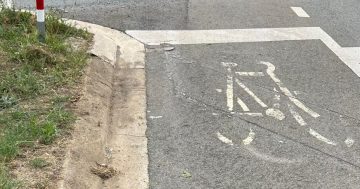
The Garden City Cycleway can be used by cyclists, scooter riders and walkers. Photo: ACT Government.
Cyclists, scooter riders and walkers now have a dedicated pathway from Ainslie to Canberra’s CBD.
It’s because the final segment of the Garden City Cycleway’s Stage 1 project is now complete and open for use.
City and Government Services Minister Tara Cheyne said this marked a significant milestone for active travel in central Canberra.
“Canberra consistently ranks highly as one of Australia’s best destinations for cycling, and we know more Canberrans will walk and ride if it is safer, more accessible, convenient and enjoyable,” she said.
“This is just one part of our significant investment in active travel infrastructure. Between the ACT and Australian Governments, $10.4 million was jointly funded to deliver Stage 1 of the cycleway for Canberrans.”
Work began on Stage 1 in 2024 and connects the city with Ainslie, Braddon and Dickson.

Stage 1 of the Garden City Cycleway is now open for riders, cyclists and walkers alike. Photo: ACT Government.
The project was split into four stages and features a combination of 3- and 4-metre-wide concrete and asphalt paths.
New traffic lights and 10 raised zebra crossings were also constructed across stages 1(a) to 1(c).
The final segment connects Torrens Street and Lonsdale Street along Cooyong Street, before riders and walkers can use the Bunda Street shared zone.
Braddon Collective representatives described the Garden City Cycleway as a “huge asset” for the area.
“It provides a coherent and consistent active travel path in an area that has lots of people getting around on bikes and by foot,” they said.
“We’re pleased by the quality path that’s been built. It’s an enduring piece of infrastructure for the busy inner north.”
They did raise some ongoing concerns with people driving vehicles onto and along the path, urging the ACT Government to use “more impactful deterrence methods” over education.
“We’ve also asked government to keep in mind that cycle paths across the city need to be fully and properly connected to destinations and to other network sections,” the Braddon Collective said.
“Right now the connection from Braddon into Civic is not great – we know more work is underway and are pushing for a safe and convenient connection across Cooyong St to be created.”
Design for Stage 2 is underway to determine the final alignment, intersection treatments, crossing locations, landscaping options and supporting infrastructure.
“Design work is focused on developing a safe, efficient and user-friendly active travel corridor while balancing the needs of residents, community groups, businesses and road users,” Ms Cheyne said.
The Commonwealth committed $5 million in the 2025-26 Federal Budget to extend the Garden City Cycleway further to Canberra’s inner north, with the ACT Government pitching in $6 million.
It will eventually extend to Watson, providing a safe cycle route through Downer, Hackett, Dickson and onwards.
Federal Canberra MP Alicia Payne said the project aims to make it easier and safer for Canberrans to get around the city.
“With another $10 million committed by the Commonwealth and ACT governments for Stage 2, we’re continuing to build a better-connected Canberra, giving people more transport choices and making our city an even better place to live,” she said.

The Garden City Cycleway will eventually extend from Watson to the CBD. Photo: ACT Government.
The detailed design will be shared with the community before construction begins.
A proposed off-road path between Hawdon Street and Angas Street is still under consideration and subject to future funding.
Pedal Power executive director Cecily Michaels said the cycleway’s momentum needed to be maintained, especially as the project had been in the planning and advocacy pipeline for “many years”.
“But today we want to celebrate that this major section is finished and people can now use it,” she said.
“We will continue to engage throughout the design of Stage 2 and advocate for prompt and timely delivery of active travel infrastructure upgrades.”

Ms Michaels said Pedal Power expected Stage 2 to maintain the high standard of Stage 1, particularly regarding the wide paths to accommodate demand.
“One of the most important things will be making sure there are no inadvertent broken links,” she said.
“A cycleway is only as useful as its connections, and a short section where people are suddenly required to negotiate a difficult road or intersection can undermine an otherwise excellent route.
“Pedal Power has been involved throughout the development and design of the Garden City Cycleway, and we feel that our input has been listened to. Most of the design aligns well with what we have advocated for, particularly the focus on providing safe, connected infrastructure that can be used by people with a wide range of ages and riding abilities.”
Despite all the positives, some frustrations remain.
This includes ensuring the infrastructure is safe and accessible once it’s built.
“We’ve already raised concerns about vehicles parking on sections of the new, wider path and obstructing people using the cycleway, and it’s frustrating to be told there is little that can be done about this,” Ms Michaels said.
“If we’re investing in high-quality active travel infrastructure, we need to make sure people can use it safely and as intended.”
Construction on Stage 2 is expected to begin in 2027.