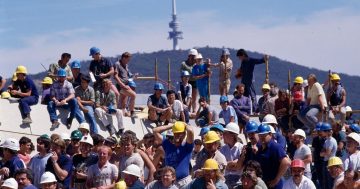
Ross Barrett OAM has played a significant role in shaping MBA ACT and Canberra. Photo: Hayley Nicholls.
When Canberra’s first apartment tower rose above Kingston decades ago, it was seen as a bold step into the future. But the developer struggled to sell it because, as Ross Barrett remembers, “nobody wanted to live in an apartment then”.
The same scepticism greeted Swinger Hill, one of Canberra’s first townhouse developments. It was unlike anything the city had seen.
Today, apartments dominate Canberra’s skyline, townhouses are commonplace, and Kingston has transformed into one of the capital’s most desirable neighbourhoods. Braddon, once known for its service stations and mechanics, has become a bustling dining precinct, while the old Kingston Harbour has given way to waterfront apartments.
For Mr Barrett, those changes tell the story of a city that has continually reinvented itself.
He arrived in Canberra on the first day of 1970 as a 29-year-old engineer, when the population was about 130,000 and the city was still being shaped under the direction of the National Capital Development Commission (NCDC).
Established by the Federal Government in 1958, the commission oversaw Canberra’s planning, development and construction, helping create the carefully planned “garden city” that distinguished the national capital from every other Australian city.
“It really was a garden city,” he says.
Mr Barrett had left Boorowa with his wife and young son, intending to build a life in Canberra. Three more children would follow, all raised in the city they soon called home.
Like many young families of the era, the Barretts rented a home in Hackett while searching for land.
Finding a block wasn’t the challenge.
Choosing one was.
The NCDC regularly auctioned serviced residential land across Canberra’s newest suburbs. Belconnen stretched only as far as Cook, Aranda and Weetangera, while Farrer marked the edge of Woden.
At one auction, Mr Barrett refused to lower his hand, paying what was then considered an extraordinary $4,000 for a 1735-sqm block in Weetangera.
“It was by far the highest price on the day,” he recalls.
The family home cost another $26,000 to build. Today, the property is worth about $2 million.
“The land was a very, very small component,” he says.
“Now the land is a massive, massive component.”
What strikes him even more than the prices is how much choice people once had. By the mid-1970s, around 7000 completed residential blocks were available for sale across Canberra.
“Now they ballot them or release them — I don’t know — maybe 50 at a time.”
Those early suburbs, he says, were built with generous backyards, wide streets, playgrounds, sporting ovals and towering trees.
For Mr Barrett, Canberra wasn’t simply somewhere to build houses.
It was where he built a family. More than five decades later, three of his four children still live in Canberra, along with seven of his 10 grandchildren.
His son lives in Griffith, close enough to walk to. One daughter now lives in the same Weetangera home where the family was raised.
Every Wednesday begins with breakfast alongside one granddaughter.
Every Saturday morning at 10.30, he has coffee with his grandson, who has Down syndrome.
“I think this kind of family life is much easier here.”
The city itself has changed dramatically.
Responsibility for shaping Canberra shifted from the National Capital Development Commission to self-government, and Mr Barrett believes some of the long-term planning vision that once defined the capital has become harder to maintain.
He misses the spacious suburban design that gave families room to grow, but accepts cities cannot stand still.
“It’s probably the most accepting city of multiculturalism,” he says.
“We don’t have little pockets of people.”
Awarded an Order of Australia Medal for his contribution to the construction industry, Mr Barrett has spent decades helping shape the capital. He has chaired several development and community organisations, including the Canberra and Region Development Corporation and CHC Affordable Housing, while also playing a significant role in the Master Builders Association of the ACT and the Civil Contractors Federation.
His fingerprints can be found across the city in the roads, bridges and suburbs he helped build.
Among the projects he is proudest of is the distinctive boomerang-shaped bridge linking Kings Avenue and Parkes Way, designed to reflect the curves of Parliament House.
Yet the legacy that means the most to him isn’t one he constructed.
Through a series of business dealings, his company came to own land on the summit of Mount Jerrabomberra. About 670 residential blocks had been designed for the site.

Instead, the land was gifted to Queanbeyan City Council to remain public open space forever.
The legal paperwork required a purchase price.
“They insisted on giving me a $1 coin,” he says with a laugh.
Today, people climb the mountain for its sweeping views across Canberra and Queanbeyan, often unaware the landscape was preserved because someone decided it was worth more than another housing estate.
Looking back on more than half a century in Canberra, Mr Barrett doesn’t dwell on what the city has lost.
He prefers to think about what it has become.
“Canberra is still the best place in the world to live.”
“It’s just a different place.”
For someone who arrived when Canberra was little more than a carefully planned garden city, there is satisfaction in watching it grow into a thriving capital — and in knowing that, in countless ways both large and small, he helped shape the place generations of Canberrans now proudly call home.
“I look back on my life, and I’m very, very content.”