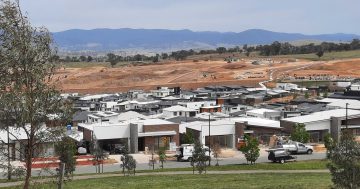
The site in Wright that the SLA can’t sell. Photo: SLA.
There’s an element of land deals in Canberra that no one is talking about: the price.
The hammer didn’t fall at a recent Wright auction because nobody turned up to bid. This was the second attempt to sell the block on Steve Irwin Avenue in Wright. Between the first and second sales attempts, the Suburban Land Agency eased the conditions, but it still made no difference. No takers.
Wright is not alone.
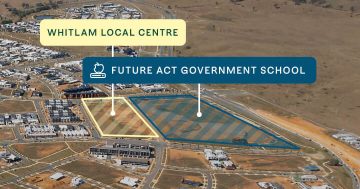
In December, the Whitlam Local Centre – the shops, main street and plaza that suburb has waited for – went to auction and passed in.
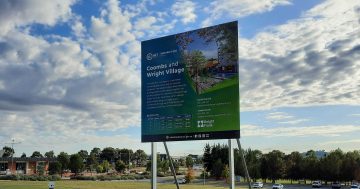
Last year the Coombs and Wright village blocks were pulled from sale, four years after the process began.
Three sites. One district. The same result.
These are not plans failing. These are sales failing.
Too much of the land is apartment sites. Building costs and interest rates have made many projects financially impossible. The Property Council’s Ashlee Berry said the result confirmed broader feasibility problems we can no longer ignore, and that land is only one factor.
She is right – all of that is true. But it’s not the whole story, because every one of those explanations is about the people buying.
None of them is about the seller.
In Canberra there is only one seller: the government. It owns the land, it decides when land comes to market, what conditions come with it, and what it costs.
When houses cost too much, we discuss interest rates, immigration and buyers. When a block does not sell, we discuss builders, banks and demand.
We rarely discuss the number the seller wrote down.
We’re not the first to say it. The Housing Industry Association’s also called the agency’s land pricing rigid and slow to respond to the market.
Last September the Suburban Land Agency wrote to our Forum about Whitlam. The sale had run from June 2022 to early 2025 with no buyer. The agency asked the developers, who looked at it, what the problem was.
They cited three problems: the requirement to build and run a community activity centre; rooftop gardens as a compulsory design element; the affordable housing requirement.
The community activity centre was removed, and rooftop gardens became optional, but the affordable housing stayed.
Price was not mentioned once.
The block went to auction in December. It still did not sell. To its credit, the agency wrote to us and told us what it was doing – that is not an agency hiding things.
But look at what moved. When the sale fell over, it was the community centre that fell by the wayside.
Here’s the part most people never see: a developer works backwards.
They start with what the finished buildings will sell or rent for, subtract the cost of building, borrowing costs and a reasonable profit. Whatever is left is what they can pay for the land.
When you add requirements to the block – such as a childcare centre or shops that won’t fill for a decade – the sums don’t work.
That’s not a developer being difficult. It’s just maths.
So a block with a community centre attached is worth less than the same block without one. Whether the valuation says so, nobody outside the agency can tell you. The method is not published.
As far as we can find, no Auditor-General report or Assembly inquiry has examined how the price of land is set.
What we do know is that the Planning Act 2023 requires the agency to sell land for no less than its market value, and its chief executive must personally confirm that the price is market value.
The price has a floor set by law, and an officer has to sign for it. The shops, the childcare and the community hall don’t have a law to protect their need. So when a sale falls through, the SLA can’t budge on price; it has to modify (reduce) conditions attached to the sale.
This matters more than a couple of failed auctions.
Gungahlin was promised jobs 20 years ago.
Last October this masthead reported a survey of more than 1300 Gungahlin residents that found 91 per cent of that district’s workers commute elsewhere for work.
Now look at the Wright block that failed to sell.
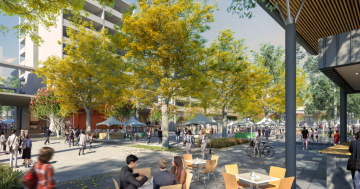
It was advertised as a mixed-use opportunity with 240 dwellings, 27 affordable homes and 10 public housing homes.
The commercial component is described as “adaptive”, with “flexibility” in how the upper levels are arranged.
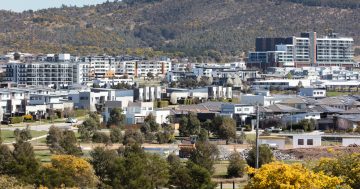
The valley wants and needs homes.
But it also wants somewhere to work and somewhere to go, and it wants them built alongside the houses, not 20 years behind them.
We are not asking the agency to sell public land cheaply. We are asking whether the market value is right and to publish how the conditions attached to a block are reflected in its valuation.
The agency’s own consultants recommended work of exactly this kind for the Whitlam Shops in 2022, to make clear what community requirements do to a site’s commercial value.
I honestly do not know whether it was ever done.
And if the price already accounts for the conditions and these blocks still fail, then the law is the problem.
And what about a third option so the agency can accept less, with a developer locking in what the community was promised?
We see the pattern, and we don’t like what is happening. Gungahlin is just one example.
Molonglo is being sold the same way, and like a slow-moving train wreck, we can see it coming. Without change, our residents will be giving the same answers to the same type of survey in 20 years.
So we’re calling for the developers! If you looked at one of these blocks and walked away, we would like to hear from you. Not to argue. We want to know what the number would have to be for the shops, the offices and the community space to stay in the deal.
We cannot make that case for you.
At the moment, nobody is making it at all.
Tom Adam is the convenor of the Molonglo Valley Community Forum, which represents residents across Coombs, Wright, Denman Prospect, Whitlam, Molonglo, Bandler and Sulman. It can be contacted through info@mvcommunityforum.org.au.