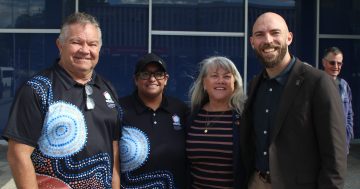
Suzanne Orr presented the government’s response to the ACT Aboriginal and Torres Strait Islander Elected Body’s report to the Legislative Assembly. Photo: Michelle Kroll.
The ACT Government has refused to hold an independent inquiry into the experiences of First Nations detainees at the police watch house.
This is despite the ACT Aboriginal and Torres Strait Islander Elected Body, which represents the Territory’s First Nations people, recommending such an inquiry in its 13th report to the government.
Minister for Aboriginal and Torres Strait Islander Affairs Suzanne Orr presented the government’s response to the elected body’s report in the Legislative Assembly this week.
She said the report found the health and wellbeing of First Nations people in the ACT was not only failing to improve, but was deteriorating in many areas.
The elected body found only four out of 22 agreement targets were on track.
“Commitments are not producing meaningful change and the report calls for a fundamental reset built on truth, transparency, shared data and genuine partnership with community,” the government’s response says.
The government agreed to 13 of the report’s 56 recommendations, while it also ”agreed in principle” or ”noted” the majority of the remaining recommendations. This means they are still under consideration.
But one of the two recommendations the government rejected was the elected body’s call to establish an independent inquiry into watch house practices and incidents, with a specific focus on the experiences of First Nations detainees.
As part of this, the government also refused to require ACT Policing and oversight bodies to publicly report on complaints, outcomes and reforms.
“ACT Policing is subject to both internal and external oversight, including by AFP Professional Standards, the Commonwealth and ACT Ombudsman, the Commonwealth National Preventative Mechanism and the Commonwealth National Anti-Corruption Commission,” the government said in its response.
“In August 2024, ACT Policing’s Chief Police Officer established the Operational Practices Committee (OPC) as an additional internal oversight mechanism.
“The OPC ensures ACT Policing is continually learning from operational experiences and that learnings are addressed and shared across the broader ACT Policing workforce to ensure learnings are informing policy at a strategic level.”
The response noted the Commonwealth and ACT Ombudsman conduct biannual inspections of ACT Policing’s watch house and custody facilities before releasing reports with relevant recommendations.
The elected body’s report noted the detention rates of First Nations people had increased by 2024, with over-representation reaching 22.3 times the non-Indigenous Australian rate for adults and 14.3 times for youths.
“These trends point to entrenched systemic factors rather than isolated failures, indicating that over-representation is not only persistent but deepening,” the report states.
“Without transformation of underlying systems and institutional practices, targets aimed at parity remain aspirational rather than attainable, illustrating the depth of structural barriers confronting Aboriginal and Torres Strait Islander communities within the ACT justice system.
“Recurrent incidents that prompted the need for a Board of Inquiry into Aboriginal and Torres Strait Islander deaths in custody at the [Alexander Maconochie Centre], as well as into investigations into watch house conduct and misconduct, speak for themselves as evidence of how systemic racism operates within the justice system.”
The government did agree to recommendations that included supporting a First Nations community-controlled housing provider, allocating proportional funding to First Nations services, introducing a culturally informed impact assessment for all cabinet and budget proposals, and requiring all new projects in public space and land management to meet Caring for Country Infrastructure Standards.