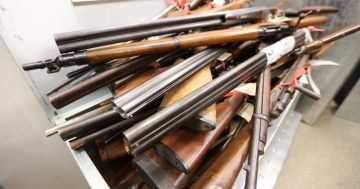
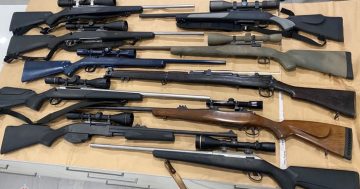
The ACT and the Commonwealth have struck a deal to set up a gun buyback scheme in the Territory. Photo: Michelle Kroll.
The Sporting Shooters Association of Australia has questioned why taxpayers should be paying to fund a gun buyback scheme that most jurisdictions aren’t adopting.
The Federal and ACT governments have reached an agreement to deliver a gun buyback scheme in the Territory following a similar agreement with NSW.
National Cabinet previously agreed to action to strengthen gun laws across the country, as well as eradicate antisemitism, in the wake of the Bondi Beach terrorist attack.
The ACT Government previously introduced the Firearms (Public Safety) Amendment Bill 2026 (Public Safety Bill), which includes proposed firearms caps, which is why compensation for surrendered firearms was being explored.
As part of the gun buyback agreement, the Commonwealth will fund 75 per cent of the scheme’s compensation and administration costs for the ACT, as well as all firearm destruction costs.
Chief Minister Andrew Barr said the agreement would strengthen community safety and support “effective firearms reforms” across the country.
“Reducing the number of high-risk firearms in circulation is a sensible and practical measure to help keep Canberrans safer. Working with the Commonwealth and NSW ensures a more coordinated approach to firearms safety,” he said.
“The ACT has some of the strongest firearms laws in the country, and this agreement supports our ongoing efforts to further reduce the risk of firearms falling into the wrong hands.
“We recognise that the overwhelming majority of firearm licence holders are responsible and law-abiding citizens. The buyback scheme will provide compensation while helping deliver further community safety outcomes.”
No start date or compensation schedule have been set.
SSAA ACT Inc secretary Nicole Small questioned what benefit the scheme would actually bring, and why the nation had to pay for it.
“Australians in Queensland, Victoria, South Australia, Western Australia and the Northern Territory are now helping to fund a buyback their own governments declined to run at home,” she said.
“They will pay the majority of the cost in the ACT – and every dollar of the cost of destroying lawfully owned firearms – for a benefit no one has been able to define.
“The people paying are entitled to know what their money is buying.”
The Commonwealth agreement with NSW is a 50:50 cost split.
Queensland and Victoria have opted not to join the scheme; South Australia hasn’t announced any plans; the Northern Territory hasn’t committed any funds; Tasmania hasn’t signed up; and Western Australia has its own scheme.
The SSAA ACT Inc has also questioned how compensation will be determined, given that the Australian Capital Territory (Self-Government) Act 1988 (Cth) provides that the Territory can acquire property only on “just” terms.
While NSW has a fixed running schedule ranging from $450 to $1000, with a $10,000 ceiling for higher-value firearms, the ACT may not be able to apply a cap.
A committee inquiry report into the Firearms (Public Safety) Amendment Bill 2026 (Public Safety Bill) recommended the full estimated cost of the scheme be tabled in the Legislative Assembly before a commitment was made.
Ms Small said the association didn’t oppose firearms regulation, but it needed to be a “proportionate” alternative, such as a voluntary buyback at market value, a five-year evidence review, and strengthened firearms storage, compliance and licence pre-approval.
“Our members are law-abiding, licensed and vetted. We are not opposed to sensible firearms regulation – we are opposed to spending hundreds of millions acquiring lawfully held firearms when the independent evidence does not show it makes anyone safer,” she said.
“We will keep making that case, on the evidence, at every step.”
Police, Fire and Emergency Services Minister Dr Marisa Paterson said this was about the government taking responsibility to keep Canberrans safe.
“We are here to work with the community as we progress through the changes. Once we have finalised the agreement, we will provide clear information to the community about the process of the buyback, including eligibility, compensation and the process for surrendering the firearms,” she said.
“Work is also continuing to progress on the development of a fully digital ACT Firearms Registry, which will be integrated with the National Firearms Register and will provide frontline police with real-time access to firearms data.”
The ACT Government has also introduced the Firearms (Firearm Prohibition Orders) Amendment Bill 2026.
There are more than 7000 firearms licence holders and about 23,000 firearms in the ACT.
It’s expected that about 14 per cent of ACT licence holders may be affected by the proposed firearms cap.