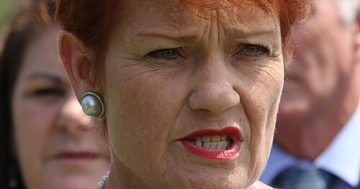
Senator Pauline Hanson is all blame and no solutions. Photo: Pauline Hanson Please Explain/Facebook.
Senator Pauline Hanson’s speech to the National Press Club stirred memories for me of another conservative warrior from the deep north, tilting at windmills.
As Ipswich born and bred and a child of the Bjelke-Petersen era, I remember just how insular and culturally constricted Queensland was in those days.
Ipswich, where it all started for Senator Hanson, was a place to get out of as soon as you could, even if it was just down the road to Brisbane.
It may have been beautiful one day and perfect the next in Queensland, but the politics and overt racism were ugly, reinforced by a gerrymander and an entrenched white settler mentality.
I once told a friend I was off to Melbourne to see my brother. “Wogland?” was the response.
In 1987, the insurgent Joh for PM campaign was launched, dividing the Coalition but flaming out the same year, with Joh forced to leave office as the Moonlight State’s corruption was finally revealed.
When Senator Hanson cited Australia’s Judaic-Christian culture, it could have been straight out of the Joh zeitgeist, when it was used to impose a puritan clamp on the education system and exclude other cultural influences.
Indeed, there was nothing Judaic or Christian about the One Nation leader’s speech.
Anti-union, a flat taxer and white culture warrior, Joh held Queensland in an iron grip until it all fell apart under the weight of his own hubris and putrefying government.
Senator Hanson is nothing new. Nor is her message, for want of a better word. It has always been a skeleton in our national closet. What’s new now is Australia’s economic anxiety, mirroring comparable nations where decades of policies that promised to make us richer have worked for some at the expense of an increasing, now restive, proportion of the population who hanker after better days.
She has made a career out of blaming others, usually anybody who did not look like her.
While immigration has been an undeniable success, enriching this country immeasurably, for Hanson and her ilk, the changing face of Australia, as if it were always one culture that could ever stay the same, is a source of bitterness and is now driving, through the unremitting algorithms of social media, a campaign that taps those economic anxieties and singles out non-European migrants for blame.
This is not about the number of migrants, a debate that should be had about Australia’s carrying capacity, but where they are from and what they look like.
It’s MAGA down under. While Joh could draw little support outside his Queensland base, this time the formidable Murdoch media and a few billionaires are cosying up to her as if preparing for a new right-wing party to replace the divided Coalition.
Indeed, Hanson’s speech was like a parade of greatest hits from the Murdochsphere columnists and was duly met with positive fawning reviews across its platforms. Gina and Rupert’s useful idiot.
In reality, it was a bleak and deeply unsettling speech designed to push buttons but offering no solutions to those she purports to represent.

Chief Minister Andrew Barr at the Local Government Association: government can bring people together. Photo: ALGA.
Another speech this week was an interesting riposte to Hanson’s dark vision.
ACT Chief Minister Andrew Barr did not mention her by name, but in his address to the Local Government Association, he had her in mind when he argued that the branch of government closest to the community had a crucial role in maintaining social cohesion.
On one level, it was simply a justification for his government’s tax and housing policies, and persisting with maintaining services in the face of deteriorating budgets.
But Mr Barr exhorted his audience to recognise that it was when people felt neglected, excluded and left behind that the social fabric started to fray.
“When people feel left behind, they don’t sit quietly. They look for explanation, and increasingly, those explanations are simple, emotional, and often wrong,” Mr Barr said.
“Uncertainty becomes grievance. Loneliness becomes anger, and that reshapes how people see institutions, policy, and each other.”
It was government’s job to hold communities together, and that could be achieved through on-the-ground policies.
Tax reform, urban infill, the compact city, more affordable and greater choice of housing in places where people want to live were all designed to make Canberra more livable and inclusive.
Services that supported and brought people together could not be simply cut without a social cost.
Indeed, the hard-to-measure social dividend is something that has been eclipsed by the hard economic dividend that can be readily declared in a blaze of numbers, although statistics can be misleading.
But this social dividend, as well as the nurturing of the public realm and amenity, is crucial if we are not to become a society of gated privileged enclaves and the rest scrabbling for crumbs. We know where that ends eventually.
No one pretends that everybody can or should be economically equal in a market economy, but public education, services, amenities and facilities reduce the imbalance, ensure mobility and a sense of belonging, which Mr Barr said was needed for the social compact to survive.
Debate can continue about the value of Mr Barr’s policies and his motivations, but in light of the Hanson speech, it was an interesting take on the practical role of government, so often maligned as the cause of our problems rather than as a force for building and sustaining community and social harmony.