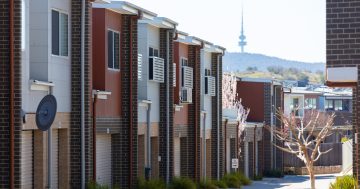
Weston Creek remains a hot spot. This four-bedroom, two-bathroom home in Duffy sold for $1,350,000 last weekend. Photo: Zango.
It’s a great time to buy in Canberra’s housing market, but there’s a catch.
The ACT has joined the other big capitals’ retreat, with prices continuing to fall and spreading to the lower and middle of the market.
With listings accumulating, more properties are available, but the spectre of another interest rate rise and declining borrowing capacity is undermining confidence among both buyers and sellers, who are wondering when the market will reach its bottom.
The Cotality Home Values Index for August shows that Canberra prices slipped into negative territory over the part 12 months, with all dwellings down 1.1 per cent for the month.
But there remain two pockets of resistance in Canberra – Weston Creek, up 4.1 per cent over the year and Tuggeranong, up 1.8 per cent.
For context, Canberra prices are down 5.2 per cent since the high in May 2022, up 6.3 per cent over the past five years and a whopping 58 per cent over the decade.
House prices led the way, falling 1.2 per cent, twice as much as units and townhouses.
The Canberra median is now about $865,000. For houses, the latest decline is pushing the median toward the million-dollar mark, about $18,000 less than in July.
Units and townhouses sit at about $586,000, about $9000 less than for July.
So far this year, house prices have declined by 3.7 per cent, and units and townhouses have fallen by 1.2 per cent.
Cotality head of research for Australia, Gerard Burg, said Canberra was now grouped with Melbourne and Brisbane, reflecting a broader downturn.
Mr Burg said that initially it was the higher-value properties going down, but now it’s spreading across a wider range of areas in the market.
He said that was good for those still in the market who had the confidence and the financial capacity to buy.
“The opportunity is definitely there,” he said.
“There’s a wider choice of properties, listings in terms of the total listings available on the market are generally higher, the time on market’s increasing and there’s a capacity to negotiate a bit more as well.”
But sellers weren’t as forthcoming as last year, with fewer new listings, and many buyers had already been pushed aside as pressures such as the three interest rate rises flowed through the market.

Cotality Home Values Index September 2026. Canberra prices are down 5.2 per cent since the high in May 2022. Table: Cotality.
Mr Burg said August listings were down slightly, from 522 to 493, and even taking into account seasonal fluctuations, they had come off a high earlier in the year.
“In the meantime, the stock of listings on the market has definitely moved higher,” he said.
“So this time last year, we’re talking about 1737 properties listed. Now it’s 2076.”
The main districts to fall furthest continue to be South Canberra (-3.3%) and North Canberra (-2.1%), while Weston Creek was the only one in August to be in positive territory at 0.9 per cent.
Mr Burg said resolving this market paradox came down to restoring confidence, and that meant an interest rate cut.
“It really comes down to just buyer confidence and believing that it’s a good time to jump in,” he said.
“It may require interest rate cuts from the Reserve Bank coming through, particularly given some of the affordability constraints a lot of people are feeling, and just the sense things are gonna get a little bit easier.”
But realistically, the earliest a rate-cutting cycle could begin is the middle of next year, Mr Burg said.
All that could mean the traditional spring surge in the market won’t happen this year.
But The Property Collective’s Will Honey said his new listings were above average for this time of the year and he remained hopeful of a good spring.
He acknowledged the market was very unpredictable, with confidence the key factor.
Good numbers were still turning out for open homes, but buyers were choosy and negotiating harder in what they saw as a buyer’s market.
Mr Honey said it was a great time to buy, but if people were waiting to find the bottom of the market, he wondered how much further it had to fall.
“It definitely doesn’t feel like it’s dead and the market’s tanked,” he said.

Mr Honey said interstate investors seemed to think the bottom had been reached at least in the cheaper end of the market.
“One thing we have noticed that’s actually happened in the past couple of months is a lot of buyers’ agents for interstate investors moving into the market and buying a lot of that cheaper stock around $500,000.
“They’re saying that we’ve bottomed out as a market, and so now it’s turning to a buy market for them. But they’re starting at that cheaper stock, so it’ll be interesting to see what they do over the next couple of months.”