Five drones were deployed to various emergencies across the ACT this past season. Photo: James Coleman.
ACT firefighters have a new weapon to keep us safe, and it just passed its first test with flying colours.
Today, 31 March, marked the end of the official bushfire season and the territory’s worst bushfire season in five years – but also the first season for the ACT Rural Fire Service’s five new drones.
The largest unit, a $25,000 DJI drone, can carry up to 6 kg of equipment, including first-aid kits, water, radios and safety gear. It is equipped with 360-degree cameras, thermal imaging and infrared vision and can zoom in on objects from hundreds of metres away. A loudspeaker can also assist in evacuations.

The drones have also been used in missing-person searches. Photo: James Coleman.
Importantly, it keeps firefighters out of harm’s way.
“We can use the drone technology across all of our four services, whether that’s fire detection, fire response, fire mapping, and missing persons searches,” ACT Rural Fire Service CEO Rohan Scott said.
“The uses … mean it’s safer for personnel. They don’t have to be put into that difficult situation. We can put a drone in instead and determine if it’s safe before putting a person in there.”
Over the past four months, the drones have mostly been used in lighter roles – scanning national parks for smoke, tracing lightning strike fires in Gungahlin, searching for missing people, and most recently, mapping storm damage to trees and buildings.
But Mr Scott says this is just the beginning.
“The drones this year were used in the infancy of their capability … As we move into the next phase of the project, we’ll use them more and more.
“It’s not just about a response capability, it’s also about planning and recovery as well. It’s a really good investment, and it’s something we’ll continue to grow as it becomes available.”
However, drones won’t replace traditional aircraft. Each season, the ACT Emergency Services Agency brings in specialised firefighting helicopters from Canada to boost aerial capability.
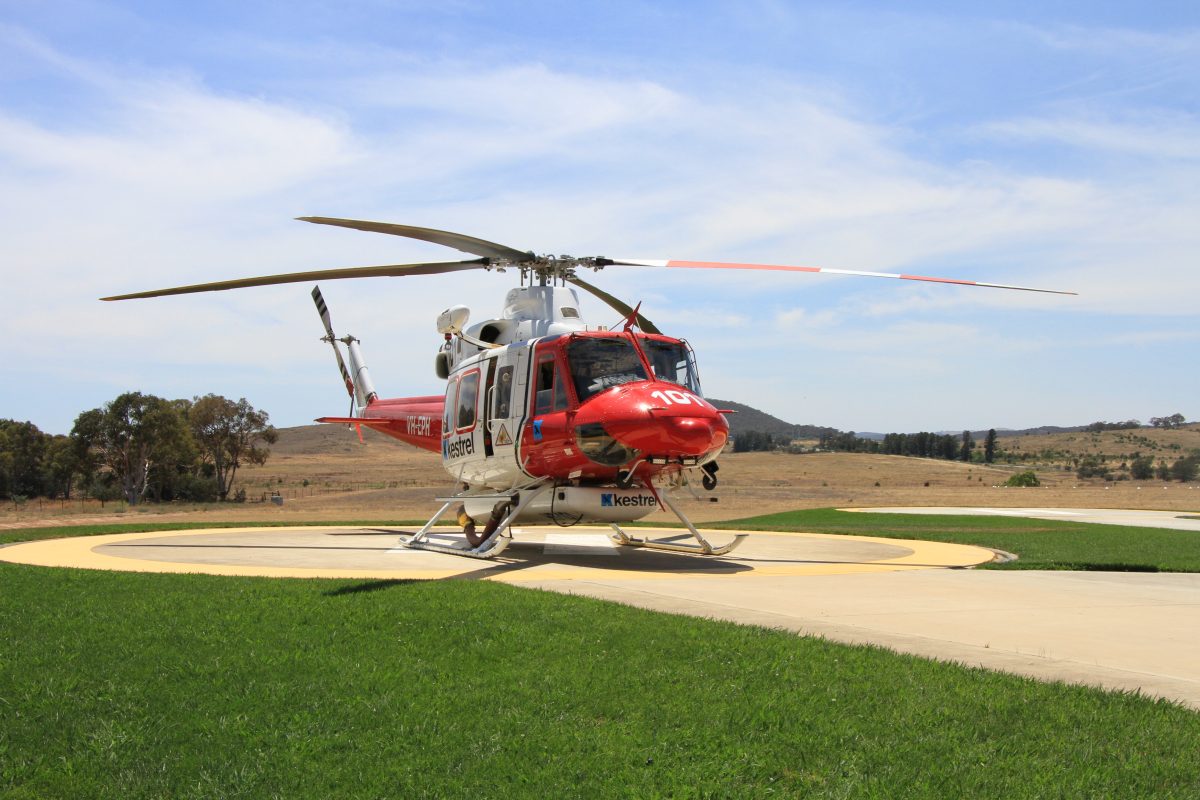
One of the two contracted medium helicopters used this season. Photo: Claire Fenwicke.
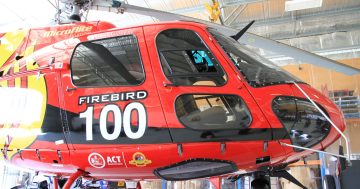
For 2025–26, that included the Firebird 100, equipped with cameras, infrared vision and mapping tools for real-time intelligence, and the HT101 medium helicopter, capable of winching firefighters into remote areas and dropping up to 1500 litres of water. A second medium helicopter joined in January, during the peak.
Mr Scott said those assets remain essential.
“We will always need the aviation assets, particularly the larger tankers. They can winch firefighters in and out, which is what we had to use during the Namadgi fires – it was the only way we could get in.
“But I do see our use of drones will increase over the years, and they’ll complement the aviation assets we do have.”

The drones are fitted with infrared and thermal-imaging cameras. Photo: James Coleman.
A mix of paid and volunteer staff – 12 in total – have undergone extensive training as drone pilots.
The technology arrived at a crucial time. The 2025-26 bushfire season was the worst since Black Summer and brought conditions similar to 2003.
“We had increased fire behaviour, particularly with those fires in Namadgi,” Mr Scott said.
“They started after a lightning band went through. We had four ignitions … very remote, very difficult to access, and the use of our technology allowed us to put crews on that very quickly and reduce the footprint of those fires to a very manageable size.
“That’s a big learning out of 2003. Very similar types of incidents … but with the learnings and the technology we had, we were able to get crews on to that very quickly.”
Four total fire bans were declared across the ACT – the most since 2020 – when conditions made fires difficult to control.
Up to 120 staff and volunteers were also deployed interstate to assist with bushfires and floods in Victoria, New South Wales, South Australia and the Northern Territory.
Just over the border, the NSW Rural Fire Service responded to more than 10,200 bush and grass fires, which burnt approximately 126,000 hectares during the season. Among the more serious incidents was a bushfire at Koolewong on the Central Coast, which destroyed 16 homes.
ACT Minister for Emergency Services Marisa Paterson said it had been “an interesting season”.
“It is a whole-of-community work in terms of how we respond to and address and prepare for emergencies … I would like to thank the community,” she said.

So far, 12 personnel have been trained as drone pilots. Photo: James Coleman.
The government faced criticism earlier in the season after it emerged the new bushfire warning system, the Single Point of Truth (SPOT) app, was not fully operational for the first 119 days.
The app is designed as a central source for real-time emergency information, including incident maps, warnings and alerts. Issues were not fully resolved until 27 January.
Canberra Liberals Shadow Emergency Services Minister Deborah Morris said: “Clearly the ACT Labor government was not ready for the bushfire season”.
Ms Paterson rejected the criticism as “fear-mongering”, saying the issues did not reduce the system’s capability and were part of a “scheduled and controlled test of system enhancements”.
“ESA has been using the same alert and warning system – the SPOT application – for 14 years,” she said.
The ACT bushfire season runs from 1 October to 31 March, unless conditions require changes.
Fire crews will now shift focus to hazard-reduction burns across the territory, with permits no longer required for landholders to conduct controlled burns on their own properties.