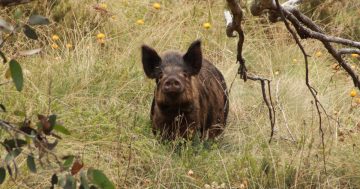
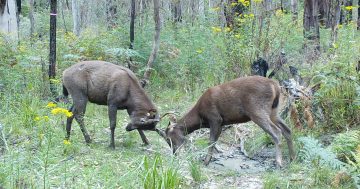
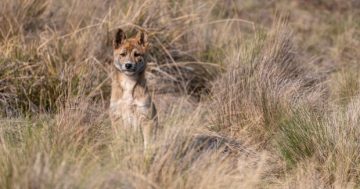
Feral fallow deer numbers have exploded across south-eastern NSW and the ACT since about 2019. Photo: Australian Bush Harvest.
It wasn’t uncommon to spot deer frolicking among the trees of the National Arboretum before 2021.
Since then, approximately $350,000 has been spent on an aerial culling program to exclude them. Rangers indicate this will need to remain a recurring expense in ACT budgets to continue keeping them out.
ACT Parks and Conservation staff are readying their helicopters, thermal imaging cameras and guns ahead of another culling season.
From Monday, 11 May, to Friday, 12 June, parts of Namadgi National Park, Tidbinbilla Nature Reserve, the Murrumbidgee River Corridor and Molonglo River Reserve will be closed to visitors for the ‘Thermal Assisted Aerial Control program’.
“Some adjacent forestry land will also be closed. These closures will be staged during the operational period, so not all areas are closed at the same time,” the ACT Government said in a statement.

Feral pigs and deer are the targets. Photo: ACT Government.
The shooting will take place for a few hours in the morning and afternoon, around dawn and dusk, over terrain that’s difficult to reach on foot.
In the rangers’ sights are pest species, chiefly feral pigs and deer, which trample delicate ecosystems and steal food from native species.
The program has been an annual occurrence since 2021, with an expansion in 2023 to include more privately owned rural properties adjacent to the protected conservation areas.
Last year, a total of 247 feral pigs, 527 feral deer, and 69 feral goats were controlled across Namadgi National Park, the Murrumbidgee River Corridor, Molonglo River Reserve and Googong.
According to the ACT’s Invasive Animals and Overabundant Wildlife Programs Manager, Mark Sweaney, the approach is working.
“Quite a few jurisdictions now around Australia are dealing with suburban deer populations, and it is a really difficult problem to control, and it increases the complexity and cost of culling significantly,” he says.
But the ACT isn’t there … yet.
“We have removed a lot of deer from areas that are really quite close to suburban areas … like a lot of fallow deer in the Murrumbidgee River and Molonglo River corridors, and around Googong.
“We’ve also had samba deer at Parliament House before, and on Black Mountain. We even had deer in the National Arboretum. Before this program, they were becoming a regular thing.”

A dead wild boar was dumped in a Coombs bus shelter in August 2024. Photo: Adam Stipancic.
Meanwhile, feral pigs were becoming common pests on golf courses along the Murrumbidgee River, such as in Kambah, and also in reserves that back onto suburbia, like Urambi Hills, Cooleman Ridge and Tuggeranong Hill.
“So the program has come at a critical time.”
The number of pests culled each year has increased, largely due to a funding boost by the Federal Government in 2023, which allowed more areas to be covered by more rangers.
While there is no set target each year, Mr Sweaney said the numbers are informed by what they know on the ground about pest populations, as well as, more simply, how many deer and pigs they can see during the flights.
“We also prioritise some areas based on conservation importance – so we’ll spend more time in parts of Namadgi that have high conservation values – and areas that are highly connected to the urban area, where, if we end up with high densities there, they’ll end up in suburbia.”
This year’s cull is paid for under the last ACT Budget, but Mr Sweaney’s team has spent the past few years compiling data on how the program is working, so they can secure an additional bucket of funding for the next two years – and beyond.
“We’ve got one more year of funding at the moment for this program, so we’ve been collecting results to try to demonstrate how important it is to keep up, so we don’t end up with a difficult management situation.”

Mark Sweaney says recreational hunters only play a small role in keeping pest numbers down. Photo: Rod Hart.
It’s been suggested that the government open up culling to recreational shooters to help bring down the cost for taxpayers, but Mr Sweaney said this ultimately wouldn’t make much difference.
“Recreational hunting might be able to put some pressure on some populations, but not in our context – where it’s very low density across a really big area,” he says.
Unlike NSW, the ACT also doesn’t have public land for recreational hunting.
“For people on private property, they’re able to control pest animals as long as they’re doing it humanely. But you can’t go into a national park on any weekend in the ACT and start shooting.”
He concludes that the public should know that $350,000 is “good value”.
“It’s good value compared to what it would cost to manage even a small population if it were in a residential area, absolutely.”
Find the full list of park closures at Parks ACT.