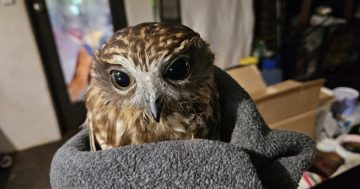
Doris (Day) and Julie (Andrews) came to us from a Wagga-based animal rescue organisation, having been born in transit on a livestock transport truck. Photo: Hayley Nicholls.
We moved to the country over 10 years ago, drawn by a combination of affordable property prices, peace and quiet, and wide open spaces.
At least, those are the factors I nodded along with as my husband justified our decision.
For me? It was always about the animals.
How many animals can I surround myself with? Which paddock will be for the llamas? Where shall I put my wildlife rehabilitation centre? Where will the macropod nursery go?
I’ll start small though, I thought. What first? Miniature cows, dwarf goats or micro-pigs?
I’m joking, obviously. While I would never turn away a tiny cow (a heartbreaking image), I love animals of all shapes, sizes and species.
One should never acquire an animal based on its ability to fit in a teacup.
Ten years ago, I naively thought my rural escape would be entirely idyllic. Sunrises spent feeding the farmyard at a yonder big red barn, nursing orphaned piglets back to full health, baking pies with woodland creatures – that sort of thing.
But I’m no longer an ignorant city slicker. I’ve outgrown my initial overenthusiasm (and any lingering obsession with diminutive animals) and – I think – found the sweet spot between animal lover and animal hoarder.
I’ve taken on poddy lambs who have emerged – unplanned and unwanted – from transport vehicles and into the arms of already overrun rescue organisations.
Our chook enclosure is home to a never-ending stream of rehomed middle-aged ladies.
We even have a resident male kangaroo. Having apparently been excommunicated by his mob, this curious squatter has called our backyard home for almost two years.
We did have a miniature bat for a while – but that was a Christmas tree related accident.


While to some degree I’ve been able to realise my dream of surrounding myself with animal sidekicks, what I wasn’t expecting was the flip side of that coin.
Surrounding yourself with animals comes with no shortage of chaos and, sadly, the inevitability of seeing them suffer, particularly when it comes to wildlife.
I won’t torture you with detail, but suffice to say I’ve experienced my fair share of incidents.
Many are stressful episodes which eventually morph into lighthearted memories. Like the lengths I went to reaching an injured kookaburra I’d seen hit by a car and flung, inconveniently, to the far side of a barbed-wire fence.
I stopped en route home to perform an impressive contortionist act for two confused kids in the backseat, only to find an extremely ungrateful bird resistant to my helpful hands.
Like a modern MacGyver, I used the only item in my boot – an empty canvas shopping bag – to keep its wings safe, and drove home with a disembodied abusive avian head snapping at me furiously. This is also the story of how my four-year-old learnt her first curse words.
Of course, many incidents aren’t funny at all – just heartbreaking.
Like the hours I’ve spent standing beside immobile kangaroos, trying to offer support without adding stress, helplessly assuring them that it’ll be over soon – one way or another.
Sometimes they survive and become stories to tell. Sometimes they don’t and we solemnly move on.
I certainly haven’t become immune to these gut-wrenching moments. I still shed my fair share of tears. But I have become a little more hardened – and a lot more practical.
I may not have realised my most overzealous animal whisperer dreams, but all rural residents – and road users – still have plenty of opportunities (and a responsibility) to care for animals in our day-to-day lives.
We don’t need a purpose-built rehab centre. We just do what we can.
I now have several animal welfare groups saved in my phone. Oh, and I always keep a towel in the boot. So never again will a furious kookaburra suffer the indignity of travelling in a Woolies bag.