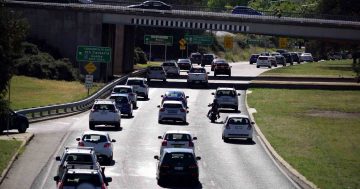
Even modern cars aren’t immune from speedo tampering. Photo: James Coleman.
The ACT’s peak automotive body wants tougher penalties for odometer tampering, arguing the Territory is lagging well behind NSW and leaving buyers exposed.
Under NSW law, the maximum court-imposed fine for winding back a car’s odometer is $55,000. In the ACT, it’s about $8000.
In a budget submission to the ACT Government, the Motor Trades Association of the ACT (MTA ACT) argued that the gap needs to be closed by bringing the ACT’s Sale of Motor Vehicles Act up to speed with a problem that’s “very widespread” in Australia.
“The Act came into place in 1977,” MTA ACT head of government relations and advocacy Collin Jennings told Region.
“While it was probably fit for purpose in the 1970s, we’re now in 2026 and the 21st century, and things have changed.”
If you think winding back a speedo is a relic of the 1980s, Mr Jennings says quite the opposite.
“It’s a very common practice around the country. It’s why NSW and other jurisdictions have recently taken a real heavy hammer to it.”
Old-school tricks were mechanical: swap in a lower-kilometre dashboard, or disconnect the speedo cable and hook it up to a battery drill to run the numbers backwards.
But modern cars aren’t immune either.
Mr Jennings said there’s an entire black market for devices that can reprogram digital odometers. These normally work by plugging into a vehicle’s OBD-II port or by directly altering the dashboard’s EEPROM chip to change the reading.
“With advances in technology, unfortunately, come advances in people working out how to do the wrong thing,” deputy chief executive Kellie Dewar of Motor Trades Australia’s Queensland office has previously said.
The NSW Government recently highlighted a case where “a seller shaved 400,000 km off a Subaru XV and sold it for $32,000 – an $11,000 increase on its previous price”.
NSW Fair Trading reported a “four-fold increase in odometer tampering” over 2021 and 2022, and during one recent crackdown alone, issued 28 fines in a month – more than half related to odometer interference.
And in 2024, NSW Fair Trading also took disciplinary action against 21 licensed dealers and repairers, cancelling 10 licences and permanently disqualifying three operators.
One man was sentenced to a nine-month intensive corrections order after pleading guilty to unlicensed motor dealing and odometer tampering. He had sold 16 vehicles online, with one wound back by more than 200,000 kilometres.
The Motor Trades Association relaunched its ACT branch in 2025. Photo: MTA NSW, Facebook.
Last year, NSW moved to strengthen its laws under amendments to its Motor Dealers and Repairers Act. From 1 September, 2025, this meant on-the-spot fines for odometer tampering increased to $5500, with maximum court-ordered penalties reaching $55,000.
However, it’s unclear whether anyone’s copped the full extent of NSW’s $55,000 fine, because in 2021 and 2022, NSW Fair Trading issued a total of $113,000 in fines across 103 penalty notices.
Service NSW now also offers a free online registration check showing the last three recorded odometer readings – even if authorities have warned this could be gamed by logging multiple odometer readings in quick succession.
But the MTA ACT says nothing like this exists in the Territory, where buyers can only see a car’s registration status via Access Canberra’s online rego check.
Mr Jennings says it’s especially important given that online car sales have surged since COVID.
“When a dealership is selling a vehicle, there’s a requirement that they have a .com.au address,” he said.
A licensed dealer must also display their licence details on online ads. If you can’t see that, he says, “you don’t know that the person selling you the vehicle is a licensed dealer”.
In NSW, online sellers must also provide a physical address where the vehicle can be inspected – something the ACT doesn’t currently require.
For now, he recommends buyers purchase the $2 Personal Property Securities Register (PPSR) check through the Australian Government’s Financial Security Authority. This shows whether a car is stolen, written off, or under finance, even if it doesn’t show its odometer history.
Buyers should also check the logbooks and service history for a consistent “paper trail” and make sure the car’s general wear and tear matches the claimed kilometres (steering wheels, pedals, seats and gear levers can all tell a story).
“Do a bit of a sanity check to say, ‘Does this match up with the kilometres travelled on the car?'” Ms Dewar has said.
And finally, get a pre-purchase inspection from a trusted mechanic.
“What we’re trying to do is bring the ACT up to date, to make sure everyone is covered, that there are protections for the consumer, and to weed out unscrupulous players,” Mr Jenning says.
Submissions to the ACT Budget 2026-27 can be lodged with the ACT Government.