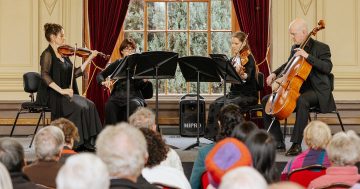

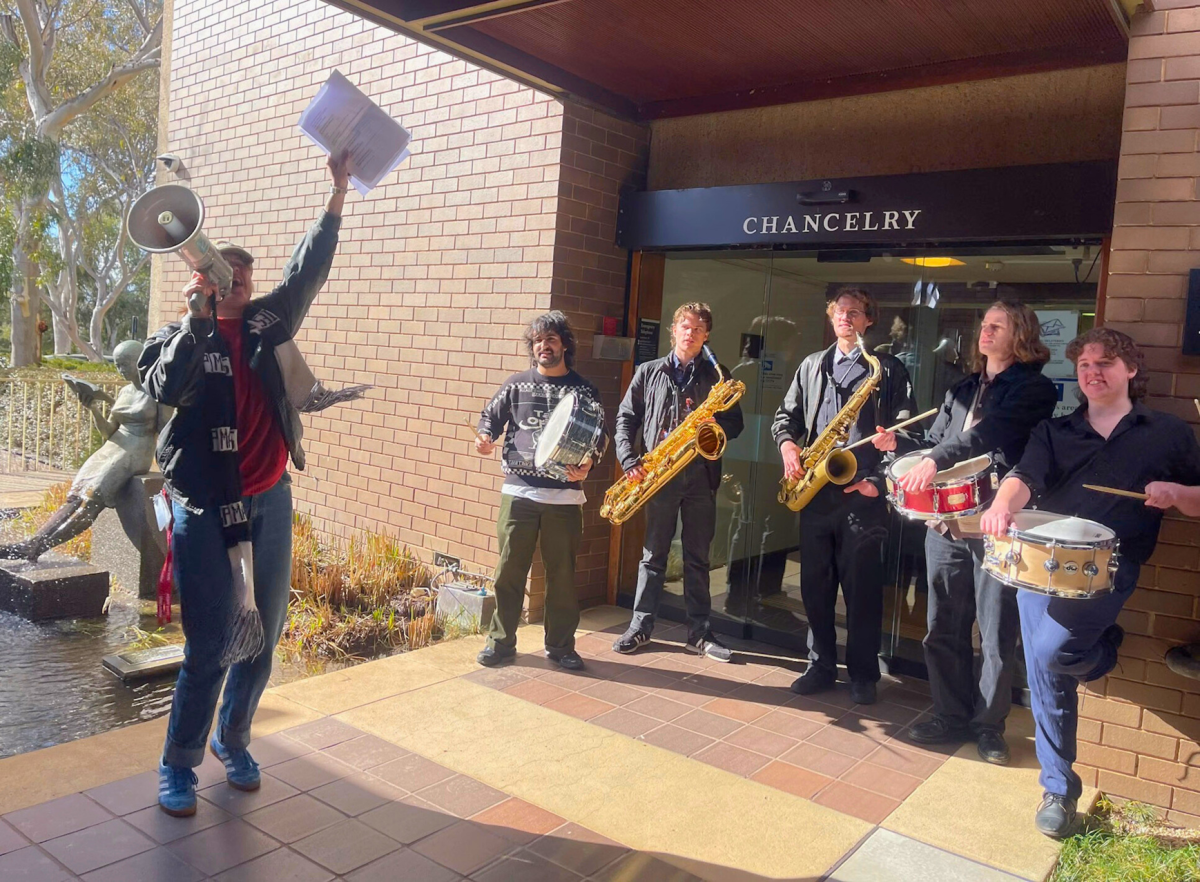
Students were particularly outraged when ANU originally proposed getting rid of the School of Music. Photo: No Cuts at ANU.
The damage may have already been done to the Australian National University’s School of Music, despite the announcement plans to dismantle the institution will no longer go ahead.
The College of Arts and Social Sciences’ implementation plan – one of the last to be released as the controversial RenewANU program wraps up – confirmed no structural changes would be made to the School, and that the originally proposed combined School of Creative Practice will not be implemented.
It’s welcome news for many, but others have pointed out the entire experience has left a sour taste that will be hard to wash out.
National Tertiary Education Union (NTEU) ACT division secretary Dr Lachlan Clohesy described the reversal as a “clear win” for union members and a sign ANU was headed in a more positive direction.
But:
“The ANU School of Music still exists, but it won’t be like it was before. The way this has been handled over the last year has been disappointing to many staff, students and community members, who all want the School of Music to succeed,” he said.
“ANU leadership has a big job on their hands to restore trust and reputation. I hope they are successful, but there will be a lot of work to do in terms of recognising the impact on people and responding appropriately.”
The Academic Portfolio implementation plan still hasn’t been released, which could have further implications for staff and students.
Another group claiming the implementation plan as a win for advocacy is student group No Cuts At ANU, stating the School of Music had been used as a scapegoat among the university’s financial issues.
Co-Convenor Ell Lappin said the backflip was due to staff and students coming out en-masse time and time again.
“The hundreds of people who called to scrap Renew ANU, and who voted in no confidence in Genevieve Bell, show that when people take action, we can win against the administration,” she said.
The group pointed out the lost jobs weren’t being reinstated in the plan and warned the promise of increased flexibility could reduce choice.
The original change proposal proposed scrapping 38 continuing and three fixed-term academic roles, and 18 continuing professional staff. 16 academic staff positions, two fixed term college leadership positions and 29 continuing professional staff positions were to be realigned, and another six positions created.
Under the new implementation plan, the realignment of professional staff from the Research Schools into central teams will go ahead.
A second voluntary separation scheme was announced on 26 August, and 28 applications from CASS have been approved.
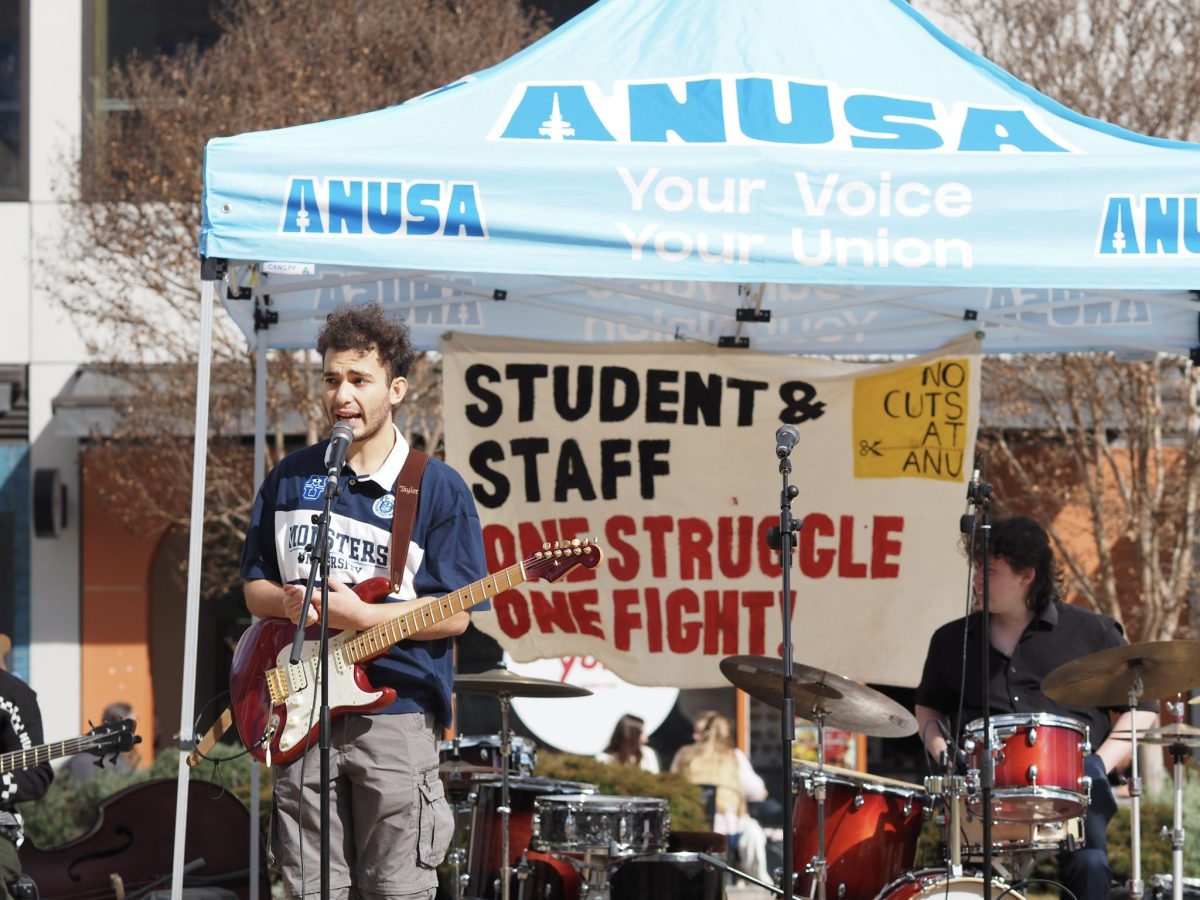
One student advocacy group still wants all the changes made under the RenewANU program to be reversed. Photo: No Cuts at ANU.
Questions have also already been raised about the changes to the Bachelor of Music.
Santrix Redston has just completed their first year of a double degree in music composition and politics, philosophy, and economics.
They said, on the whole, the changes seemed more promising than students initially expected, but they’re concerned about potential “weaknesses” with the bachelor’s new structure.
“My understanding is that, as a composition student, I will complete [the subject] Topics in Music Analysis – or its new technology-focused companion Topics in Music Technology – up to five times. This is because the ‘Topics’ courses have replaced a number of previously specialised composition and production courses such as Sound Archiving and Materials of Music,” Santrix said.
“My concern is that replacing specialised courses with ‘topics’ equivalents will offer breadth at the expense of depth.
“Myself and other students are getting less ‘music’ in our music degrees.”
Santrix also noted this was the second redesign of the course structure in as many years, and questioned why this was the case.
“I am at a loss as to why a one-year-old study design is no longer fit for purpose and not entirely convinced that this is the end of the matter in terms of changes to the School.”
READ ALSO: How Qatar Airways delivered the best Christmas present ever for Canberra Airport
Those acknowledging the positives include the Advocacy Roundtable for the ANU School of Music, which said the announcement was good news for music lovers.
Chair Robyn Hendry stated the new Performance+ Hub particularly would strengthen performance teaching for auditioned musicians.
“The Roundtable .. applauds the fact that ANU has taken creative leadership to keep music practice in the heart of the university and found not only a way to do this very effectively but to enhance the school’s offer, including for contemporary music careers,” she said.
The Canberra Symphony Orchestra’s CEO Rachel Thomas said the new hub would also benefit the entire ACT arts ecosystem.
“This extremely positive outcome is the result of our community coming together to fight for an institution they hold dear,” she said.
Ms Thomas added the updated curriculum had the potential to be nation-leading.
“This curriculum also closes a long-standing gap by building a complete music pathway, linking schools, tertiary study and the professional sector, and giving young musicians a clear route to lifelong careers in the arts, whether that’s in classical music or any other endeavour,” she said.
“We’ve made significant progress in a very short time and while details are still to be fleshed out, we look forward to continuing to work with the university to deliver something groundbreaking in music education.”
ACT independent senator David Pocock was vocal during the RenewANU process and during grillings of ANU executives at committee hearings.
He welcomed the commitment to reimagine the original proposal and the continuation of one-on-one tuition.
“The future of the School of Music should never have been in doubt … I commend the interim Vice-Chancellor on listening and acting in line with community feedback.”