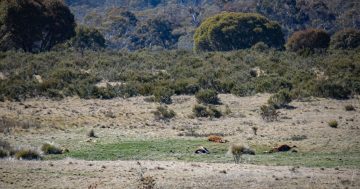
Wild horses grazing near Kiandra goldfields in Kosciuszko National Park. Photo: Supplied.
Parts of Kosciuszko National Park (KNP) will be closed to visitors for more than three weeks next month as aerial shooting operations target feral animals across the iconic alpine site — but authorities have declined to say whether wild horses will be among those culled.
The NSW National Parks and Wildlife Service (NPWS) has issued a public notice advising of the closure of sections of the park from 9 to 30 June, with a second round of operations already scheduled for 2-27 November, covering areas around Charlotte Pass, Perisher and Thredbo, where NPWS says the focus will be on pigs and deer.
Wild horses, or brumbies, have been at the centre of one of Australia’s most bitter environmental debates for more than a decade.
The animals have been present in the Snowy Mountains since the 19th century and hold deep cultural significance for many Australians.
But scientists and conservation groups have documented extensive damage to the park’s fragile alpine ecosystems from trampling, grazing and erosion, and the Federal Government’s Threatened Species Scientific Committee has listed habitat degradation by wild horses as a key threatening process — one that may prove decisive in the survival of species including the northern corroboree frog, the broad-toothed rat and the critically endangered alpine she-oak skink.
In 2018, the then-NSW government passed the Kosciuszko Wild Horse Heritage Act, known as the Brumby Bill, which recognised the cultural value of the wild horses in the national park.
That law was repealed by the NSW Parliament in November 2025, a decision that will ultimately see wild horses treated as an invasive species across the entire park.
In the interim, the existing 2021 Wild Horse Heritage Management Plan (WHHMP) remains in effect until a new KNP Plan of Management is adopted in 2027.
The current plan divides KNP into three zones: retention areas, where up to 3000 “heritage” horses are permitted to remain; removal areas, where all horses must be eliminated by mid-2027; and prevention areas, where wild horses were not known to occur when the plan was finalised in November 2021 and which are to remain horse-free.
When the new plan takes effect, the permanent protection afforded to horses in retention areas will lapse.
NPWS confirmed this week that wild horses will continue to be managed until that transition occurs, with control measures including trapping, rehoming, and aerial and ground shooting.
Since the plan’s adoption in November 2021, when the population was estimated at around 14,380 horses, 9198 wild horses have been removed from KNP — 6041 by aerial shooting, 1075 by ground shooting and 1165 rehomed.
The remaining 868 horses were disposed of as follows: 672 were sent to a knackery, 109 were shot in the yards, 70 were euthanased and 17 were recorded as “other deaths”.
A feasibility report on reproductive control options — examining whether fertility control could play a role in managing horse numbers — is also being finalised.
NPWS said horse numbers were tracked through annual aerial surveys using internationally recognised distance sampling methods.
The most recent published estimate, from the 2024 aerial survey, put the wild horse population in KNP at between 1579 and 5717, while a more recent count, conducted in October and November 2025, is currently being peer reviewed and will be released once finalised.
NPWS said the latest survey results would inform management decisions in retention areas.
“No control programs have occurred in those areas since the 2024 survey,” a spokesperson said.
However, NPWS said control would continue in wild horse removal and prevention areas, where the plan requires all horses to be removed by mid-2027.
“This includes reducing the number of horses in the park to 3000, to be retained in wild horse retention areas,” a spokesperson said.

The focus on wild horses has also prompted debate about the role of other feral species in the park, with some critics arguing pigs and deer cause comparable damage.
NPWS and conservation groups maintain all invasive species are managed as part of a broader pest control program.
Unlike wild horses, NPWS does not routinely publish park-wide population estimates for other feral species, instead reporting removal numbers and broader trends in pest activity.
During 2025, NPWS removed 603 pigs, 2058 deer, 213 goats and 107 foxes from KNP and surrounding reserves.
NPWS said promising early signs of environmental recovery had been observed, including reduced bare ground, increased vegetation cover and less damage to stream banks around sub-alpine waterways and broad-toothed rat habitat — findings consistent with independent research published in January 2026 by scientists from Charles Sturt University and the University of Sydney.
Conservation groups say recent data suggests, for the first time, that horse removals are now outpacing population growth — a shift they argue is critical to allowing damaged alpine ecosystems to recover.
Marilyn Nuske, principal lawyer and founder of the Brumby Action Group, has written to NSW Environment Minister Penny Sharpe ahead of the June operations, urging compliance with the WHHMP’s protections for horses in retention zones.
Ms Nuske has warned that large-scale culling could wipe out certain heritage brumby bloodlines and has called on the minister to apply the precautionary principle to wild horse management.
“Unless the population survey has been completed, and depending upon the numbers disclosed, which is believed to be well below 3000, no brumby should be shot in any retention zone if numbers are below 3000,” she said.
The Brumby Action Group has also launched an online petition ahead of the June operations, calling on the NSW Government to halt aerial shooting, with 217,328 signatures recorded.
Animal Justice Party MP Emma Hurst, who chaired a NSW Upper House inquiry into the aerial shooting of brumbies between December 2023 and July 2024, has said population survey data supported previous claims that horse numbers had been overstated by the government.
The Australian Brumby Alliance has separately argued that studies concluding brumbies cause environmental damage are based on correlative data and weak inferences, and that the same research contains evidence horses can have a positive environmental impact.
The Invasive Species Council has firmly backed the government’s approach.
It described the repeal of the Wild Horse Heritage Act as a landmark win, crediting advocacy around aerial shooting with helping to reduce horse numbers to between 3000 and 4000.
Council advocacy director Jack Gough said the community faced a stark choice.
“No-one likes to see animals killed, but the sad reality is that we have a choice to make between urgently reducing the numbers of feral horses or accepting the destruction of sensitive alpine ecosystems and habitats,” he said.
The June closure affects two large sections of the park.
The northern block takes in the Bimberi, Goobarragandra and Bramina Wilderness areas and the northern Kosciuszko High Plains.
The central block covers the Jagungal Wilderness and surrounding areas including Happy Jacks, Tolbar, the Gungarlin River, Jagumba, Tooma, Yellow Bog and Dargals.
In total, 32 NPWS locations are affected, including campgrounds, huts, walking tracks and picnic areas.
Visitors planning trips to Kosciuszko during June should check the NPWS local alerts page before travelling.
Original Article published by Edwina Mason on About Regional.