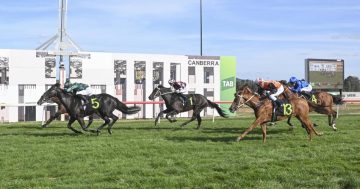
The Thoroughbred Park precinct could accommodate up to 6200 homes. Photo: Thoroughbred Park.
Public and community housing will be required as part of the proposed 6200-home redevelopment of Thoroughbred Park, but the ACT Legislative Assembly has rejected a Greens push to guarantee 10 per cent of the precinct as rent-fixed public housing.
ACT Greens Leader Jo Clay introduced a motion calling for developers to provide 10 per cent of homes – potentially about 620 – as rent-fixed public housing, plus additional community housing spread throughout the precinct.
She also wanted developers to provide parks, playgrounds and community infrastructure, and for land to be set aside and planning to account for future primary and high school capacity.
But Planning and Sustainable Development Minister Chris Steel moved two amendments that retained requirements for public and community housing while removing the fixed percentage, and removed the requirement to specifically reserve land for future schools.
The amendments were supported 15 votes to six before Ms Clay’s motion was passed in its amended form.
Labor and the Canberra Liberals backed the amendments, along with former Liberal MLA Leanne Castley, who now sits as an independent. Independent MLAs Thomas Emerson and Fiona Carrick supported the Greens’ original position.
The Thoroughbred Park precinct could accommodate up to 6200 homes and between 11,400 and 16,400 residents.
Ms Clay argued that made it a rare opportunity to significantly increase Canberra’s public housing stock.
“We are in furious agreement on the principles here,” Ms Clay told the Assembly.
“But we are not in agreement about the commitment and the delivery.”
She told the Assembly public housing represented about 11 per cent of ACT homes in 1989 but had fallen to 5.7 per cent, with community housing accounting for another 0.6 per cent.
At the same time, she said the public housing waiting list had grown from about 3000 people at the beginning of the current term to more than 3600.
“This one precinct alone could add over 600 homes to our public housing stock,” she said.
For Ms Clay, the timing was critical. She argued inclusionary zoning needed to be established before development proceeded so public housing requirements could be factored into planning and financing from the beginning.
“The time to commit is now.”
Mr Steel, however, drew a distinction between guaranteeing public housing and setting a percentage before the government’s inclusionary zoning and feasibility work was complete.
“The ACT Government has previously committed to ensure that social housing is provided in the Thoroughbred Park Precinct,” he said.
“There clearly can’t be a new subdivision that is the size of a new suburb without social housing included.”
Mr Steel argued that setting a figure before feasibility testing had been completed could jeopardise the broader redevelopment.
“If it is unfeasible, and picking a number out of the air like 10 per cent, which may be unfeasible, not only won’t the social housing homes be built, the entire precinct will not be redeveloped at all,” he said.
The second amendment dealt with schools. Ms Clay’s original motion called for planning to set aside land and account for future primary and high school capacity.
Mr Steel removed the requirement to set aside land. Instead, the amended motion requires planning for the precinct to account for future primary, high school and college capacity to support additional housing development in the inner north.
He argued education and community infrastructure needs should be addressed as planning for the precinct progresses, rather than requiring land to be reserved for future schools now.
Ms Clay had pointed to 2026 enrolment data showing several schools surrounding the precinct already approaching capacity.
Lyneham High and O’Connor Cooperative are at 93 per cent, while Dickson College and Lyneham Primary are at 90 per cent. Majura Primary is at 84 per cent, North Ainslie Primary at 78 per cent and Ainslie Primary at 77 per cent.
Nearby Yowani Country Club could also accommodate another 1000 to 1200 dwellings and between 3000 and 5000 residents, as well as a hotel.
The Greens say the combined population growth from the two developments could be equivalent to adding about three Ainslies to the inner north.
“If we don’t reserve space for schools now, any future government may not have any realistic opportunity to do so,” Ms Clay said.
Canberra Liberal MLA Deborah Morris supported Mr Steel’s amendments, arguing public and community housing and school capacity needed to be considered but the Greens’ original requirements were too prescriptive.
“During a housing crisis, the important thing is to get on with it,” she said.
The Property Council also supported increasing social and affordable housing but opposed locking a fixed requirement into the project at this stage.
ACT and Capital Region executive director Ashlee Berry argued every additional mandate could add costs and affect project feasibility, potentially reducing the number of homes ultimately delivered.
“The Thoroughbred Park precinct represents one of Canberra’s best opportunities to deliver new housing supply – up to 6200 homes,” she said.
“The priority should be creating the conditions for more homes to be built, not adding new costs and obligations that could make projects harder to deliver.”
Planning for the precinct moved forward in October 2025 when consultation opened on a proposed major amendment to the Territory Plan.
The proposal envisages up to 6200 homes, shops, community spaces and active-travel links while retaining the racecourse. Consultation attracted 151 submissions, including support for greater density and retaining the racetrack, alongside concerns about transport, community infrastructure and liveability. Some supported removing the racetrack.