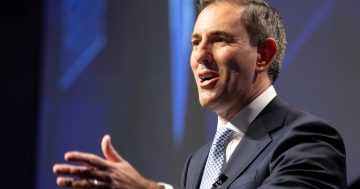
Even the Prime Minister’s ‘good news’ fell flat this week. Image: Screenshot.
As things go, it’s been a shocker of a week for Labor and the Federal Government.
The week ends as it began, with bad news on the cost-of-living front thrusting Labor’s economic credentials under increased scrutiny.
Tuesday’s Reserve Bank interest rate hike to a 15-year high of 4.6 per cent set the scene for a continuous round of commentary that can only be described as disastrous for the government.
RBA Governor Michele Bullock did Treasurer Jim Chalmers no favours in explaining the contributing factors to the current levels of inflation – and it’s not all the Middle East war.
“The bottom line is that productivity is doing nothing,” she said during her press conference to explain the RBA Board’s decision.
“And I know we talk about productivity a lot, but it’s so important if we want the economy to be able to grow and create jobs.
“The bottom line is that there are a number of pressures all bearing down on inflation at the moment, and the problem is that demand is growing more quickly than supply, and all sorts of things are contributing to that.
“And then you layer on top of that, the Middle East conflict, and we’ve got a very difficult situation.
“So I don’t want to suggest blame one way or the other on any of this. It’s just we’ve got to slow the rate of growth of demand down, and our instrument is the interest rate.”
That, and the fact that government spending was mentioned at all, has led to questions about tensions between the RBA Governor and the Treasurer, with Chalmers having to repeatedly insist there aren’t any.
The Coalition’s attack, led by Opposition Leader Angus Taylor and shadow treasurer Tim Wilson, has been sustained and vicious. That’s to be expected. They wouldn’t be doing their jobs if they weren’t questioning the government’s management of the economy.
But when independent economists far and wide start joining the fray singing the same tune, it’s a formula Labor doesn’t want to see.

Former RBA governor Dr Philip Lowe also had a crack at the government. Image: Screenshot.
Former RBA governor Philip Lowe pulled no punches the next day, blaming rising inflation squarely on the government.
“Government spending has been adding to demand progressively over time, and that’s putting upward pressure on inflation,” he said.
That was the same day the Australian Bureau of Statistics released the latest inflation data, showing the Consumer Price Index (CPI) rose 4.0 per cent in the 12 months to August 2026, up from 3.5 per cent in the 12 months to July.
ABS data shows housing was the largest contributor to annual inflation in August, rising 5.7 per cent, with transport the second-largest contributor, rising 5.6 per cent due to higher fuel prices.
Higher world oil prices and the unwinding of fuel excise relief in Australia obviously explain the spike in transport costs.
On a monthly basis, automotive fuel prices rose 14.8 per cent in August, up from 7.5 per cent in July.
By Thursday, the ABS had also released job vacancies data – more bad news the government has to grapple with. Unemployment is up.
Job vacancies fell by 3000, or 0.9 per cent, to 325,000 in the three months to August 2026, according to new quarterly figures. This followed a 2.2 per cent decline in the previous three months.
The best the government has done this week is promise more cost-of-living relief measures to come in MYEFO, and throw up a few stats showing that Labor’s expanded 5 Per Cent Deposit Scheme is helping more first home buyers.
Then of course, there’s the card payment surcharge ban coming into effect.
On the face of it, customers will appreciate it, but the business sector is promising to pass on the impost by raising prices.
It was made worse this week when the Tax Office rubbed salt into the wound by announcing it won’t take credit card payments anymore because of the surcharge ban.
Meanwhile, the Greens have a change of leader, and that’s not great news for the government either.
Former leader Larissa Waters was able to (in her words) “get shit done” through constructive negotiations with the government and the Opposition.
She held the Greens’ line without being unnecessarily obstructionist.
The praise and well wishes she received from some Labor ministers on her resignation from the leadership this week is a testament to her style.
All that’s out the window with new Greens leader David Shoebridge. He’s promising to torch the joint (my words, not his) and take no prisoners.
He insists he and the new-look Greens are not there to improve Labor but to replace it (his words, not mine).
As ridiculous as that statement is – because it ain’t gonna happen – it doesn’t augur well for any level of future cooperation between the Greens and the government.
Friday couldn’t come soon enough for Labor this week, but there’s certainly no hint next week will be any better.