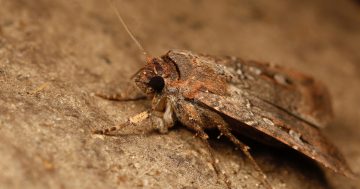
Swarms of bogong moths are making their way across eastern NSW and the ACT. Photo: Jesse Wallace.
In the past week, Canberra has been hit with swarms of uninvited guests in the form of bogong moths, invading homes and frightening residents.
While the swarms of moths might display a freaky appearance and cause concern that they might eat through your best linens, one professor from the Australian National University is trying to put everyone’s mind at ease.
Dr Benedict Keaney said Canberra could expect swarms of moths for the next month or so as they travel from west of the Great Dividing Range down to the NSW mountain ranges for the summer period.
“Don’t worry, they’re not going to eat your clothes. They’re not going to harass anyone. They’re just flying on through as they head to the mountains to hibernate over the summer,” Dr Keaney said.
“Everyone is safe and sound. Just let bogongs be bogongs.”
Dr Keaney explained that residents can expect the swarms of moths to last for at least a few weeks.
“It should extend out until the beginning of November,” he said.
“At the moment, the atmospheric conditions have been conducive to their migration. We call these conditions low-level jet streams.
“Essentially, they use these winds to carry them across the country instead of constantly having to flap their wings. These winds carry them through Canberra, which is why we are seeing swarms pop up around Canberra and the surrounding areas.
“It takes them right through to the mountain ranges.”
Over the past few years, there have been growing concerns about the low number of bogong moths and how that impacts on the role they play in the ecology of other animals.
Dr Keaney said the number of swarms was actually a welcome sight.
“The bogong moths are very iconic to the Canberra region and play a very important role in the ecology of a lot of species of birds, especially magpies,” he said.
“For a few years, we were very, very concerned about the numbers and the possibility of a crash that the moth wouldn’t be able to recover from. So, it’s a big relief seeing those numbers come back through again.
“With that said, they are just passing through. They’re not going to get in your pantry and and eat your flour.
“If you see a stray moth, please just catch them gently. The best option is to use a cup and paper and let them out outside.”
Dr Keaney said it was unlikely that there would be a similar migration event in the opposite direction in the cooler months.
“The moths are food sources for other animals, so what we often see is that their numbers will deplete over the summer months,” he said.
“The other point is that what we’re seeing now is a convergence. It’s all the moths from different areas coming together at one location. That won’t be the case in autumn.
“Instead, they’ll diverge and spread out.
“I know that many people are disturbed by the moths and seeing them in large numbers is not ideal. But please, don’t stress. It will pass.”