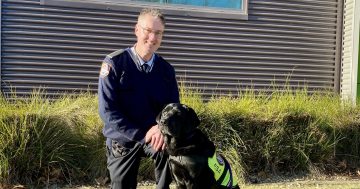
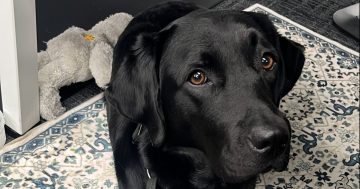
Lachie the labrador has just been awarded the Australian Animal Distinguished Service Medal for his therapy work in the ACT health system. Photo: ACT Health.
The man hadn’t spoken for a long time. Not a word to hospital staff, to visitors, to anyone.
For Chris Dudfield, manager of Spiritual Services at Canberra Hospital – who spends his working days striking up conversations with people – it was clearly a challenge.
“I’ve been doing this, talking to people, for 15 years,” Chris said. “But this guy didn’t want a bar of me.
“He looked at me and typed on his device, ‘I don’t want to see you’.
“But I noticed on his device that he had a picture of a dog.”
The next thing, Chris’ dog Lachie, a former guide dog, was in the man’s room, having his head patted.
“That was my invitation to go back into the room,” Chris said.
The two ended up having a 30-minute conversation, mostly about Lachie, then about the man’s dog, then about what was happening deeper in the man’s life.
“Since then, we’ve been having conversations over about a year,” Chris said, “and we eventually got to the core of what was an existential issue – he needed to be with his dog to make a life-saving decision about his treatment.
“He ended up writing a letter which he left with the nurses thanking Lachie and having time to think about his own dog – otherwise he would not have been here today.”
It would be hard to estimate how many lives Lachie, a handsome black labrador, has saved.
He lies at the bedsides of the dying, in trauma bays of hospitals and in the aftermath of disasters alongside the emergency personnel who give their lives to save strangers.
A registered assistance animal and therapy dog who works with Chris in ACT Health, Lachie has just been awarded the Australian Animal Distinguished Service Medal. It’s a rare national honour, presented for exceptional service to the community.
And, if you ask Chris and most everyone else who works alongside or has met him inside and out of the ACT health system, it could not be more well deserved.
First responders ask for him by name, grieving families write letters of thanks, medical staff thank him with happy tears.
People who have to be strong for others, break down when they talk of him.
“He really is a special dog,” Chris said. “He has this effect on people.

Manager of Spiritul Services at Canberra Hospital, Chris Dudfield, with therapy dog Lachie at the awards ceremony. Photo: ACT Health.
“Sometimes when nurses see him they will hug him and then start to cry. I ask if they’re OK and they say, ‘I will be now. I just needed a hug from your dog’.”
Chris and Lachie started working together in 2022. He had approached Guide Dogs Australia and they told him about this dog called Lachie.
“I had wanted a white, female labrador and got a male black one,” he laughed, adding that their bond was immediate – even though Lachie came with a 254-page manual.
“In the first three days it tells you you have to be with the dog 24 hours a day and set behaviour milestones like not going on the furniture. Within days, Lachie was on the lounge – he had instantly grabbed the spot where everyone was.”
Lachie’s impact on people stretches far wider than just with the people he works alongside.
“I’ve had big burly truckers yell out at me from across the street saying what a handsome dog he is.

The Australian Animal Distinguished Service award citation presented to Lachie. Photo: ACT Health.
“Even when we’re just out shopping, there’s something about him that makes an impact on people. He seems to bring people out of a negative place. That’s why it’s so important for him to be integrated into my work as a spiritual care practitioner.
“Lachie is very intuitive. He will sit on a person’s feet or draw close to them – he will stay with them as long as they need him. Sometimes he just stares at them, or puts his head on their hands which allows me to use that as a lever to move into deeper spaces with them.”
Chris said Lachie also helped him deal with the sort of support work he faced every day.
“A third of the work we do is about death and dying,” Chris said. “Having Lachie as a peaceful companion really helps.”
But despite all his training, Lachie’s still a labrador and knows the difference between working and not working.
“When his vest comes off he knows all about free time – and loves to do zoomies. Or I’ll call him and he’ll be on the couch and looks at me as if to say, ‘no thanks’.
“He’s still a dog after all.”