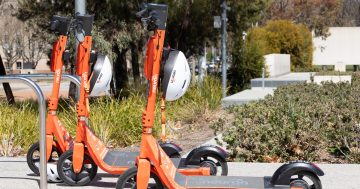
Lime has officially taken over as Canberra’s e-scooter of choice, after securing a three-year deal with the ACT Government. Photo: Region.
Less than three weeks after bright green scooters from Lime hit Canberra’s streets, claims are already emerging of “carnage” in the city centre.
The Canberra e-Scooter Club says the first two weekends of the rollout have been marked by dangerous riding, drunken behaviour and mounting injuries – and is now calling for a late-night curfew.
Club president David Hine says the situation in Civic has quickly spiralled.
“We can’t have rideshare scooters in Canberra because we can’t control bad rider behaviour,” he says.
“And it’s usually young people who cause the problems for us. The last two weekends have been really bad around the city, because there are more e-scooters around, and everybody’s having a go on them … It’s carnage.”

Lime offers 1100 e-scooters across all of Canberra’s town centres, in addition to e-bikes. Photo: ACT Government.
But Mr Hine says the increased numbers have come at a cost.
“Drunk riding, going too fast, not wearing helmets, double riding – I saw three people on one once – all that sort of stuff,” he says.
“And we’re seeing the same sorts of issues with the e-bikes as well. I saw one dumped up a tree recently. Honestly, I have no idea how they got it up there.”
The problems appear most acute late at night.
Construction work around Civic – including closures behind the Sydney and Melbourne Buildings – has created choke points where riders and pedestrians mix, and Mr Hine says traffic controllers are reporting chaotic scenes.
“They said it gets really crazy when all the drunk people are coming out of the nightclubs,” he says.
“They just couldn’t believe it – these kids were just riding them, smashing the scooters into things and laughing and everything … Everybody else is left to clean up the mess the next day.”
The club is now pushing for a shutdown period between midnight and 6 am to curb alcohol-fuelled riding.
“Urgent action needs to be taken,” Mr Hine says.
Mr Hine says serious injuries are already a known risk, pointing to “heaps” of cases involving broken bones and costly surgeries.
“They’re those major orthopaedic injuries like broken wrists, broken arms, broken collarbones … You’re looking at surgeries over the $10,000 mark.”

Civic traffic controllers are reporting “crazy” e-scooter scenes after dark. Photo: David Murtagh.
Exact data is hard to come by, but within months of e-scooters’ arrival in the ACT in 2020, nearly 60 Canberrans had presented to emergency departments. A later 2023 study found 623 hospital presentations over 15 months, with 17 per cent requiring major reconstructive surgery.
Despite raising concerns with the ACT Government, Mr Hine says he was directed to take complaints to Lime’s head office, “instead of them looking at the broader issue of policy development, like how are we gonna manage this?”
Beyond safety, the club fears responsible riders are being tarnished.
“Our major concern is that we’re getting a bad name – us, responsible private riders,” Mr Hine says.
For now, the club will “keep advocating”, but Mr Hine isn’t hopeful.
“It feels like a bit of a lost cause.”
Lime says several safety measures are in place. Speed limits of 10 km/h apply at high-priority crossings and 15 km/h in high-congestion areas, enforced through in-app geofencing that riders must accept before starting a trip.
Users must also complete a safety quiz before unlocking a scooter, and are required to return helmets and submit a photo showing the scooter has been parked safely at the end of each ride or risk fines ranging from $25 to $635.
But this tech may not be enough to keep them from disappearing interstate.
In Queensland, proposed new laws would introduce a 10 km/h footpath speed limit, a minimum rider age of 16 and a requirement for users to hold a valid driver licence.
Neuron says the changes could slash usage by up to 50 per cent and put the viability of shared scooter schemes “at risk”, while Lime has warned the rules could deter tourists – a key user group.
In a joint submission, the companies said the proposed laws, if unchanged, “could see the end of services in all Queensland cities”.
The ACT is not considering similar laws.
CORRECTION: This story was updated on 7 May.
The original version stated:
More than 1100 Lime scooters replaced the city’s previous Neuron fleet earlier this month, bringing higher speeds – up to 32 km/h – and wider availability across all of Canberra’s major town centres.
According to the ACT Government:
Lime e-scooters are limited to the following speed restrictions:
- 15 km/h on footpaths
- 25 km/h on shared paths, bicycle paths or the bicycle side of separated paths.
- Riders must slow down to 10 km/h when approaching and travelling across a crossing.
Lime e-bikes are subject to the same speed limits as other vehicles in the ACT.
Where the rider is riding in an area with speed limit signs, the rider must ride at or below the posted speed limit.
In areas without speed limit signs, the rider is subject to the default speed limit of 50 km/h; however, the power assistance of Lime e-bikes is cut off at 25 km/h.
Lime devices are currently operational only within areas where Neuron previously operated. As part of its permit, Lime has the ability to expand its service area; however, this has not yet occurred.