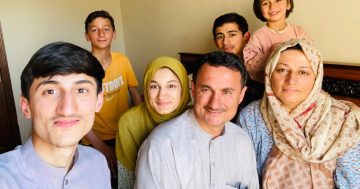
Mrs Haque (centre) with her children Arif (standing), Masuda (right) and Nazneen (left) at their Canberra home. Photo: Naziya Alvi.
The first few times Mazharul Haque and his wife visited the home of an elderly Canberra couple who had befriended their family, they weren’t taken through the front door.
“They’d take them through the back door,” their daughter Nazneen remembers.
It was 1968. The Haques were one of very few South Asian families living in Canberra, and Mr and Mrs Hancock were an elderly Australian couple who had become unlikely but important friends.
The Haques’ arrival coincided with a changing Australia. The White Australia Policy was already being dismantled, with restrictions on non-European migration relaxed in 1966. But Australia still placed a strong emphasis on a predominantly European population, and the policy’s final remnants would not disappear until the 1970s.
The Haque children didn’t need to know the politics to understand what that Australia looked like.
Few people looked like them. Few shops sold the food they ate. And there were few Muslims to celebrate their festivals with.
And sometimes, there was a front door they weren’t expected to use. Yet the Hancocks were also among those who helped the family most.
The Haques’ son Aslam had muscular dystrophy, and as his condition progressed, the elderly couple helped him obtain wheelchairs and other equipment. Mrs Haque, in return, crocheted and made things for their charity work.
The families shared genuine kindness. But there was also a boundary.
Then the Haques invited the Hancocks home for lunch. Nazneen remembers one of their first observations.
“They said, ‘Oh, your house doesn’t smell … your house is not Indian. It doesn’t smell or anything.’”
Although the Haques were Pakistani nationals at the time, the Hancocks, like many Australians, assumed they were Indian.
The Hancocks stayed. They ate the family’s food. They talked. And something in them shifted.
“The next time my parents went to their house, it was the front door.”
More than half a century later, that small moment feels to Arif, Masuda and Nazneen like part of something much bigger they have watched happen around them. Canberra changed.


When Mr Haque arrived in Canberra, he came as a diplomat and a father, not as a migrant intending to settle.
He sought a transfer from Jakarta to the Pakistan diplomatic mission in Canberra after his son, Aslam, stopped walking after a fall. An Australian doctor had recommended Canberra for specialist treatment.
The decision was medical. What followed was history.
For a Bengali Muslim family arriving from South Asia’s diplomatic world, Canberra offered little that felt familiar. For the children, those differences could sometimes be confronting.
At school, Masuda remembers children collecting chalk from the blackboard and blowing it into her face, telling her: “Now you know what it feels like to be a white person.”
The chalk stung her eyes and covered her hair and clothes. No teacher intervened. Nazneen remembers her fifth birthday, when almost every child in the room was white Australian.
Yet some of the siblings’ strongest memories from those years are of white Australian families showing up when they needed them most.
The Haques were living in Deakin when illness swept through the family. One after another, family members ended up in hospital. Eventually, the only one left at home was eldest son Arif. He was 13.
Two white Australian families stepped in — the parents of his younger sister’s school friends.
They checked on him. They offered to do the family’s washing. They took him grocery shopping because he was too young to drive.
What stayed with the siblings wasn’t simply that somebody had helped. It was who had turned up.
“Not the Bangladeshis, Indians, Pakistanis, nobody. English people.”
Then, in 1971, the political world Mazharul Haque had come from was torn apart.
War erupted between East and West Pakistan. Mr Haque was Bengali and working at the Pakistan High Commission in Canberra. East Pakistan was becoming Bangladesh. He left his diplomatic position when the conflict began. He was recalled but did not return.
The temporary posting had become permanent.
For Mr Haque, the next chapter was not diplomatic. He joined the Australian Public Service and built a career serving the country where his family had unexpectedly found itself.
For a man who had arrived in Australia at a time when race still shaped the country’s institutions and social attitudes, the trajectory was striking. He had come representing another country. He would spend his working life serving this one.
And Australia itself was changing.
The remaining discriminatory elements of immigration policy were removed in the early 1970s. Multiculturalism emerged as a national policy. The Racial Discrimination Act followed in 1975.
In November that year, the Haques became Australian citizens. Citizenship did not mean abandoning the world they had brought with them.
Bengali remained the language the children spoke with their mother. Food, faith, family and memory remained part of daily life.
But the family was also becoming unmistakably Australian.
The clearest measure of how much Canberra still had to learn came with Aslam’s death. The boy whose illness had brought the family to Canberra became the first Muslim buried at Mitchell Cemetery. The family wanted an Islamic burial, but the cemetery’s procedures did not accommodate one.
Aslam’s body was removed from the coffin and placed in the ground according to Islamic custom. The family was told the coffin could not leave the cemetery. They devised a makeshift arrangement using concrete slabs around and above the body, with the coffin placed on top before the grave was filled.
Nazneen remembers that the grave was not properly aligned with Islamic practice.
Today, Canberra has facilities, trained volunteers and arrangements to accommodate Muslim funerals that were simply unavailable then.
By the time the next generation was growing up, Canberra was a very different city.
Arif, Masuda and Nazneen had grown up conscious of being different. Their children entered classrooms where South Asian faces were no longer unusual. Through the 1990s, 2000s and 2010s, the siblings say their children rarely came home with stories of the kind of racial abuse they themselves had experienced.
“It’s not the same Canberra,” Nazneen says.
But it was not an entirely different Canberra.
After the September 11 attacks in 2001, Masuda was travelling on a Canberra bus with her young son when an elderly woman told them to get off and go back where they came from. What disturbed Masuda most was not simply the woman’s words.
“What upset me was not so much her behaviour, but the fact that no one stood up for us.”
By then, Masuda had spent most of her life in Canberra and more than 30 years in the Australian Public Service.
An unavoidable irony lay in being told to go back. There was nowhere else to go back to.
Her siblings had built their lives here too. Their children were educated in Canberra and entered professions including law, Defence, occupational therapy and the public service. Arif would go on to co-found an Australian water-technology company and chair the Canberra Multicultural Community Forum.
The passage of three generations is visible in the family home.
Mrs Haque still wears her sari. Her children still speak Bengali with her. Among the siblings themselves, however, English has become their primary language.
The old country survives in food, language, memory and ritual.
The new one is embedded in everything else.
Mazharul Haque’s own journey mirrored that transformation. He arrived in Canberra representing a country that war would soon transform. He stayed when that diplomatic world disappeared from his life and spent his working life in the Australian Public Service.

More than five decades after the Haques arrived, Australia is a fundamentally different country from the one they encountered in 1968. Multiculturalism is no longer an unfamiliar idea waiting to be accepted. It is part of the national story.
But the Haque family’s experience also carries a quieter warning.
For Arif, a multicultural society is not sustained simply by changing laws or by people of different backgrounds living alongside one another.
“It depends on whether people are prepared to recognise one another as equally part of the same civic community, and whether, when someone is treated as an outsider, others are willing to stand up.”
That is the unfinished part of the story.
Mazharul Haque came to Canberra because an Australian doctor believed the city might help his sick son. Today the boy who brought them to Canberra is buried here. So is the father who never intended to stay.
The family did not set out to become part of Australia’s transformation. They simply lived through it and, through the lives they built, became part of it.
In 1968, Canberra was a place they had come to. More than half a century later, it is the place they call home.