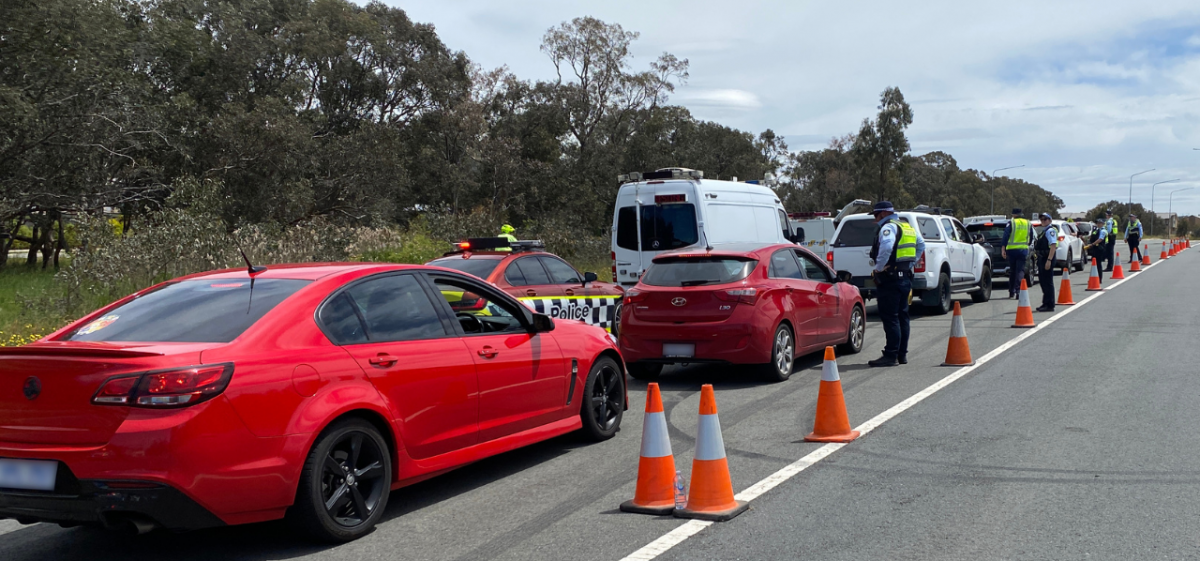
Unlike alcohol, there is no agreed THC threshold that police can use to determine when someone is too impaired to drive. Photo: ACT Policing.
Canberra’s medicinal cannabis users face a longer wait for protection from drug-driving laws, with the ACT Government arguing a surge in prescriptions and the lack of a reliable roadside impairment test make reform too risky for now.
But the government has not closed the door completely, conceding that detecting THC is not the same as proving a driver is impaired and suggesting better technology could eventually clear the way for change.
The issue was at the centre of an Assembly inquiry into ACT Greens Deputy Leader and transport spokesperson Andrew Braddock’s Road Transport (Alcohol and Drugs) Amendment Bill 2026, introduced earlier this year.
The Bill seeks to provide a defence for medicinal cannabis patients who test positive for THC after legally using their prescribed medication, while retaining offences for driving while impaired.
Currently, a prescription does not provide a defence if THC is detected in a driver’s system.
Health Minister Marisa Paterson pointed to the rapid growth in medicinal cannabis prescriptions as one reason the government was reluctant to change that approach.
The inquiry heard there were about 56,000 prescribing events involving about 10,600 ACT patients between June 2024 and June 2026.
Dr Paterson said the growth of telehealth prescribing also meant patients could receive medicinal cannabis from someone other than their regular GP, who may not have access to their complete medical history.
But Attorney-General Tara Cheyne acknowledged one of the key arguments made by supporters of reform.
“We can all appreciate … that presence and detection of THC is not the same as impairment,” she said.
Unlike alcohol, however, there is no agreed THC threshold that police can use to determine when someone is too impaired to drive.
Ms Cheyne said THC could affect people differently and current roadside testing could detect its presence but could not provide sufficient certainty about impairment.
She rejected suggestions the government was taking a “zero tolerance” approach, saying it recognised people had legitimate medical reasons for using cannabis.
“I absolutely think there’s a technology answer to this,” she said.
“It’s just we’re not there yet.”
ACT Policing backed the cautious approach, warning that drugs could affect concentration, reaction times and a person’s ability to safely control a vehicle.
ACT Chief Police Officer Scott Lee said moving away from presence-based testing would leave officers with the difficult task of assessing impairment at the roadside.
Signs such as slightly slower reactions, reduced concentration or poorer decision-making might not be immediately obvious, and Deputy Commissioner Lee said expanding impairment testing would require significant additional training and resources.
Mr Braddock challenged why medicinal cannabis patients should face a presence-based offence when drivers taking prescription opioids and other potentially impairing medications do not.
Police said officers could still act where they suspected someone was impaired by another drug. If roadside alcohol and drug screening returned negative results but there were reasonable grounds to suspect impairment, a driver could be taken for a blood test and toxicological evidence could be used to support a driving-under-the-influence charge.
Mr Braddock said evidence from medicinal cannabis advocates and medical and public-health organisations showed the ACT could learn from other approaches rather than leave patients with the status quo.
“No one should drive whilst impaired and my bill doesn’t change that,” he said.
“Patients taking medicinal cannabis are extremely low risk and we heard evidence that common driving distractions such as listening to the radio pose a much higher road safety risk.”
The inquiry also considered whether any new defence should extend to learner and provisional drivers and heavy-vehicle operators.
Police pointed to NSW, where some categories of drivers are excluded, and argued the ACT should consider similar safeguards.
The government has also questioned the Bill’s retrospective provisions. ACT Policing has not historically recorded whether cannabis detected in a driver’s system was legally prescribed, which could make earlier cases difficult to reassess.