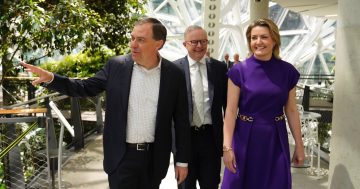
Microsoft CEO Satya Nadella and Prime Minister Anthony Albanese announce a massive AI investment commitment. Photo: Microsoft.
Microsoft is investing $25 billion in new digital infrastructure to help protect government agencies across Australia from cyber attacks and to boost AI cloud infrastructure for the public, private and non-profit sectors.
Prime Minister Anthony Albanese joined Microsoft chief executive officer Satya Nadella on Thursday (23 April) for the announcement, saying the government was determined to make the most of artificial intelligence for the benefit of the country.
“We want to make sure all Australians benefit from AI. Our National AI Plan is all about capturing the economic opportunities of this transformative technology while protecting Australians from the risks,” Mr Albanese said.
“Microsoft’s long-term investment in our national capability will help deliver on that plan – strengthening our cyber defences and creating opportunity for Australian workers and businesses.”
The PM said the investment would mean more training, better technology and new opportunities for Australians to get ahead.
The investment is an expansion of the Microsoft-ASD Cyber-Shield the Federal Government and Microsoft first announced in 2023.
The $25 billion in capital and operational expenditure will be fully delivered by the end of 2029.
This latest commitment will significantly expand Microsoft’s Azure AI supercomputing and cloud infrastructure in Australia.
It will see Microsoft collaborate with the recently-established Australian AI Safety Institute, take the Cyber-Shield to additional government agencies, deepen collaboration on national resilience with the Home Affairs Department and equip three million Australians with workforce-ready AI skills.
Mr Nadella is currently in the country for Microsoft’s global “AI Tour”, showcasing the software giant’s advancements with the technology.
“Australia has an enormous opportunity to translate AI into real economic growth and societal benefit,” he said.
“That is why we are making our largest investment in Australia to date, committing $25 billion to expand AI and cloud capacity, strengthen cybersecurity and expand access to digital skills across the country.”
With Home Affairs, the partnership will create a shared approach to trusted private public cooperation to strengthen Australia’s national and economic resilience.
Priority areas for engagement will include connectivity, data centre and hyperscale cloud infrastructure resilience.
Microsoft will also train three million Australians with workforce-ready AI skills by 2028 – the largest commitment of its kind ever made in Australia.
That builds on the company’s previous goal to skill one million people across Australia and New Zealand by the end of 2025, which was achieved ahead of time.
Microsoft also launched on Thursday its Elevate for Educators program, a free tool to help teachers and school leaders build confidence using AI responsibly.
And it launched Elevate for Changemakers, a similar program to help strengthen nonprofit leadership with responsible AI.

Data Centres Australia chief executive officer Belinda Dennett said the investment took Microsoft’s commitment to Australia to a new level.
“This investment in new digital infrastructure provides Australia with the opportunity to benefit from and to lead in the most profound technological shift we have ever seen,” she said.
“It will enable digital services for Australians and capture more of the AI value chain locally, supporting high skilled jobs and playing an important role in the energy transition.
“This is a significant vote of confidence in Australia as a hub for AI infrastructure investment and data centre development.”
Business Council Australia chief executive Bran Black described the investment as a “global game-changer for Australia” and just what was needed to capture the economic opportunity of the AI era.
“Microsoft’s $25 billion commitment to infrastructure and cyber security will support jobs, lift productivity and contribute to long-term economic growth,” he said.
“This shows how Australia can be a leader in AI and the scale of the economic opportunity that comes with it.”