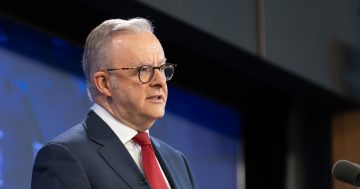
Prime Minister Anthony Albanese has missed a chance to call out the actions of the US and Israel, despite advocating for a rule of law and international norms of behaviour. Photo: Thomas Lucraft.
The Federal Government has missed a golden opportunity to call out the US and Israel’s unprovoked attack on Iran last weekend.
Instead, Prime Minister Anthony Albanese, his deputy Richard Marles, and Foreign Minister Senator Penny Wong have all danced around questions as to the attack’s legality.
“We support the United States acting to prevent Iran from obtaining a nuclear weapon and to prevent Iran continuing to threaten international peace and security,” a 28 February statement from the PM reads.
When asked on 1 March if he was concerned that the attack might erode further the rules-based order, Mr Albanese ducked and weaved, saying, “Well, those judgements and statements [are] for the United States and for those involved directly in the attack.
“What I would say is that the threat to international peace and security of the Iranian regime is real,” he said.
“The fact that they orchestrated attacks here in Australia on the other side of the world underlines the threat that this regime presented to the rule of law and to international norms of behaviour.”
I’m sorry, but that is both lame and a cop-out. And, ‘rule of law and international norms of behaviour’ anyone? Trump? Netanyahu? Bueller?
Australia hasn’t been alone in its inability to criticise the US’s actions. Canada’s Mark Carney – despite his inspiring speech in Davos a few weeks ago where he called on middle powers to come together against unilateralism – instead focussed his initial statement on supporting the US’s supposed effort to dismantle Iran’s nuclear program.
He said, “Canada supports the United States acting to prevent Iran from obtaining a nuclear weapon and to prevent its regime from further threatening international peace and security.”
But in a briefing with media in Sydney on Wednesday, Mr Carney said that, while he supported the action “with regret”, he added that, “prima facie, it appears that these actions are inconsistent with international law”.
UK PM Sir Keir Starmer initially said the UK would not participate because he “does not believe in regime change from the skies”, but refused to go further in criticising the attacks, instead saying Iran should “never be allowed to develop a nuclear weapon”.
Sir Keir said the UK had learned from “the mistakes of Iraq” and that it “will not join the offensive action now”, but has allowed UK bases to be used by the US to launch attacks against Iran.
In the meantime, Spain and France have taken a much stronger stance. Spain not only didn’t allow its bases to be used to launch operations against Iran, but its Prime Minister launched a scathing response to the attacks and to Trump’s threats to suspend trade with Spain.
In a pointed remark directed at President Trump, Prime Minister Pedro Sanchez said on 4 March that Spain would, “not be complicit in something that is bad for the world – and that is also contrary to our values and interests – simply out of fear of reprisals from someone”.
“You can’t respond to one illegality with another because that’s how humanity’s great disasters begin.”
France’s President Emmanuel Macron was quick to back Spain’s stance, saying on Tuesday, “The United States of America and Israel decided to launch military operations, conducted outside international law, which we cannot approve of”.
Few of us reading (or indeed, writing) this are experts in international law, but claiming the legality of the action which, five days in shows no signs of letting up, is up to the US and Israel just doesn’t cut it. The UN special rapporteur on human rights and counterterrorism Ben Saul has said that international lawyers are united in their opinion that the attacks by the US and Israel are a breach of international law.
All of Australia’s national security cabinet (NSC) would have been well briefed as to the legality of the strikes. In fact, they likely would have been briefed well before the strikes started due to the not-too-subtle build-up of US air and naval forces in the region which analysts say rivals that of Operation Desert Shield in 1990.
So, with advanced briefings and plenty of time to formulate a diplomatic, coherent, and strongly worded reaction to the strikes, Australia has instead chosen to duck any and all questions over their legality, and instead just focus on how evil the Iranian regime is … or was.
There’s no doubt the hard-line Iranian government has been guilty of atrocities against its own citizens, and of fomenting trouble right across the Middle East.
The Khamenei regime – and those that came before it – has brutally oppressed minorities and its female populace and has violently put down protests in recent weeks, while the Islamic Revolutionary Guard Corps has rightly been designated a terrorist organisation.
Iran has backed Shia factions through Iraq during that prolonged conflict and continues to do so, it supported Syria’s brutal Assad regime, has actively shored up the Houthi rebel government in Yemen and supplied it with weapons, and has underpinned the Hezbollah and Hamas terror groups in Lebanon and Gaza.
No one but the hardest of hard-line extremists will mourn the Iranian leadership’s demise.
But while Mr Albanese can find all the reasons in the world to be seen to supporting the venture, with even the briefest scrutiny, few of them stack up.
Trump and Netanyahu’s claims that they would not allow Iran to obtain nuclear weapons is somewhat ironic, seeing that Israel has an estimated 200 such weapons, and is itself not a signatory to the Treaty on the Non-Proliferation of Nuclear Weapons (NPT).
And it invites further doubt, because in June last year after Trump ordered a wave of attacks on Iranian nuclear sites by US B-2 stealth bombers supported by Israeli and other US combat aircraft and missile attacks, he triumphantly claimed the Iranian nuclear program had been “obliterated”.
Remember also that, in 2018 it was Trump who tore up the 2016 Joint Comprehensive Plan of Action which was designed to limit Iran’s nuclear program in exchange for the relaxing of sanctions against the state.
But even if we look at Trump’s other claim that he wanted to bring about regime change in Iran, how does this align with his 2024 statements that he would never attack Iran, and that he had no interest in exploring any regime change ventures?
And even if the attack genuinely was carried out to kill Iran’s leadership, one only has to look at what happened in Iraq after the capture and subsequent death of Saddam Hussein, with the Taliban in Afghanistan, and in Syria following the fall of the Assad regime to see how these recent ventures have resulted in a region increasingly wracked by factional infighting.
There is clearly little local interest in the increasingly perverted model of western democracy the US is seemingly trying to impose.
I’m hoping someone will get an opportunity to question Mr Albanese when the Canadian PM visits Australia this week, and ask just how do the US’s and Israeli actions come anywhere near to complying with the rules-based order that he seems so keen to promote, and how does supporting the killing of 185 schoolgirls and bombing of a country back to the Stone Age promote peace and stability?
Original Article published by Andrew McLaughlin on PS News.