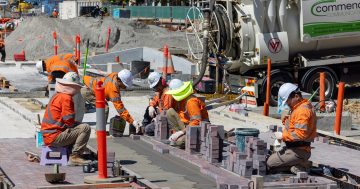
Work is continuing on sections of light rail stage 2A despite the stumble with the Secure Local Jobs Code. Photo: ACT Government.
Government leaders and the union movement have united to defend the Secure Local Jobs Code after the expiration of a certificate brought much of one of the ACT’s biggest infrastructure projects to a halt last week.
Work was disrupted on the light rail extension to Commonwealth Park after the Construction, Forestry and Maritime Employees Union (CFMEU) discovered interstate traffic management firm Altus Traffic Pty Ltd did not hold a current certificate and raised the matter with Infrastructure Canberra.
Without a current certificate, Altus’s subcontractor could no longer provide traffic control services on the $577 million project.
Canberra Liberals Leader Mark Parton reiterated his call to scrap the Code, which is under review in the wake of the corruption finding in the ACT Integrity Commission’s report on the Campbell school upgrade project.
Mr Parton said it had become a vehicle for privileged access rather than a genuine safeguard for workers and local businesses.
Master Builders ACT CEO Anna Neelagama has come out in support of the Liberals’ call, declaring the code a box-ticking exercise that favoured big interstate and international firms and only added to the administrative burden of local companies.
“Local builders have no confidence that procurement in the ACT is undertaken fairly and transparently, which is backed by the Operation Kingfisher findings,” she said.
Chief Minister Andrew Barr said on Monday (24 August) that only some parts of the light rail project were affected, the firm was in the process of renewing its certificate, and Canberra Metro was using alternative traffic management.
Mr Barr accused Mr Parton of playing politics, before taking a shot at the Opposition Leader’s recent text messaging antics in Estimates.
“There’s always someone who’s going to whip up the politics here, that’s Mark Parton’s job, when he’s not bored,” Mr Barr said.
“That’s what he does, but in reality, the project continues.”
Mr Barr said the purpose of the Code was to ensure that firms contracted for government work had a history of meeting their legal obligations and that the Code was checked and assessed.
“Work is continuing on the site. It is, I understand, progressing very well,” he said.
“We’ve had a pretty good run of weather over the winter, so I think everyone wants the construction completed, and I hope the matter of a renewed certificate is resolved very quickly.”

Planning and Sustainable Development Minister Chris Steel says the Code maintained community expectations. Photo: Ian Bushnell.
Planning Minister and Sustainable Development Minister Chris Steel said it was critical that there was a transparent way to ensure the government engaged ethical suppliers and for the community to make complaints.
“The ACT Government wants to make sure that we meet community expectations when engaging contractors, that they’re doing the right thing by paying proper wages and conditions and superannuation,” he said.
Mr Steel warned that the Liberals’ proposal would result in the government unwittingly hiring unethical suppliers.
“I don’t think that meets community expectations,” he said.
Unions ACT president Maddy Northam said the Secure Local Jobs Code was an Australian first that kept workers safe.
Ms Northam called it an integrity measure, and without it, there would be a race to the bottom on pay and conditions.
“Abolishing the Secure Local Jobs Code would take away a really important protection for workers right here in Canberra, for our local community,” she said.
Infrastructure Canberra confirmed that the certificate expired on 19 August, and it became aware of the matter the following day.
It said a contractual notice was issued to Canberra Metro seeking confirmation of the subcontractor’s status and requesting details of measures being taken to ensure traffic management could continue.
Canberra Metro had confirmed the subcontractor had submitted documentation to seek a new Secure Local Jobs Code certificate, and that an outcome could be expected by midweek.
“Essential traffic management measures remain in place wherever required to protect the community and workers,” Infrastructure Canberra said.
“Work is continuing across parts of the project that do not require traffic management services. Work in impacted areas will recommence once an appropriately certified traffic management contractor is in place to ensure all safety requirements are met.”
Infrastructure Canberra said the issue was not expected to have a material impact on the overall project schedule or delay delivery of Light Rail Stage 2A.
There were no expected impacts to the overall cost of the project.