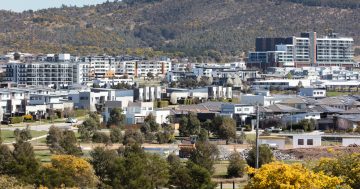
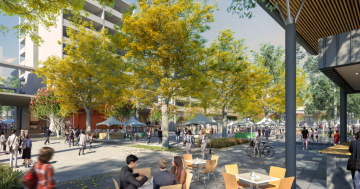
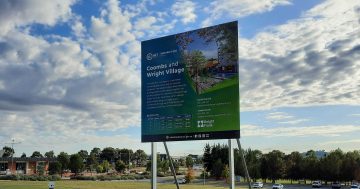
The Molonglo Town Centre will have 7000 homes. Image: SLA.
The Suburban Land Agency has rejected claims that the proposed Molonglo Town Centre will be a town centre in name only, saying the just-released master plan shows it includes all the attributes of a district service and shopping hub.
The Molonglo Valley Community Forum says the master plan confirms its fears of a residential-heavy town centre with insufficient commercial land and employment centres.
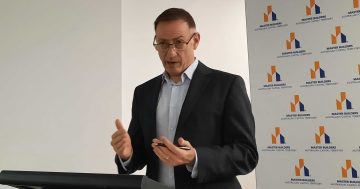
SLA CEO Adam Davey said the master plan foresaw 7000 homes, with the first residential release in the town centre to happen soon, enough for 700 homes.
But the plan also includes sites for a library, police station, community hub, sports facilities, and education, although the education precinct is still to be finalised.
“When you look at what’s planned for commercial and especially retail and other things, there are thousands of jobs,” he said.
“So it’s definitely the scale for it to be a town centre.”
Mr Davey said SLA was striving to activate sites for shops and services early, but acknowledged that development would be staged.
He said development would be proportionate to the population forecast of 70,000 by 2050.
“It’ll be comparable in that sense to other town centres,” Mr Davey said. “The plan ensures shops and services and jobs were delivered early, including supermarkets, retail and everyday services.”
But the amount of developable land has been reduced by about 4 ha to retain more trees and open space, leading to a condensed commercial core, which Mr Davey said did not mean smaller, just more in less space, “a smarter use of land”.
He said there was 23,000 sqm of big box retail, such as two or three major supermarkets and a few “mini majors”, 8000 sqm of specialty street-based retail and just under 50,000 sqm of large format big box retail, such as warehouses, showrooms, furniture stores, services and trades.
There was also about 10,000 sqm of commercial office space, which caters for between 700 and 1000 people, and about 2500 sqm of hospitality space.
The Town Centre is divided into eight character areas with building heights ranging from one storey up to landmark structures of 20 storeys in the core, with the highest buildings along John Gorton Drive and the future Molonglo Parkway Drive Connector.
A Noisy Sub-Precinct is designed to be a 24-hour commercial area.
Mr Davey said the ACT Government was committed to getting this town centre working effectively early.
But to ensure the success of the commercial core, growth would need to be staged in line with population growth.

The Molonglo Town Centre is divided into eight character areas. The education one in the centre is still being finalised. Image: SLA.
The Forum has criticised the master plan for being too vague about this commercial core growth, and fears Molonglo could suffer the Gungahlin malaise of being a jobs desert and dormitory.
“Residents were promised a vibrant, employment-generating urban core for a future population approaching 70,000 people,” Forum convenor Tom Adam said.
“Instead, the Suburban Land Agency’s long-delayed Master Plan delivers a basic group centre dressed in town centre language.”
But Mr Davey said the plan needed to be flexible and not too prescriptive.
He said it was a bit like the chicken and the egg: which came first?
“If you are too dictatorial in the approach, we might find we’re a bit stymied, and things take longer,” he said.
“We need to include some flexibility to allow the opportunities that might come from investors and developers who do work and have an interest in shopping centres and town centres.”

Molonglo Town Centre facilities. Image: SLA.
Mr Adam said the SLA had indicated that initial residential space could later be converted to commercial use, but the Forum rejected this approach.
“We have never seen it happen, and the reason is simple,” Mr Adam said.
“Developers will build to the minimum compliant standard. They do not add the ceiling heights, loading access, servicing and fire ratings that a real commercial conversion needs.
“Once a unit is sold, titled and lived in, converting it back needs owner consent, body corporate agreement, re-approval and a lease variation. At scale, it does not occur. ‘Convertible later’ becomes ‘residential forever’.”
The Forum wants to see guaranteed anchors in which space is identified for a large-scale government or private sector tenancy, with the land withheld from sale until a tenant is secured.
It says there should be committed employment space across the Town Centre Core, Eastern Gateway and Noisy Sub-Precinct, rather than one retail pocket owned by a single landowner and commercial development delivered in the first construction stage, not deferred to future years.
The Forum is calling for a mix of rates and tax discounts to encourage early commercial take-up and fit-out support for tenants.
“There is a way to do this properly, and we will be pushing for discussions on how to build these incentives into the new town plan,” Mr Adam said.
“We are ready to work with the Suburban Land Agency, the Planning Directorate and our local members. A real town centre needs real employment targets, real transparency and integrated transport from day one.”
Mr Davey said the SLA had not decided on whether to adopt a single developer model or not.
Mr Davey said the SLA was still waiting on more information from the Education Directorate to finalise the schools precinct, which was quite large and could also include some housing.
He said the master plan was a significant milestone and there would be more consultation with industry and the community, while working towards the Subdivision Development Application process by the end of the year.
To learn more about the master plan, visit the YourSay ACT.