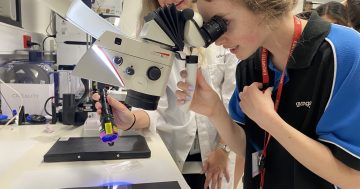
Rebekah explains how fingerprints are collected and examined as evidence at a crime scene. Photo: Naziya Alvi.
Rebekah notices fingerprints everywhere. On the kitchen bench. On tables. On surfaces most of us would never give a second glance.
Sometimes she catches herself doing it and remembers she is at home, not processing a crime scene.
“Yeah, yeah,” she laughs. “I guess you become a bit more vigilant of other people’s behaviour around you, just based on the things that you see.”
It is one of the smaller ways six years of looking for evidence has followed the 30-year-old Canberra woman home.
There are bigger ones.
Rebekah, whose surname has been withheld for privacy reasons, is a forensic crime scene investigator with AFP. She estimates she has walked into about 800 crime scenes – burglaries and stolen cars, assaults and sexual assaults, fires, clandestine laboratories, homicides and death investigations.
A day in Rebekah’s working life can begin with a burglary and end at a homicide scene. She rarely knows how long a job will take.
Some scenes have taken 15 hours at a stretch to process. Complex ones can keep investigators returning for several days. And then, when the shift is over, Rebekah goes home. She has dinner with her family. She sees the fingerprints on the table. She tries to leave behind whatever she has just seen.
When the call comes, she usually arrives with another crime scene investigator. Before a fingerprint can be analysed, before DNA can produce a result, and long before evidence reaches a courtroom, their job is to slow everything down and look.
Rebekah begins photographing the scene, recording what she sees through notes and sketches and working through it methodically. A fingerprint on a surface. A shoe mark. Blood. Trace DNA. Something seemingly ordinary that might matter.
“We have a very fine eye for detail,” she says. Perhaps a reason, she says, the department now has more women than men.
And while television dramas often give the forensic investigator the satisfaction of following a clue all the way to the culprit, Rebekah’s role is different. She documents, examines and collects. The evidence then leaves her hands and goes to specialist teams — fingerprints to fingerprint examiners, other exhibits to the relevant forensic experts — for analysis.

Rebekah demonstrates how evidence is marked and photographed during crime scene processing. Photo: Naziya Alvi.
As a teenager, she became fascinated with forensic science through crime shows. She took science subjects in Years 11 and 12 before completing a Bachelor of Applied Science in forensic studies. Years later, she found herself inside the scenes television had tried to recreate.
But no glamorous investigators race from a body to a laboratory and solve a case before the credits roll.
“They’re always in suits and high heels and that’s not the reality of it at all,” she says.
The results do not arrive instantly either. And crime scene investigators do not do everything from interviewing suspects to analysing every exhibit.
“We are primarily just focused on attending scenes, documenting, recording and collecting evidence.”
Television also struggles to show what happens when evidence is surrounded by grief.
“There are definitely scenes that I’ve been to that will stick with me,” Rebekah says.
Sometimes something about a scene feels relatable. Sometimes it is the family and friends standing nearby.
“You feel really awful for the family and friends that are there with you.” She will not describe those scenes. Not even anonymously. Canberra is small, she says. Someone could be casually reading a story and realise the person being discussed was their uncle or someone else they loved.
“At the end of the day, it’s still someone.”
Learning to work in those environments is itself part of the training.
New AFP crime scene investigators are not simply sent into the most confronting situations and expected to cope. Rebekah went through a Gradual Exposure to Deceased Persons Program, attending scenes with a mentor and checking in with mental health clinicians as she progressed.
For her, that meant about six mentored scenes before she moved further through the process.
“We are human; it’s always gonna be confronting; there’s always going to be things that stick with us,” she says.
The point is not to remove emotion. It is to learn how to carry it without allowing it to take over the job.
At a confronting scene, Rebekah narrows her attention to the task in front of her: “This is why I’m here, and this is what I need to do.”
If a scene becomes too confronting for an investigator, another crime scene member can take over. After difficult jobs, colleagues talk and debrief, while team leaders and mental health clinicians can check in.
Rebekah says experience has not made her numb. “I wouldn’t say that we become completely desensitised… we still do feel emotion.”
The challenge is keeping those feelings “at a level that allows you to do your job”. Some scenes have left her deeply upset. Others she knows will remain with her.
But another danger is spending your working life looking almost exclusively at what has gone wrong.
“100% of what we see is crime, but that’s not reality,” she says.
That distinction matters. The job has made her more vigilant to other people’s behaviour. She notices things she once might have overlooked.
“I’m definitely a different person from who I was,” she says. “You become a lot more aware, I guess, of what goes on in the world.”
Yet perhaps the most profound change has little to do with suspicion. It is gratitude.
She says what she has witnessed has made ordinary moments with family and friends more valuable.
“When you see the things that we do, it makes you really appreciate everything that you have,” she says.
“When I go home and have family dinner, like I just embrace that that moment’s happening and that we’re still all together and, like, how lucky we are to have that.”
Her family could hardly be further removed from forensics. Many are teachers. Her grandmother, however, has a theory about where it all went wrong. She used to watch crime movies when Rebekah was little and now jokes that perhaps they should never have let her watch them.
Six years and roughly 800 crime scenes later, Rebekah remains certain about the choice she made.
“I love what I do; I couldn’t imagine doing any other job,” she says.
She feels satisfied when a fingerprint, DNA sample, photograph or other piece of evidence she collected helps an investigation or ultimately matters in court.
“It’s always a good feeling to know that you’ve helped in some way.”