David Pocock, Thomas Emerson, Larissa Waters, Shane Rattenbury and Fiona Carrick, hoping the Senate motion would pass. Photo: Region
The Canberra Liberals were able to convince the federal Greens and independent Senator David Pocock to follow their lead and call for cheap public transport during the current fuel crisis, but they were at odds with their own party at the federal level.
The federal Liberal Party even managed to cause a split in the Coalition over a Senate vote that all but mirrored one put up in the ACT Assembly by Liberal leader Mark Parton.
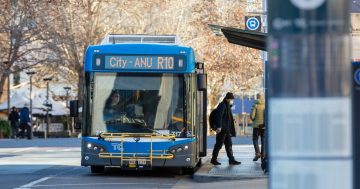
Mr Parton on Tuesday (24 March) called for a trial of 50-cent fares across the Transport Canberra network to encourage more people onto buses and light rail.
Senator Pocock thought that was a great idea and found support not only from the Greens but also the Nationals for a nationwide reduction in public transport fees, and put up a motion to that effect.
To get the Nationals on board, Senator Pocock and Greens leader Larissa Waters agreed to slightly change the wording of the motion calling for free public transport to “accessible, free or affordable nationwide public transport” for the duration of the current fuel security crisis.
Nationals Senate leader Bridget McKenzie was even happy to co-author the motion, and she got the whole team to vote in favour. It was expected that, with the Nationals on board, the whole Federal Opposition would be voting for it.
But lo and behold, the Liberals abstained, proving they still don’t quite belong to a united federal Coalition and – perhaps even more starkly – they don’t really care much for what their party gets up to at the ACT level.
Nor, for that matter, do the federal Libs care to consider what their mates in the Queensland Government are doing, where 50-cent public transport has just been made permanent.
The wording of the motion agreed to by Senators Pocock, Waters and McKenzie was straightforward.
That the Senate: (a) notes:
- the ongoing fuel security crisis as a result of conflict in the Middle East and associated volatility in global energy markets;
- the significant cost-of-living pressures faced by Australian households, including rising transport costs;
- the importance of building national fuel resilience and reducing Australia’s dependence on imported liquid fuels, including through use of biofuels;
- the need to ensure fuel is being distributed to areas of need, including to ensure that regional communities and farmers have the fuel they need to produce food and fibre; and
- the environmental and public health benefits of reducing private vehicle use and increasing sustainable transport options.
And (b) calls on the government to:
- work with state and territory governments through National Cabinet to deliver accessible, free or affordable nationwide public transport for the duration of the current fuel security crisis, and
- work with the state and territory governments to significantly increase planning and investment to integrate active transport infrastructure to support walking and cycling projects across Australia.
But the Liberals couldn’t bring themselves to vote for it, despite what their Coalition partner was doing and despite what the Canberra Liberals wanted.
By abstaining, the Liberals let Labor off the hook.
The motion failed in the Senate Tuesday evening.
Before the vote, when everyone expected it to pass, Senator Pocock and Senator Waters called a press conference at Parliament House. They were joined by ACT Greens leader MP Shane Rattenbury and independent MLAs Thomas Emerson and Fiona Carrick to talk up the need for such action.
“Free public transport just makes sense,” Senator Waters said.
“Our government needs to step up and help ordinary people with the cost of this fuel crisis.”
Not enough sense, though, for the federal Liberal Party, it would seem.