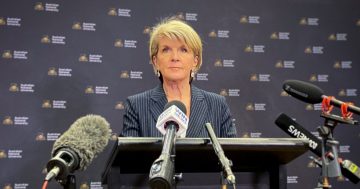
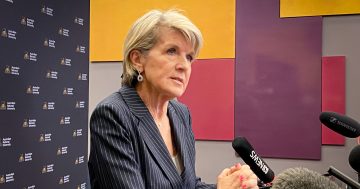
ANU’s 14th chancellor Gordon de Brouwer wants to further the university’s role as a knowledge institution. Photo: Claire Fenwicke.
Newly minted ANU chancellor Dr Gordon de Brouwer has vowed to restore trust in the troubled institution, admitting the university’s “not performed properly” in its governance following a string of damaging executive scandals.
Dr de Brouwer said the university was on his mind as he announced his resignation as the Australian Public Service Commissioner in January.
He wasn’t ready to retire just yet, and saw advancing ANU’s national mission as a knowledge institution as a good fit.
“I’ve spent my whole life around public institutions and the idea of — as I say this, you hear the public servant in me — serving the public … how do you improve and protect people’s lives and our natural world, and how do you then support that?” he said.
“One of the things I’ve been grappling with for the past few years, when I was in the public service, was trust and how do you get a strong society? Your economic and social policies have to work for that, and so does your security policy, and you have a holistic approach.
“If you’ve got a strong set of institutions that advance knowledge, then actually we’re better placed.”
Trust is a word that’s come up often in the conversations around ANU’s future. It was decimated at an executive level due to the devastation of the unjustified Renew ANU program, and this resulted in both former chancellor Julie Bishop and vice-chancellor Genevieve Bell stepping down.
Interim vice-chancellor Professor Rebekah Brown also highlighted the importance of trust during the launch of the ANU by 2030 strategy.
Region asked how Dr de Brouwer planned to balance ANU’s mission of advancing knowledge with being a sustainable business and getting the budget back on track.
He referenced not just the Australian National Audit Office (ANAO) report into Renew ANU, but the Nixon Report into gender and culture and the unpublished Thom Review into allegations against ANU Council members when speaking about what exactly he wanted for the institution where he studied, taught and now leads.
He’s also awaiting the results of the yet-to-be-finalised Briggs Report into ANU’s management governance systems.
“It’s a great university, but it’s not performed properly … in its governance and some of those aspects of management,” Dr de Brouwer said.
“That, to my mind, is, you be honest and really open about that, and then how do you make sure that it does actually have fantastic governance? So we want excellence in thinking and knowledge, and we want excellence in governance and in behaviour.
“And [in terms of] financial management, I thought those reports are a really good way of showing that … [those experts were] critical of that, and we don’t want to be there again.”
Pressed further about what governance failures he wanted to rectify, Dr de Brouwer said it was clear from independent reports that the university needed a “really highly functioning council”.
“A council has to operate as a council, and all members have equal standing, and then you have to work through a really clear understanding of what the facts are, or the evidence, and you have to interrogate that,” he said.
“You have to work through options, and the Renew [ANU plan] didn’t have options, it just said, ‘Here’s what we’re going to do’.
“When you’re doing anything like that, you have to really work very closely with the people who are affected by it … especially when there are jobs involved.”
Region spoke to Dr de Brouwer on his second day in the role, so he hadn’t had time to read all reports into ANU.
Hence, he couldn’t answer the question about what he thought was at the front of ANU Council’s mind when it ticked off on Renew ANU.
But he was adamant the same mistakes could not be made again.
“What do you start to do differently and what do you do differently, and how do you conduct yourself in the future?” Dr de Brouwer said were key questions leadership had to ask itself.

The chancellor and council are the oversight bodies of ANU, while the vice-chancellor manages and runs the university.
Dr de Brouwer said the news surrounding ANU needed to be about its people, not what was happening at an executive level.
“I’d really like … the focus on ANU [and] the brilliance of its students and its staff, what it’s contributing to the nation and to Canberra,” he said.
“I think the chancellor, in a sense … is a voice of the university to the public and within the university as well, and I love ANU … it’s a vital national institution that has a unique mission as the only national university, and I want to celebrate that.
“I don’t want the governance to be in the news … the news is actually the contribution of staff and students.”