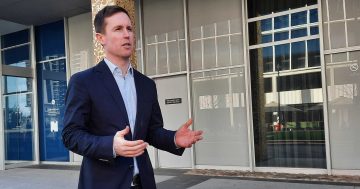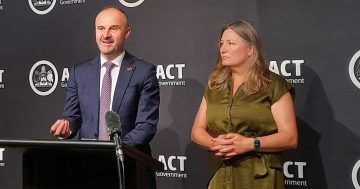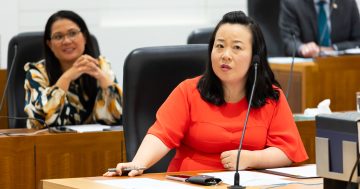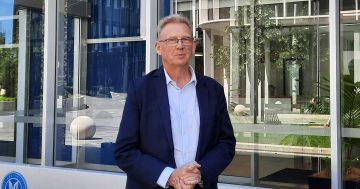

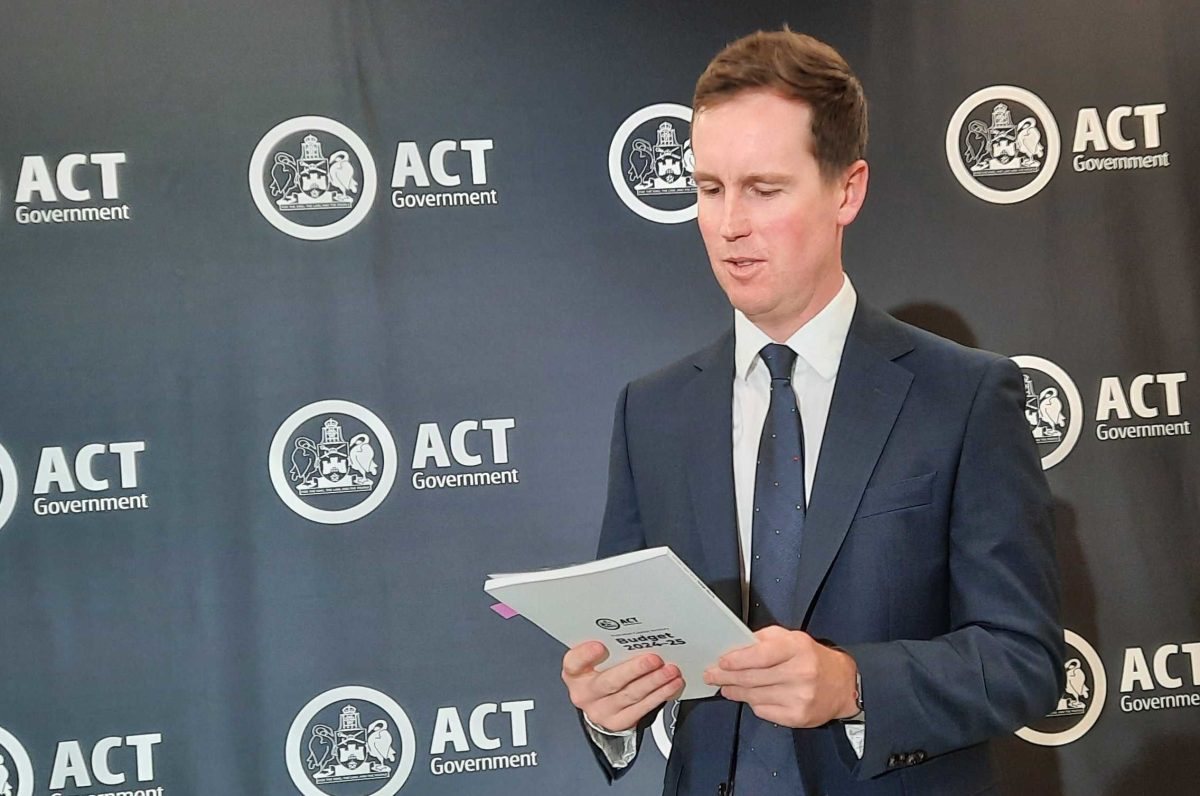
Treasurer Chris Steel is wary a select committee inquiry into the ACT’s fiscal sustainability will be a ‘political exercise’ but he’s happy to be proven wrong. Photo: Ian Bushnell.
A select committee will be set up to examine the ACT’s fiscal sustainability, but any suggestions to improve the bottom line won’t be applied to the upcoming ACT Budget.
Canberra Liberals leader Mark Parton and ACT Greens leader Shane Rattenbury joined forces to have the inquiry established on the last sitting day of the Assembly for 2025 in an attempt to understand how the Territory came to be in its financial situation, and where it could go from here.
The 2025-26 ACT Budget forecast a headline net operating deficit of $424.9 million and a cash operating deficit of $63 million.
Interest expenses were more than $522 million for 2024-25 and predicted to exceed $1 billion in 2028-29.
Mr Parton said fiscal sustainability wasn’t just a matter for accountants, it laid the foundation for “every service Canberrans rely on”.
“This motion aims to shine a bright torchlight into the deepening cavern that is ACT finances,” he said.
“We want to get to the bottom of the things that have led to a strangulation of services and a rising of costs.”
He pointed to S&P’s further downgrading of the ACT’s credit rating to AA and rising rates and levies as reasons why this needed to be examined now.
“This government doesn’t just spend, it overspends, under delivers, and leaves families to pick up the bill,” Mr Parton said.
The select committee is expected to call on a broad base of internal and external witnesses to evaluate the fiscal position and sustainability of the budget, assess how well the ACT Government is seeking and obtaining Commonwealth funding, assess the effectiveness and fairness of own-source revenue, review the costs associated with managing and delivering government services, analyse the current and proposed capital works pipeline, assess the effectiveness of the ACT’s wellbeing framework, and any other financial management matters that arise.
“If we fail to act now, the debt we ignore today will become the burden our children carry tomorrow,” Mr Parton said.
Mr Rattenbury added that the budget and finances were key issues that were constantly raised and, given the substantive crossbench this term of government, it was “incumbent” on all members to find out what was contributing to the ACT’s bottom line.
“It is the parliament that passes the budget when you have a minority government, and so my view is that we all need to be involved in this conversation,” he said.
“We need to be exploring options about what is the long-term pathway for the ACT’s finances.”
The motion passed unopposed, but Treasurer Chris Steel flagged that the committee could not rely heavily on treasury staff to assist with the work, as they’ll be busy preparing the 2026-27 ACT Budget, as well as negotiating with the Commonwealth on funding and agreements.
“It is important that the committee does not rely on treasury as the sole source of the information for their review,” he said.
“If matters are raised in March [when the interim report is due], it is too late for the 2026-27 Budget. But, it may be a longer-term consideration.”
He also said, with Assembly funds to be spent on this inquiry, it had to be different to both the annual reports and estimates hearings, and the independent budget review provided each year by Pegasus Economics.
Mr Steel did voice concerns about the motions, stating he felt the terms of reference were “eerily similar” to the Tony Abbott-era Commission on Audit and he was worried this would be an “entirely political exercise”.
He also took a shot at the Opposition and crossbench, and their criticisms of the ACT Government’s attempts to raise money while also asking for more services.
“There is a role for every member of the Assembly in addressing our fiscal challenges,” Mr Steel said.
“The chamber cannot oppose and curtail every revenue measure, call on the government to continue to spend more and more, oppose sensible savings and reprioritisation measures by the executive, and then [expect to be able to] credibly argue that the government is not effectively managing the budget and the Territory’s finances.”
It’s expected the select committee will deliver its full findings by August 2026.