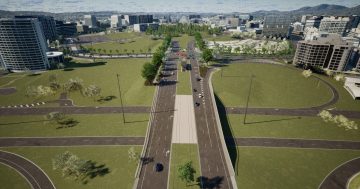
Commonwealth Avenue where rows of Himalayan Cedar and Chinese Elm have already been planted. Photo: Ian Bushnell.
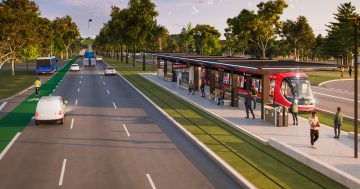
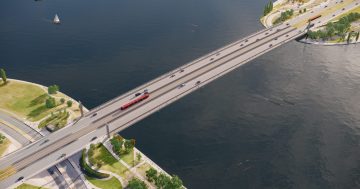
More than 140 large trees will adorn the light rail route from Alinga Street to Commonwealth Park in a major planting program to green and soften the impacts of the $577 million project.
Canberrans can now discover where and what species have and will be planted with the publication of a new interactive map on the Built for CBR website.
The Light Rail Stage 2A Tree Plantings Map provides an interactive guide to the city’s planned urban tree canopy, including the locations of new trees, the species selected, and the environmental benefits they will provide.
The new plantings feature a mix of deciduous and evergreen species that will complement existing trees along London Circuit and Commonwealth Avenue, including Himalayan Cedars (Cedrus deodara) and Pin Oaks (Quercus palustris).
Other species to be planted are London Plane, Chinese Elm “Yarralumla”, Zelkova Green Vase or Japanese Elm, Weeping Myall, Tulip Tree and Red Spotted Gum.
Infrastructure Canberra said the trees were already growing at Yarralumla Nursery, so trees could be well advanced before being planted as part of the project. Many were standing over four metres tall.
It said the Himalayan Cedars planted along Commonwealth Avenue had been propagated from the same seedstock source as the trees south of the lake near Albert Hall planted under the direction of Charles Weston.
The more than 100-year-old Himalayan Cedars in the Commonwealth Avenue median are slated to be removed when the planned Light Rail Stage 2B to Woden alignment is constructed through the Parliamentary Zone.
On the Northbourne Avenue median between the Sydney and Melbourne Buildings, green tracks will be flanked by plantings of deciduous Green Vase Zelkova.
Along London Circuit, deciduous, climate-resistant London Plane trees will dominate. These trees were selected on the advice of the National Capital Design Review Panel to maintain a consistent streetscape and provide symmetry with the numerous other London Plane trees across the city.
The interactive map says Commonwealth Avenue’s tree selections strengthen its historic character as an elegant tree-lined boulevard.
Along the verges, there will be rows of evergreen Himalayan Cedar and deciduous Chinese Elm, while between the green tracks in the median will be a row of Pin Oaks well suited to the Canberra climate.
Small strategic stands of Tulip Trees and Red Spotted Gum round out the selections.

Infrastructure Canberra said that, once established, the new trees along Stage 2A were expected to increase tree canopy coverage along the route to more than 30 per cent, in line with the targets of the ACT Government’s Urban Forest Strategy 2021-2045.
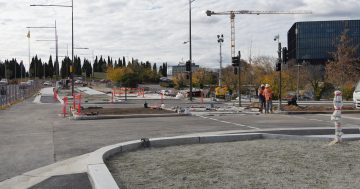
Infrastructure Canberra said planting had already commenced on parts of the alignment, with new trees in position outside the Sydney and Melbourne Buildings, and on the Commonwealth Avenue verges.
Further planting is scheduled for later stages of the construction program.