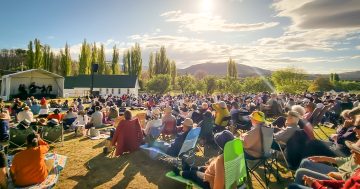

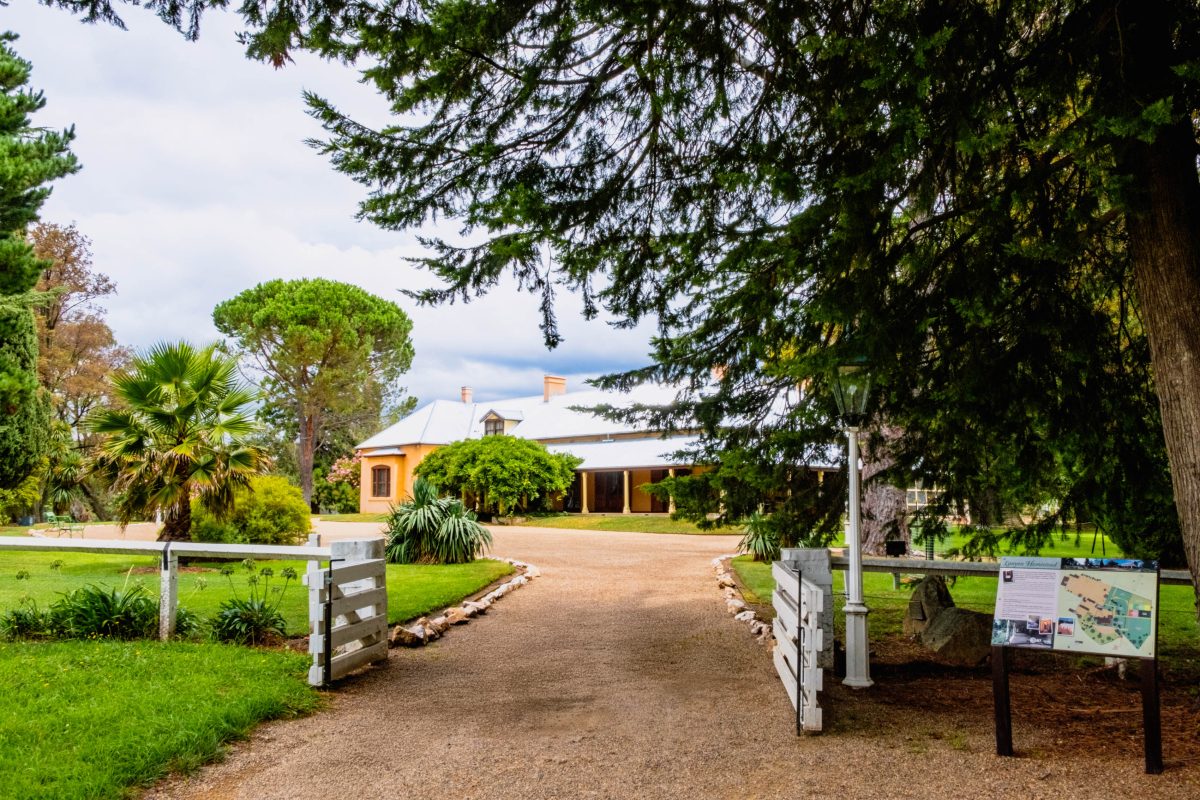
One of Australia’s earliest heritage rules is the reason you’ll never see suburbia from the Lanyon Homestead’s verandah. Photo: Dom Northcott.
Ever look at a map of the ACT and wonder why we’re worried about running out of land? South of Tuggeranong’s deepest suburbs – Gordon and Banks – there’s a vast green stretch running all the way to Tharwa and beyond. Ripe for development, you could assume.
In fact, planners once assumed exactly that. But one historic property stopped Canberra’s southern expansion in its tracks: Lanyon Homestead.
And thanks to a series of decisions made more than 50 years ago, it’s the reason Tuggeranong will never creep further south.
From the front verandah of Lanyon Homestead, there are no rooftops, no cul-de-sacs, no modern suburbs. Just rolling paddocks, the Murrumbidgee River corridor and Mount Tennant rising in the distance.
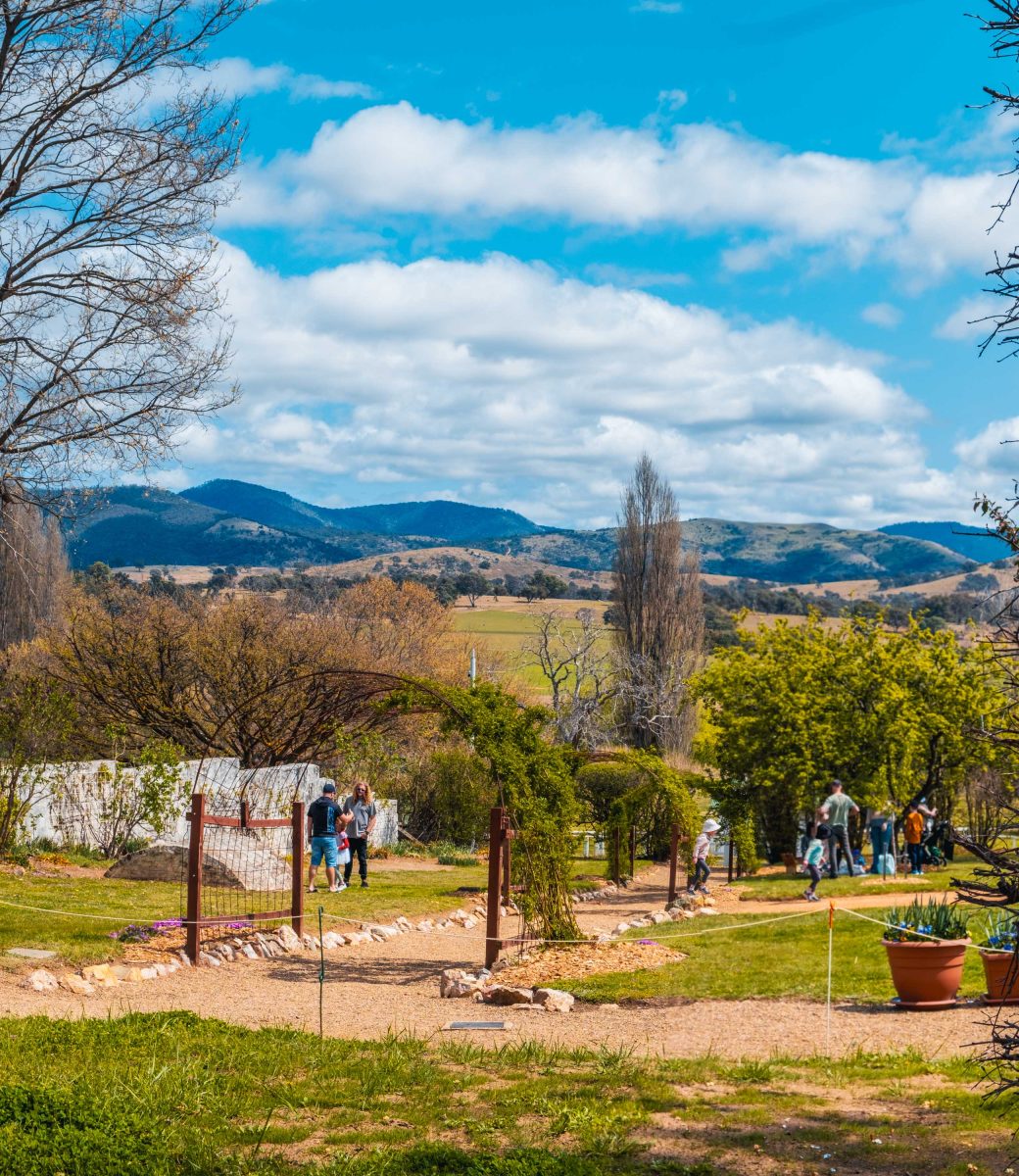
The view from the Lanyon Homestead’s gardens. Photo: Dom Northcott.
According to ACT Galleries, Museums and Heritage director Anna Wong, that uninterrupted view is no accident.
“You will never be able to see a modern house from the front veranda of Lanyon,” she says.
That promise, made in the 1970s, still shapes Canberra today.
When Canberra was chosen as Australia’s federal capital in the early 1900s, large swathes of land were resumed by the Commonwealth. Major estates such as Duntroon, Ginninderra and Tuggeranong Homestead were absorbed into the new city.
But Lanyon Homestead, despite being owned by the same Cunningham family as Tuggeranong Homestead, was not.
“So most of central Canberra that we see today was part of the Duntroon estate,” Dr Wong explains.
“At that stage, it didn’t include Lanyon Homestead.”
For decades, Lanyon remained a working rural property on the city’s fringe. That changed after World War II, when Canberra’s population began to boom.
From the 1950s and 60s, the National Capital Development Commission (NCDC) was tasked with expanding Canberra under its now famous “Y Plan” – creating satellite town centres such as Woden, Belconnen and Tuggeranong.
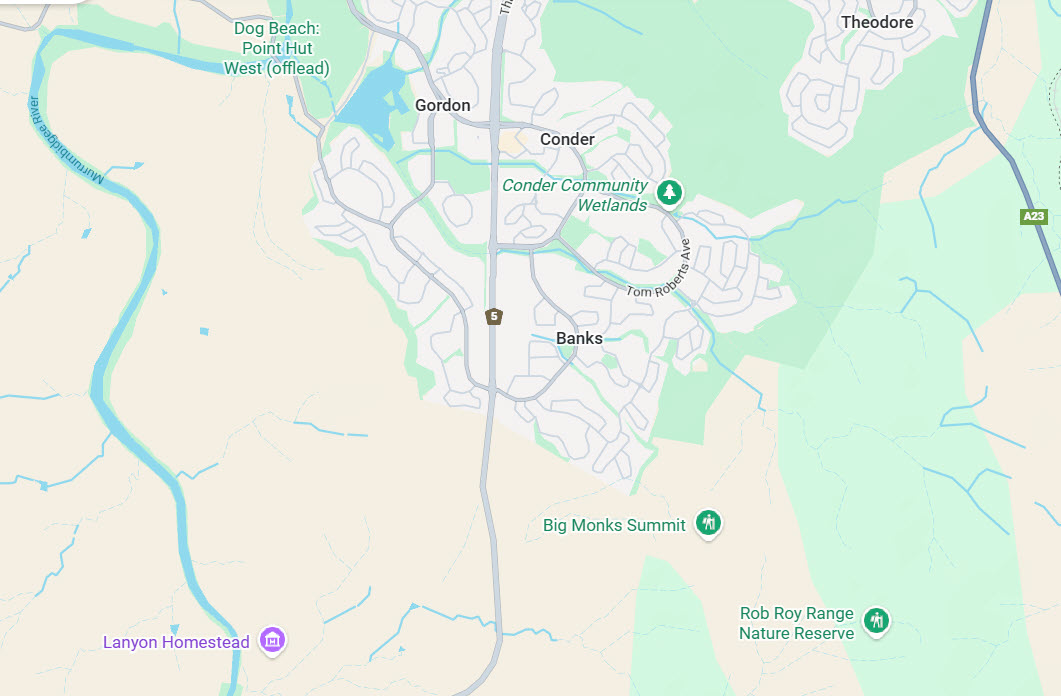
A map showing Lanyon Homestead’s relation to the southern-most suburbs of Gordon and Banks. Image: Screenshot, Google Maps.
By the 1970s, attention turned south.
“By the 1970s, Lanyon Homestead was the largest privately owned estate left in Canberra,” Dr Wong says.
At the time, it was owned by the Field family, who had purchased the property in 1930. The Federal Government began negotiations to acquire the land, with an eye to subdivision and a brand-new suburb.
That’s when things stalled.
The government offered compensation based on “land only value”, excluding the homestead and improvements. The Fields disagreed, arguing the land should be valued for its “future development potential”.

Dr Anna Wong at the Lanyon Homestead gardens. Photo: Dom Northcott.
The dispute went as far as the Supreme Court and while it dragged on, another battle was brewing.
Amid fears Lanyon could be demolished or swallowed by suburbia, the National Trust stepped in, placing the property on its heritage register.
“It’s all happening at the same time,” Dr Wong says.
Then, in 1974, Australia elected the Whitlam government – a turning point for heritage protection nationwide.
“Prior to Whitlam, there was no legal heritage protection framework in Australia,” she says.
Under Whitlam, the Australian Heritage Commission was established and heritage conservation became a national priority. Key to Lanyon’s survival was lobbying from heritage advocates, including ANU landscape architect Professor Ken Taylor.
Ken Taylor famously brought federal minister Tom Uren to Lanyon, standing with him on the homestead’s verandah to explain the importance of “curtilage” – the surrounding landscape that gives a heritage place its meaning.
It was then Uren delivered the now immortal edict: “You will never be able to see a modern house from the front verandah of Lanyon”.
“And that was really the beginning of saving the land and homestead as a rural property,” Dr Wong says.
“It was a really pivotal moment.”
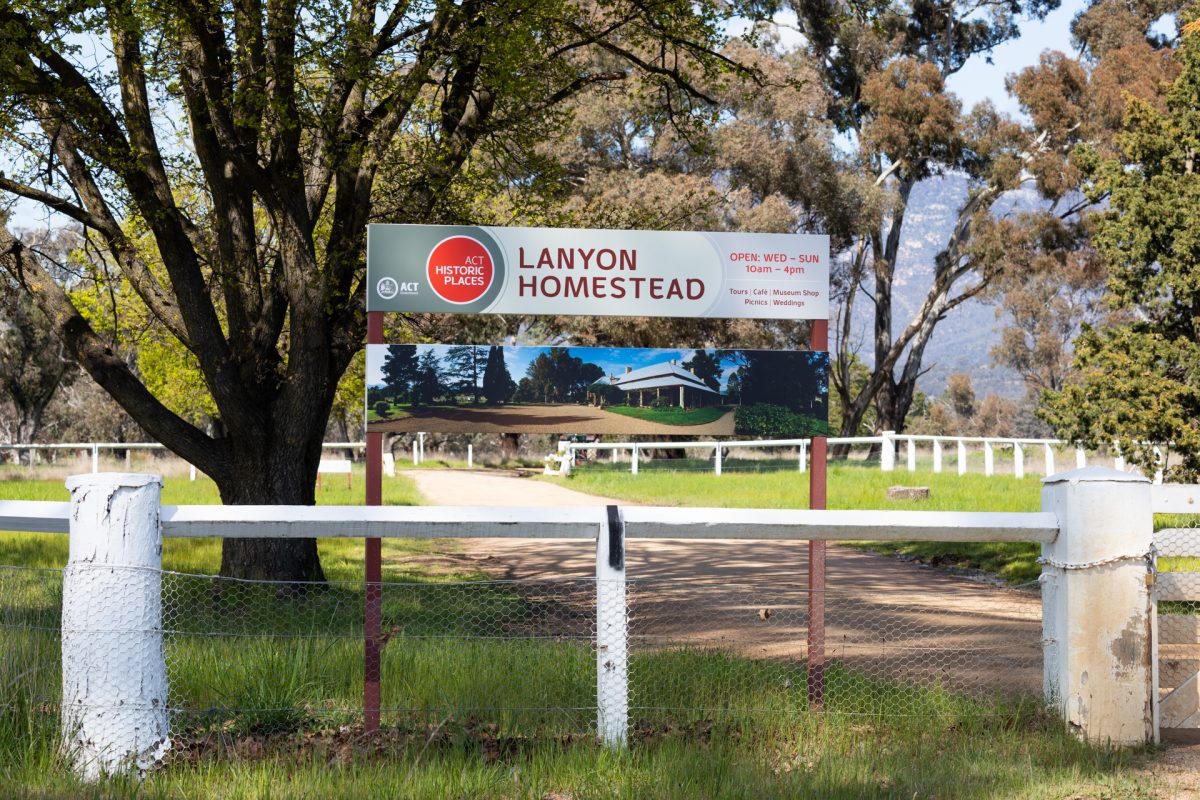
Lanyon Homestead is open to the public from Wednesday to Sunday, 10 am to 3 pm. Photo: Michelle Kroll.
Not long after, the idea of the “Lanyon Bowl” took shape. Formally declared later under the Hawke government, it protected about 5000 ha of land stretching from southern Tuggeranong to Mount Tennant, bounded by the Murrumbidgee River and surrounding hills.
“It really protected the visual and landscape integrity of that whole area,” Dr Wong says.
The result is one of the most intact cultural landscapes in Australia and a hard southern boundary for Canberra’s growth.
“It has led to Lanyon still being one of the most well preserved, holistic cultural landscapes that we have in Australia,” she says.
That preservation was underscored earlier this year with the acquisition of an 1832 painting by colonial surveyor Robert Hoddle.
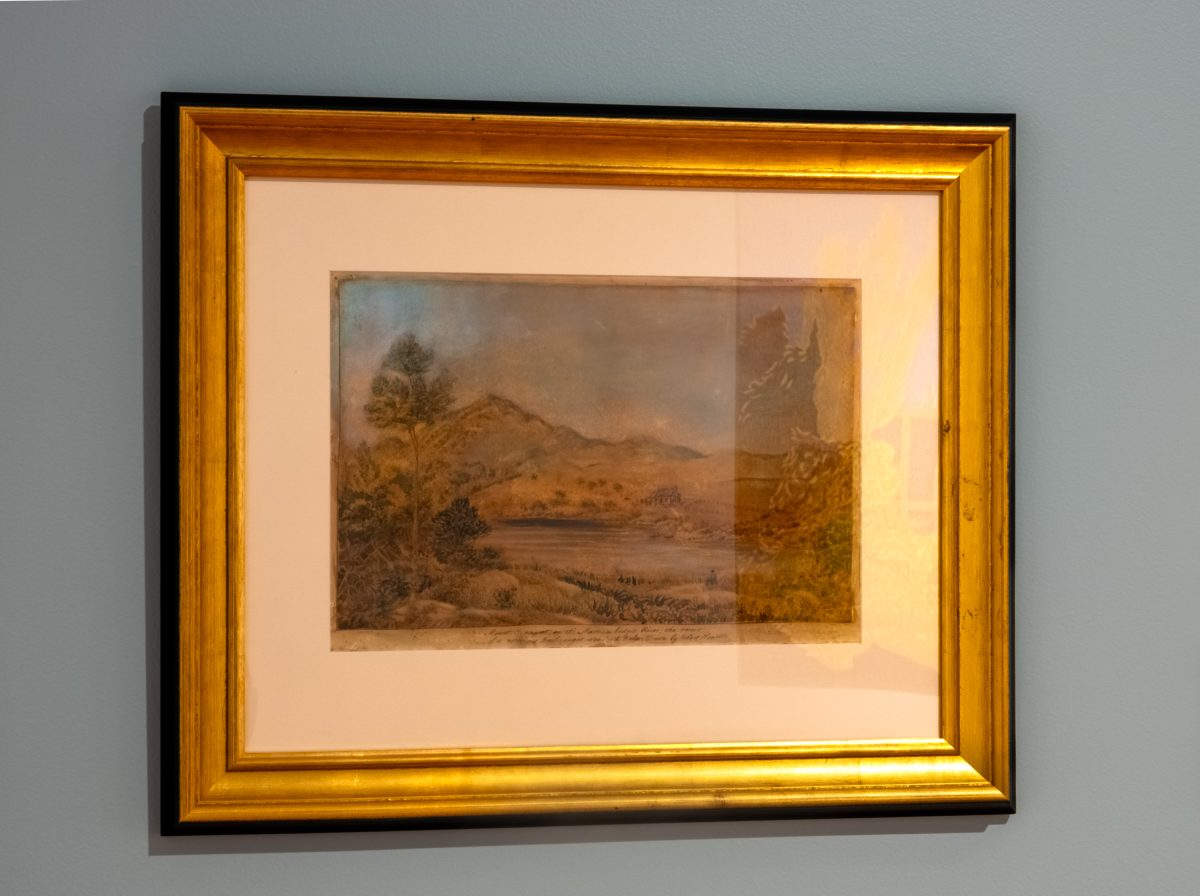
Robert Hoddle, Mount Tennant, on the Murrumbidgee River, the resort of a notorious bushranger, New South Wales, 1832, Canberra Museum and Gallery.
Titled Mount Tennant, on the Murrumbidgee River, the work is believed to have been painted from the site of Lanyon Homestead itself.
“We’re 99 per cent sure that it was painted from the current site of Lanyon Homestead,” Dr Wong says.
And nearly two centuries later, the view remains strikingly similar. And always will. Because while Canberra might continue to grow up and out, it will face a hard time getting past Lanyon’s front gate.
Mount Tennant on the Murrumbidgee River is on display at the Canberra Museum and Gallery (CMAG). CMAG is open Monday to Friday, 10 am to 4 pm and Saturday and Sunday, noon to 4 pm. Entry is free.