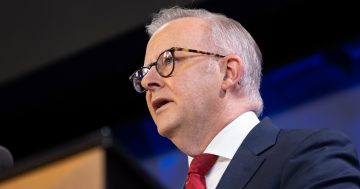
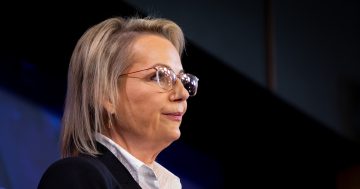
Environment Minister Suzanne Orr launched a 10-year plan to restore the health of Tuggeranong Lake. Photo: Naziya Alvi Rahman.
Only six of the ACT Government’s 30 new climate actions will directly reduce greenhouse gas emissions, despite more than $9.3 million being allocated to deliver the first stage of its Climate Change Strategy, Budget Estimates has heard.
The revelation prompted Shadow Minister for Environment and Climate Change Elizabeth Lee to question whether the government’s roadmap to net zero by 2045 relies too heavily on policy development and planning rather than practical emissions reductions.
During the hearing, Ms Lee asked officials how the funding would be spent and how much would go towards policy work, practical programs and administration of the strategy.
Officials said $9.307 million over four years had been allocated to deliver the first action plan. The largest components include $3.29 million for adaptation and resilience policy work and $2.12 million to continue climate change and energy policy work.
The package also includes funding for nature and land-use emissions accounting, community engagement, travel demand research, community partnerships, climate adaptation planning and a Territory-wide climate risk assessment.
Ms Lee later questioned whether the strategy contained enough tangible action.
“The strategy is described as a practical pathway to strengthen climate resilience and reduce emissions, but half of its 16 key milestones simply seem to be commitments to develop more strategies, more plans and more reports,” she said.
“How can Canberrans be confident that these are actually going to result in … a practical pathway, over just more strategic and planning documents?”
She also pointed to the government’s own assessment showing that only six of the strategy’s 30 new actions were classified as having a direct emissions-reduction impact, while the remainder were assessed as indirect or enabling actions.
Climate Change Minister Suzanne Orr rejected the criticism, saying the ACT had moved into a new phase of climate action.
“I don’t think it’s quite as simple as that,” she said.
“We have a lot of work across government that has been ongoing that this builds on.”
Ms Orr said much of the work involved understanding the next steps needed to reach net zero and should be considered alongside climate programs already underway across government.
She also rejected suggestions the government had ignored feedback received during consultation, saying the document released last year was a discussion paper rather than a draft strategy.
“There has actually been a lot of feedback through the discussion paper, through the public consultation, that is absolutely reflected within the climate change strategy,” Ms Orr said.
Climate Change executive branch manager Bethel Sundaba said consultation had led to changes in the final strategy, including refinements to its pillars and a stronger focus on intergenerational impacts, supporting vulnerable Canberrans and strengthening community involvement in climate action.
Officials defended the relatively small number of direct emissions-reduction measures, arguing that the ACT had already completed much of its first phase of climate action and was now focused on embedding climate considerations across government.
Executive group manager Fiona Wright said the next stage was about changing the way government made decisions.
“A lot of these actions now seek to actually change the systems of how we operate, and so they are by their nature enabling.”
The hearing also revealed the government does not yet have quantitative modelling for every action in the strategy.
Asked by Greens MLA Andrew Braddock whether Canberrans should have confidence that the ACT would reach net zero by 2045, Ms Orr said the government would continue to identify additional actions as the transition progressed.
“We are still identifying further actions that need to be taken as we work through particularly the more complex aspects of this transition,” she said.
Officials said they had modelled emissions reductions for some government programs, including electrifying government-owned gas assets and transitioning the ACT Government’s vehicle fleet to zero-emission vehicles.
However, they acknowledged that they had not undertaken quantitative modelling for all of the strategy’s actions because many of them depended on different future scenarios.