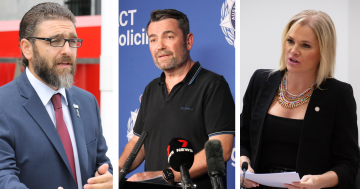
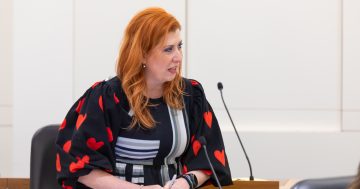
Shadow Attorney-General Chiaka Barry (centre, with Mark Parton and Deborah Morris) says the ACT’s sentencing practices for sexually violent offences need to be re-examined. Photo: Canberra Liberals.
Public outcry over a teenager’s suspended sentence for the rape of a young woman has led to calls for an inquiry into the ACT’s sentencing practices for sexually violent crimes, and for the Canberra Liberals to push for new laws to allow the Attorney-General to intervene if a sentence seems too lenient.
It comes as the Director of Public Prosecutions is considering whether to appeal the 18-month good behaviour order imposed on the now-18-year-old man by the court.
The teenager was 16 when he assaulted the young woman, meaning under ACT law, prison could only be considered as a punishment of last resort.
A petition has voiced concerns about whether sentences imposed for sexual violence are “appropriate, proportionate to the offending and sufficient to deliver justice for victims and protect the community”.
“All sexual violence causes profound and lasting harm. Sentences must reflect the gravity of offending, hold offenders accountable and provide meaningful deterrence,” the petition read.
“Recent sentencing judgments have prompted concerns about whether wholly suspended prison sentences adequately meet these responsibilities.
“The community needs assurance that sentencing outcomes are justified, assessments of reoffending risk are rigorous, and mitigating factors do not diminish victims’ entitlement to justice or community safety.”
Shadow Attorney-General Chiaka Barry said she wouldn’t comment on the recent case, but described it as a symptom of a “systemic problem” with Canberra’s sentencing law.
“Repeated community concern that sentencing outcomes are inadequate necessitates a careful review of the full justice response,” she said.
“We cannot continue to operate under a system that is glaringly at odds with community expectations.
“If the law is the problem, it must change.”
Such community concern has led to law reform before, including changes around recidivist dangerous drivers and proposed bail changes to better guide magistrates and judges on whether they may or should consider certain circumstances.
One aspect of the petition picked up on the justice’s comments that the offender was a recent migrant to Australia, and so his sexual inexperience, cultural background and limited familiarity with “Australian societal norms” were considered when deciding a sentence.
Ms Barry said judicial discretion was important because it allowed courts to consider individual circumstances, but community sentiment showed that the legal settings courts followed needed to be examined.
“Judges exercise discretion in accordance with the legislative framework. It is our job, as legislators, to ensure that sentencing legislation is up to scratch to send a clear signal of legislative intent to the judiciary,” she said.
“It is time for a sophisticated, comprehensive and independent review of sentencing in the ACT to scrutinise where the system is failing and identify how to fix it.”
The Canberra Liberals will also move a motion in this month’s double sitting weeks calling for new legislation to allow the Attorney-General to instruct the Director of Public Prosecutions to appeal a sentence that’s viewed to be “manifestly inadequate”.
Ms Barry said Queensland had a similar direction.
“Obviously the DPP would then consider whether or not there is sufficient evidence to appeal, but that instruction can be given by the executive to the DPP, conveying community expectation,” she explained.
“I think [that’s] what the community expects, that the Attorney-General should be able to issue a direction to the DPP to appeal a matter if the sentence is manifestly inadequate.”
Reforms to sentencing practices were recommended in the 2021 Listen. Take Action to Prevent, Believe and Heal report.
This report noted offenders found guilty of committing sexual offences in the ACT were “less likely to go to prison than in other jurisdictions” or, if they did, they’d receive a shorter sentence.
It recommended penalties should align with practices in other jurisdictions more closely, introduce a legislative presumption that intensive correctional orders and suspended sentences not be imposed for serious sexual offences.
For serious sexual offences, it said the ACT Government should introduce a legal presumption that a prison term be imposed unless exceptional circumstances apply.
The judicial system is independent of government, but Attorney-General Tara Cheyne said the sentencing system wasn’t beyond scrutiny.
“The response from the community comes from a good place and they are entitled to ask whether the consequences adequately reflect the seriousness of the offending,” she said.
“I don’t think we should be afraid to ask whether our sentencing laws are getting the balance right, particularly when it comes to serious sexual offences.
“We have to earn the confidence victim-survivors should have in our justice system through the way people are treated, the support they receive and the outcomes our system delivers.
“I am prepared to make changes to sentencing legislation where the evidence supports them.”