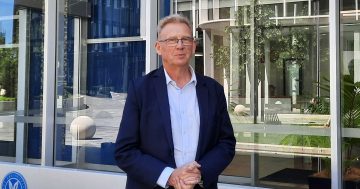
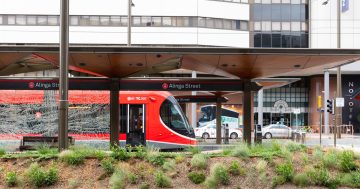
Could the Canberra Liberals be taking a different stance on the next stages of light rail? Photo: ACT Government.
It appears the Canberra Liberals are considering a change of attitude toward light rail after years of being dead set against the entire project.
Opposition Leader Mark Parton fronted the media on Tuesday (3 March) to respond to economist Saul Eslake’s interim report on the ACT’s fiscal sustainability.
One of Mr Eslake’s recommendations was that the ACT Government should set a “ceiling” on the growth rate of aggregate spending and provide a “more rigorous and transparent process” for setting an overall level of capital expenditure.
When asked about whether this could be a way to constrain spending, Mr Parton said “every dollar that we spend” would need to be questioned going forward.
“In this particular political term, the Canberra Liberals have not arrived at a position on, for argument’s sake, the tram,” he continued.
“But we’ll be examining the business case extremely robustly when it comes out, because there are a lot of things that we can have as a Territory that we’d like to have, but given the state of the finances, we really have to examine how it fits into that envelope.”
Mr Parton went on to highlight Mr Eslake’s finding that, over the past decade, ACT Budgets had included ‘capital initiatives’ totalling at least $5.7 billion, which have been entirely funded by debt.
“We’re going to have to examine these things going forward, and I’m sure Labor will be examining them as well, but unfortunately, when it comes to projects like the tram, they’re so far down that rabbit hole that it would appear that they’re unable to get out of it,” he said.
The Canberra Liberals went to the 2024 election firmly against Stage 2B to Woden.
Chief Minister Andrew Barr was also asked about spending caps on capital infrastructure works as he appeared before the committee inquiry into the ACT’s fiscal sustainability.
He argued there were already two other measures that restrained capital projects.
Mr Barr said one was market capability to deliver such projects, and this already gave a “clear upper benchmark” to the government.
“There’s no point putting out an infrastructure program that is bigger than the industry capacity to deliver, because you just end up with money rolling over,” he said.
Industry capacity can be boosted when national construction companies are bidding for what are defined as Tier 1 projects, such as light rail.
The other measure included “fiscal components” – how the Territory funds infrastructure.
The ACT Government typically funds infrastructure through a Commonwealth contribution, revenue from asset sales (usually land), operating cash surpluses, and borrowings.
There are also some public-private partnerships.
Mr Barr questioned how exactly a cap would add to the measures already considered by government when deciding on capital projects.
“[There’s also] the question of whether that dollar cap would be a fixed nominal value over time or it would be a proportion,” he said.
Treasurer Chris Steel was asked after the hearings about whether he supported caps on capital works expenditure.
He didn’t directly answer the question, but acknowledged net debt needed to be consolidated.
“We’ll need to continue in each budget to look at the capital program to make sure that it’s realistic, that it can be delivered by the civil construction sector here in the ACT, but also make sure that we can actually fund it sustainably in the long-term,” he said.
“There’s a range of different infrastructure projects around Canberra, many of them are to renew aging assets in the Territory, to make sure that we can continue to meet the needs of our population, but also a lot of the infrastructure projects are about supporting more housing as our city grows, and the infrastructure required to support those new residents.
“So it’s important that we do continue to invest in infrastructure, but we also need to make sure that those levels are sustainable, and we look at that in each budget.”


Mr Eslake’s interim report stated that policy choices were responsible for the ACT’s deteriorated bottom line.
Mr Barr responded during the hearing that there had been significant expenditure and revenue loss during the COVID-19 period.
States and territories were encouraged to grow the economy during the pandemic, and Mr Barr said the government had also received advice to ramp up generational infrastructure projects at the time because borrowing costs were very low.
Canberra was now seeing that wave of infrastructure spending “peaking”.
“You are seeing the tail-end of that COVID-period capital works coming to an end,” Mr Barr said.
Opposition Leader Mark Parton took a different view, describing the policy choices statement as a “remarkable slap down”.
“One of the big reasons that I moved to establish this committee [with the ACT Greens] was to assist the Canberra Liberals in the development of policy to actually deliver better outcomes for Canberrans,” he said.
“This is a watershed moment for Canberra.”
The hearings continue on Thursday (5 March).