
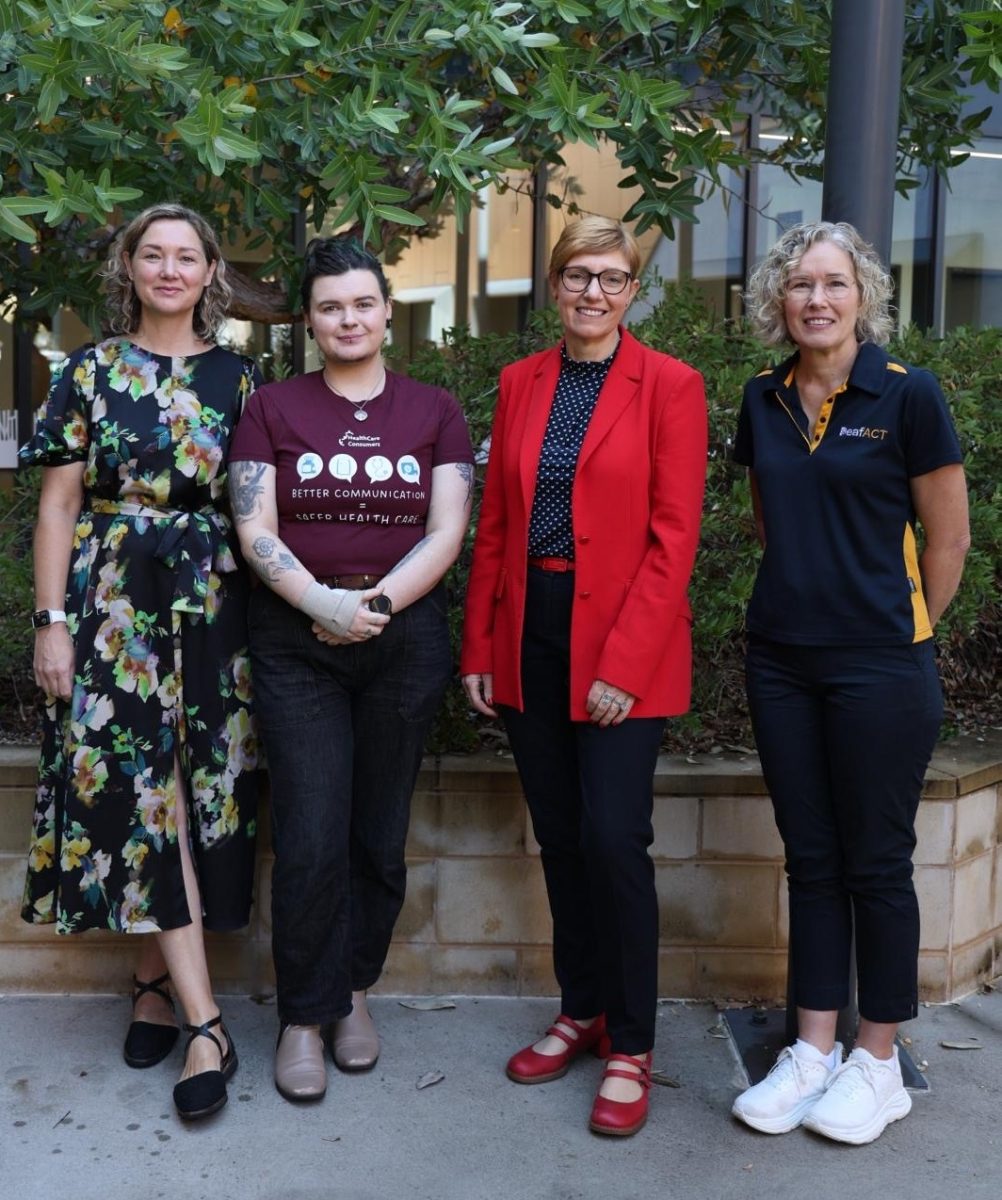
Josephine Smith (CHS), C Moore (Health Care Consumers’ Association), Health Minister Rachel Stephen-Smith and Louise Irvine (DeafACT) have encouraged people with a disability to update their access needs and details in the Digital Health Record. Photo: Supplied.
Person-centred care has made significant progress in the ACT, with people now able to identify their disability and outline any access requirements in the Digital Health Record.
More than three years after the DHR was first launched, a questionnaire has been built into the service (and MyDHR) to allow consumers to record and update their access needs, which is then available to Canberra Health Services staff.
DeafACT secretary Louise Irvine said communication was often the biggest challenge for people who are deaf or hard-of-hearing when accessing healthcare.
“There have been times when no Auslan interpreter was booked, or when people assumed that all deaf patients could easily read English, which isn’t true for everyone. Face masks have made things even harder, because facial expressions and mouth patterns are such an important part of communication in Auslan,” she said.
“We will now have the ability to add and edit our own communication needs in the Digital Health Record – this is a huge step forward.”
The information will enable healthcare staff to make simple, reasonable adjustments when providing care.
This could include providing information in different ways (such as simplifying language or providing large-print information), adjusting appointments to ensure carers or support people can attend, using visual alerts in waiting rooms, communicating via SMS or email rather than phone calls, or utilising quiet or low-sensory areas if available.
It also means a person shouldn’t have to explain their access or communication needs to each different clinician during their healthcare journey.
Ms Irvine said there were many examples in healthcare settings where able-bodied communication methods could be taken for granted.
“Simple things like booking systems that require phone calls, waiting rooms that only call out names verbally, or poor lighting in consultation rooms can all create unnecessary stress,” she said.
“The introduction of Canberra Health Services’ reasonable adjustments is so meaningful. These changes generally respond to barriers that deaf people have been facing for a long time.”
Canberrans can voluntarily update their records or receive assistance from a care provider at their next appointment.
Health Minister Rachel Stephen-Smith said it was about creating a more inclusive health system.
“We know that people with disability often experience poorer health outcomes and have more complex health needs. Asking whether a person identifies as having a disability, and understanding their access needs, is essential to delivering truly person-centred care,” she said.
“Until now, there hasn’t been a consistent way to capture this information or make it visible across someone’s health journey.”
Making reasonable adjustments to enable a person to access healthcare is a legislative requirement in the ACT.
Ms Stephen-Smith admitted there would still be some physical constraints that could make accessible care difficult or unachievable for some, but that this was front of mind when designing newer health buildings or carrying out refurbishments.
“There will be some barriers we know we’ll need to continue to work through, we know there’s more to be done, but as we refresh our infrastructure and as we refresh our training, we’ll continue to improve that accessibility,” she said.
Health Care Consumers’ Association health literacy officer C Moore said completing this information in the DHR would also give the ACT Government a clearer understanding of the types of disabilities experienced by Canberrans and what’s needed to assist them in accessing the healthcare they need.
“Collecting this information will also help to build a clearer picture of the needs of people with disability to create a more accessible public health system,” they said.
“Gathering this information will help to increase the visibility of people with disability within health system data. We hope this will be used to promote ongoing improvements that make healthcare safer and more accessible for everyone.”