
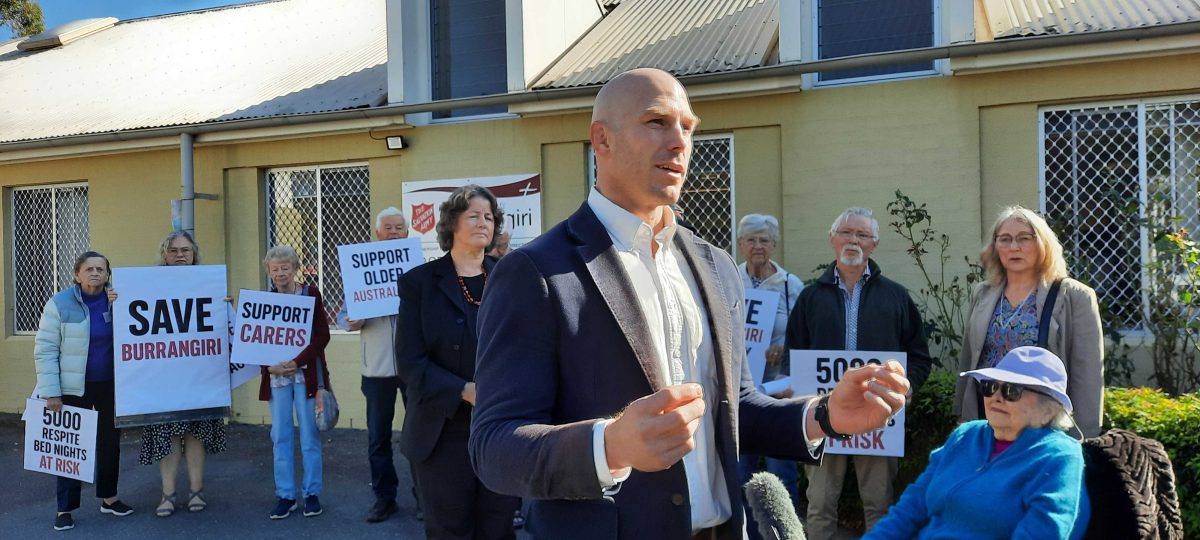
Senator David Pocock at a rally for Burrangiri last year. Photo: Ian Bushnell.
Access to aged care respite services has worsened in the ACT despite a $10 million election commitment from the Albanese Government, according to ACT Senator David Pocock.
Eight months after the election, the long-term future of the Salvation Army-run Burrangiri Aged Care Respite Centre in Rivett, and similar services in the ACT, remains uncertain, with no clear proposal or decision on how the $10 million is to be spent or what model of care will be pursued.
Senator Pocock said that people had been unable to access Burrangiri since the introduction of the federal Support at Home system. This newly branded home care system provides a budget for senior Australians to get the support they need to stay at home, including respite care.
He said that while they could still access respite in residential aged care, there were very few beds available in these settings and that people preferred Burrangiri.
According to Senator Pocock, part of the government’s commitment to transitioning to Support at Home was that no one would be worse off, but people who were accessing Burrangiri on their package before the transition could no longer do so.
Last year, he raised this with the office of the Health and Aged Care Minister, Mark Butler, but had not received a response.
Following criticism of the ACT Government’s plans to close Burrangiri, which they argued was no longer fit for purpose – a point that supporters of the centre questioned – federal Labor responded by providing $10 million in funding.
ACT Health Minister Rachel Stephen-Smith also gave the facility a two-year lifeline to the end of June 2027.
But concerns have been raised that little has happened since the election, leaving carers nervous about what they can expect.
Senator Pocock said feedback from stakeholders was that the Federal Government was likely to fund the purchase of houses to turn into “cottage respite” options – essentially houses with three to four bedrooms, where people could stay, with a care worker also available.
But respite users did not see this arrangement as a “like-for-like” service with what Burrangiri provided, and it was not what the community wanted.
For example, there was unlikely to be a registered nurse available 24/7, as at Burrangiri, in a cottage situation, given that current cottage respite facilities didn’t offer this service.
Senator Pocock said the community, including current and past users of Burrangiri, had told him that there had been no consultation on the future of Burrangiri or on a long-term plan for respite in the Territory by the ACT Government.
“Canberrans deserve to have a say on the future of respite in the ACT and to be meaningfully consulted on how this $10 million will be spent,” he said.
An ACT Government spokesperson said that no decision has been taken to refurbish Burrangiri or to build a new purpose-built facility.
The spokesperson said a range of options were being considered to support respite in the ACT, and the government continued to work with the Commonwealth, which was responsible for respite aged care, to ensure the availability of respite services beyond 2027.
Work was underway to explore sustainable models of respite service delivery that responded to the evolving needs of older people and their carers.
“The ACT Government continues to work with Carers ACT to deliver on our commitment to identify an appropriate site for them to deliver more respite,” the spokesperson said.
“This builds on the additional respite beds Carers ACT have opened or are planning.”
The ACT Government was also working closely with the Salvation Army regarding Burrangiri, but the centre had not received extra funding for improvements beyond its service agreement.
Senator Pocock is awaiting answers to questions on notice placed at Senate estimates in December concerning the future of respite care in the ACT and consultation with the community before any funding is allocated.