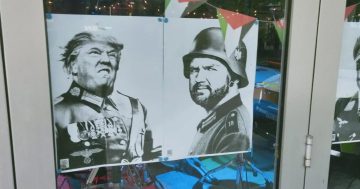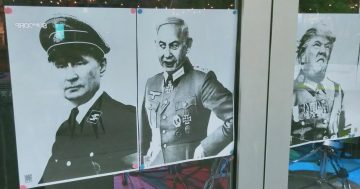

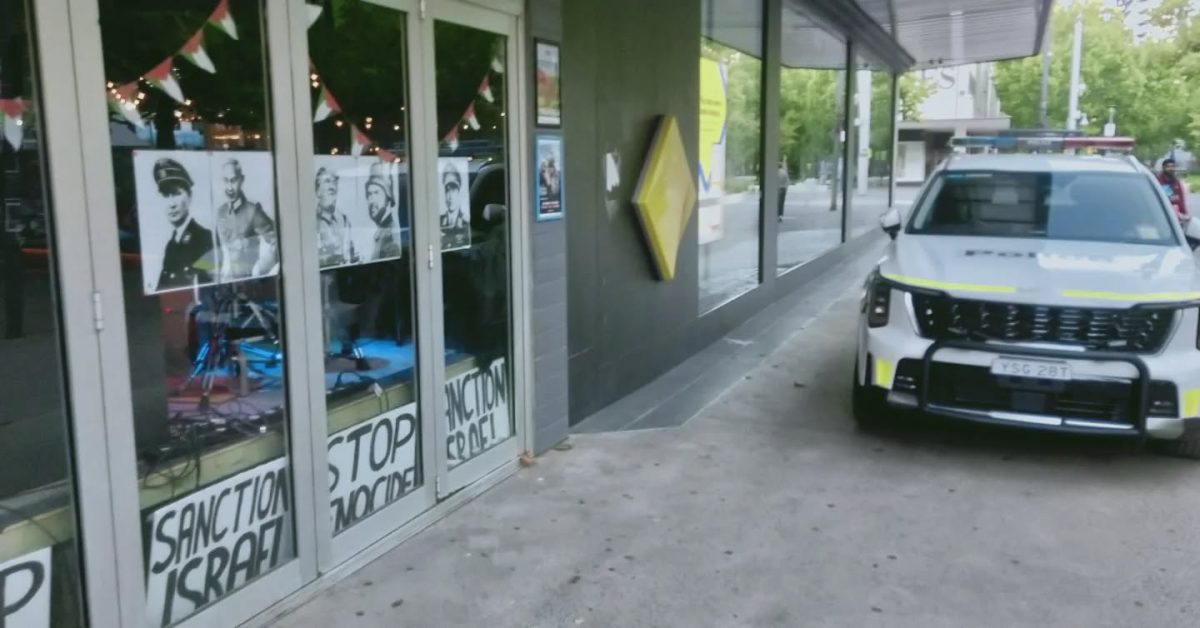
ACT Policing seized five posters from the windows of Civic’s Dissent Café and Bar on Wednesday night, citing new Commonwealth hate laws. Photo: Dissent Café and Bar.
Australia is watching as a Civic bar becomes the first real test of the Commonwealth’s new hate-symbol laws – but one Canberra criminal lawyer said police may struggle to make the case stick.
Dissent Café and Bar owner David Howe declared he is ready to fight in court after officers shut his City Walk venue on Wednesday night (18 February) and seized five posters from the front window.
No charges have been laid, and both parties are still seeking legal advice.
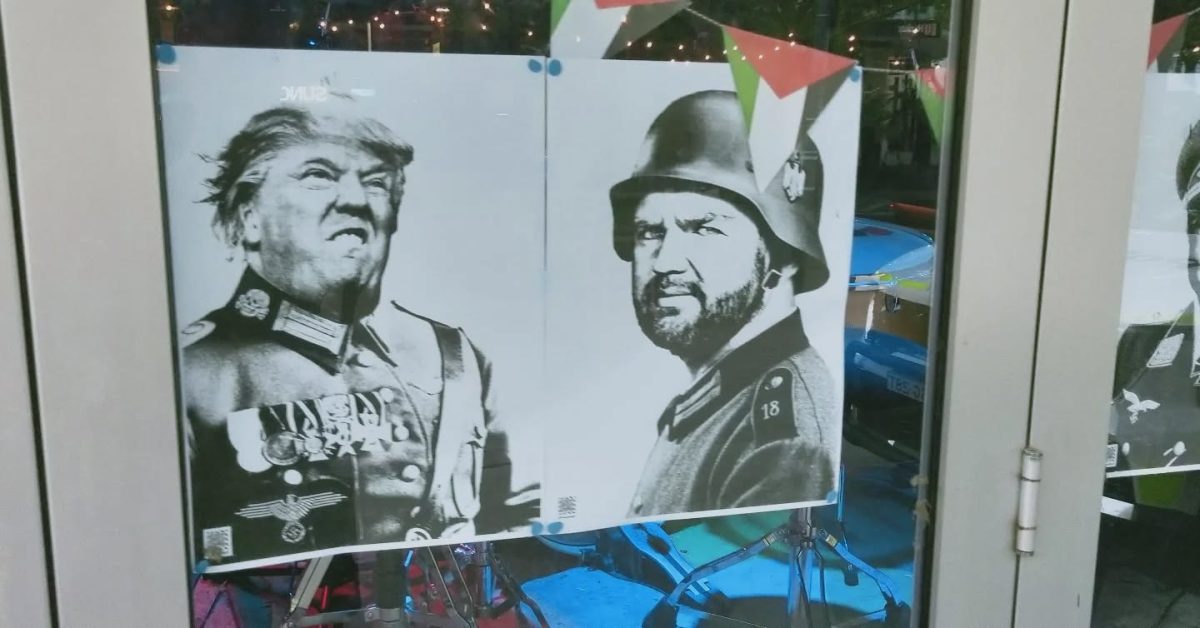
Two of the posters depict US President Donald Trump and Vice President JD Vance. Photo: Dissent Café and Bar.
But senior associate Asfandyar (Ash) Shaffi, from Andrew Byrnes Law Group, said a “simple reading” of both ACT and federal law suggests the posters fall within recognised exceptions.
“By a simple reading of the definition – and an understanding of what is at hand and what ACT Policing have effectively shut down the café for – yes, it would qualify as an exception,” he told Region.
The legal case: ACT and Commonwealth laws collide
Police acted under the Commonwealth’s Combating Antisemitism, Hate and Extremism (Criminal and Migration Laws) Act 2026, passed last month in reaction to the Bondi shooting. It makes it an offence to publicly display a prohibited Nazi symbol and gives officers the power to seize items displayed in public.
But the law also contains defences. A display is not unlawful if it is for “religious, academic, educational, artistic, literary, or scientific purposes” and not contrary to the public interest.
“Satire in effect is art. It’s a form of art,” Mr Shaffi said. The real question, he said, is “whether satire then qualifies as the art that is under that exception or not”.
The seized posters depicted global political figures – including Donald Trump, Benjamin Netanyahu, Nigel Farage, JD Vance, Vladimir Putin and Elon Musk – in Nazi uniforms under the heading “The Turd Reich”.
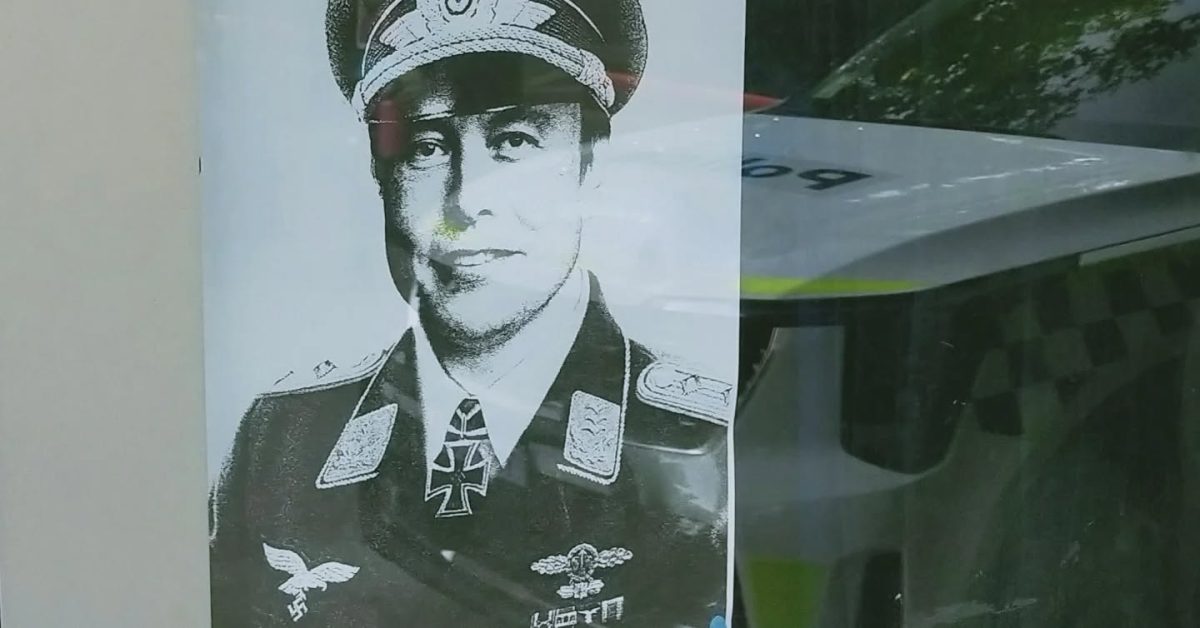
The bar owner describes the posters as ‘antifascist’. Photo: Dissent Café and Bar.
Owner David Howe describes the message as antifascist.
“Absolutely, that is the intent, and anybody who would see these posters would recognise that,” he told Region.
Mr Shaffi said this is where context matters.
“If those individuals who were depicted were unknown individuals, and the wording where it’s playing on the ‘Third Reich’ was absent, the posters would qualify as more or less Nazi symbols in a public place,” he said.
“But where there’s other information – for instance, we know Elon Musk wasn’t present back then – there’s clearly some level of common sense required.”
The ACT has its own hate-symbol offence. But Section 752 of the ACT Criminal Code also provides an exception if the symbol is displayed in opposition to fascism or Nazism. ACT discrimination law also allows acts done reasonably for “artistic purposes or in the public interest”.
“I don’t see them necessarily contradicting each other,” Mr Shaffi said of the ACT and Commonwealth laws.
“If anything, the ACT legislation section seems to expand further on what the prohibitions and what the exceptions are.”

Asfandyar (Ash) Shaffi is a senior associate at Canberra’s Andrew Byrnes Law Group. Photo: Andrew Byrnes Law Group.
If the matter proceeds, he believes ACT Policing will face difficulty.
“They will have a hard time arguing,” he said, although he warned the outcome could set an important precedent.
“It is going to set a precedent and – moving forward – that might be a concern depending on what considerations are drawn from this.”
Police union hits back at critics
The Australian Federal Police Association (AFPA) has strongly defended officers, saying they simply responded to a complaint about “alleged antisemitic material on public display”.
Officers first sought voluntary compliance, which “the owner declined, which was their legal right”, the union said in a statement. Police then seized five posters and declared the venue a crime scene to preserve evidence.
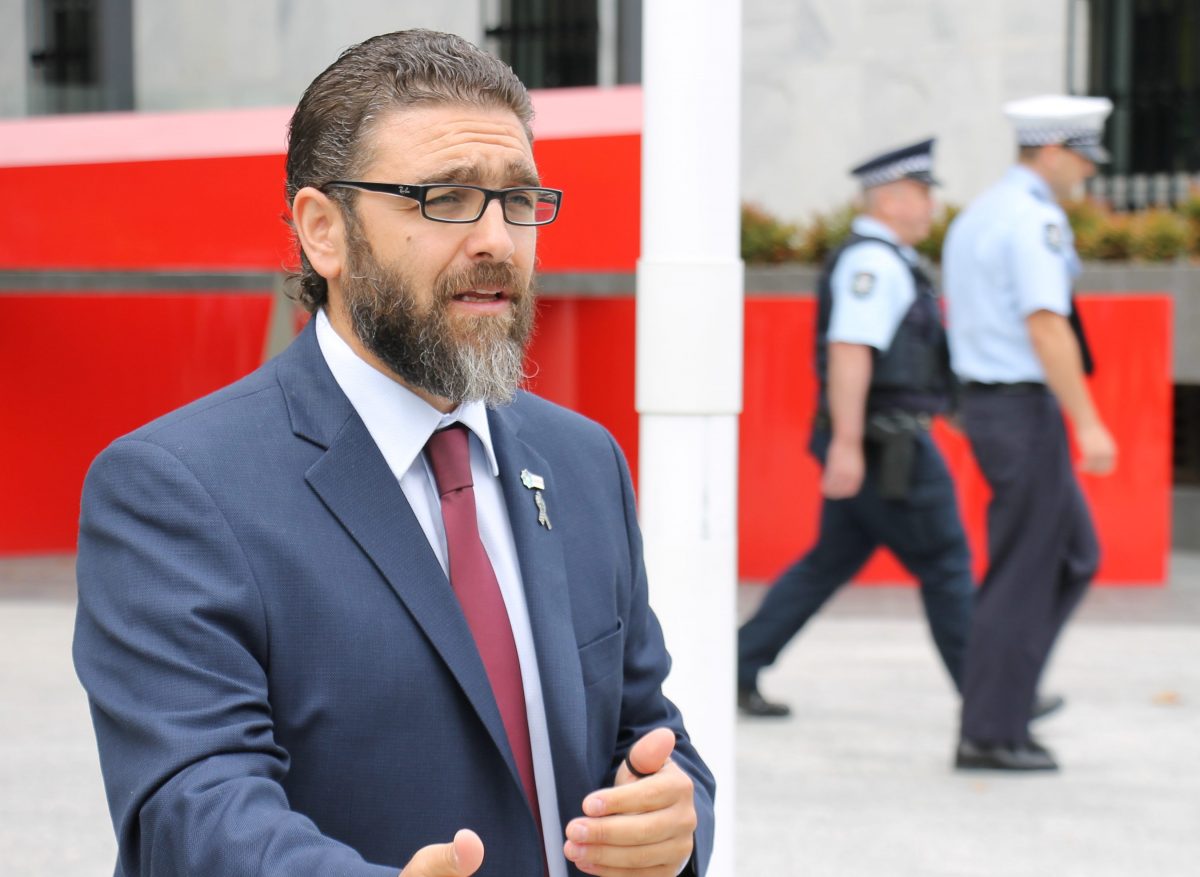
Australian Federal Police Association president Alex Caruana said police acted in accordance with the law. Photo: Albert McKnight.
AFPA president Alex Caruana said police do not “pick and choose” which reports to attend.
“Police responded to a report, attended the site, spoke to the owner, and tried to resolve it cooperatively. When that cooperation was not returned, the police officers used the powers available under law to secure evidence so the legal process could commence.”
He said it was not the police’s job to decide what counts as satire.
“It is not the role of politicians or police officers to decide what is, or is not, satire, especially when no legal precedent has been set. Satire, artistic purpose, and legal defences are matters for the judiciary.
“Police gather and preserve evidence, and the judiciary decides where the legal line sits. If people want to debate the scope of the laws, do it with lawmakers. Do not blame the officers tasked with applying them.”
If prosecutors decide the posters do not meet the threshold, “they should be returned, as ACT Policing has agreed to do”, Mr Caruana said.
What happens next
For now, the posters remain in police custody while legal advice is sought. No charges have been laid.
ACT Police Minister Marisa Paterson said she has sought clarification about the application of the new Commonwealth law and will continue to seek advice.
The ACT Human Rights Commission has noted that territory law seeks to balance the elimination of vilification with freedom of artistic expression, warning that “the misapplication of laws can have a negative effect on social cohesion”.
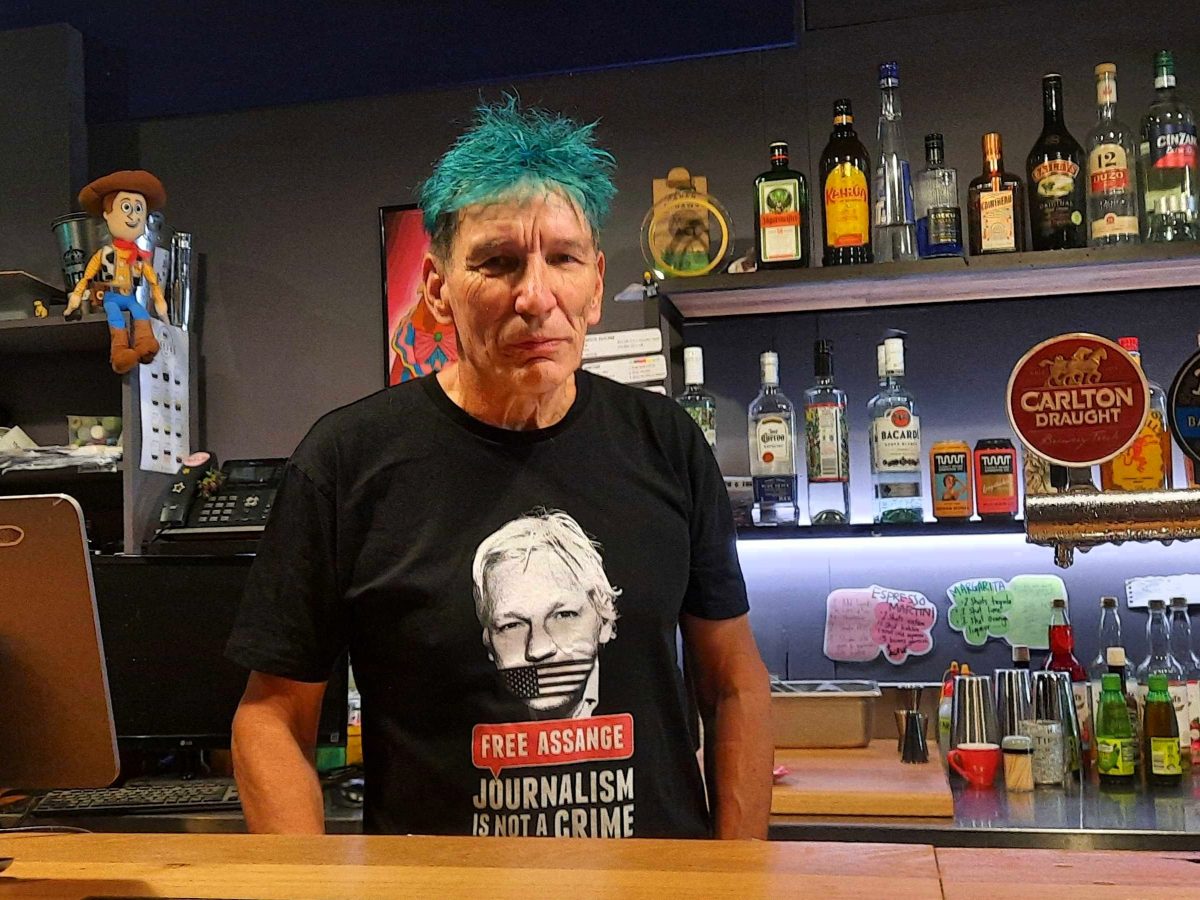
Dissent Café and Bar owner David Howe has already rehung several posters. Photo: Ian Bushnell.
But it also warns the community needs to remain engaged with the topic as the ACT Government plans to strengthen its own hate laws this year. Chief Minister Andrew Barr has flagged this could include “increased civil penalties, and in extreme cases, criminal penalties”.
Dissent owner Mr Howe said he has “heard absolutely nothing” since the seizure but is “quite happy” to contest the matter.
“If this is genuinely what the law intended, then we’ve got some bigger problems,” he said.
Until then, it’s business as usual. He’s already returned several posters to the bar’s windows, albeit now with red “Censored” text over the top.
“I guess we just keep on doing it. See what happens.”