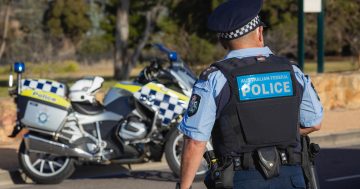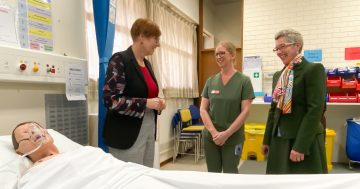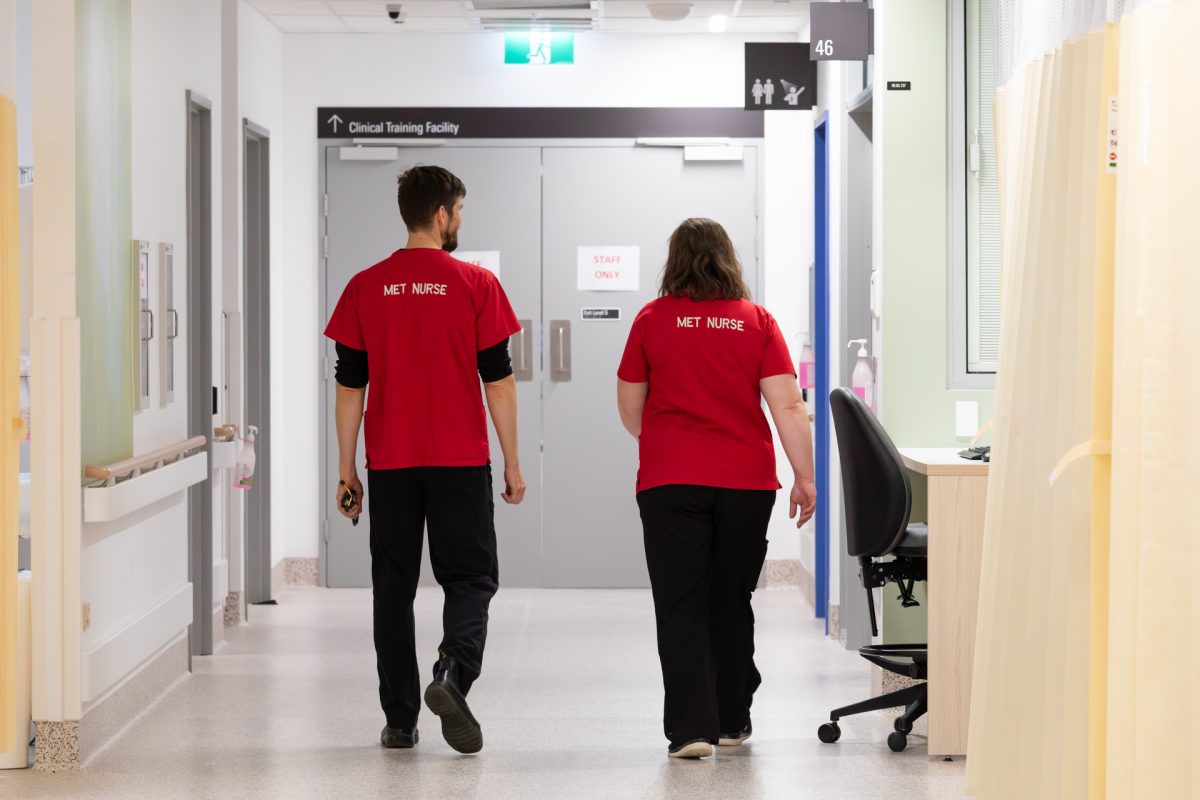
Occupational violence rates continue to climb in Canberra’s public health settings, putting healthcare staff and police officers at risk. Photo: Michelle Kroll.
Police and health workers are being exposed to “avoidable risk” due to unsafe systems across the public system.
That’s according to the Australian Federal Police Association which has warned violence in hospitals and at other health settings was placing additional pressure on the force.
President Alex Caruana said when violence escalated in a hospital, police were often the last line of defence.
“ACT Policing members are called into volatile environments where they may have limited information, limited control over the setting and limited ability to prevent the situation before it reaches a crisis point,” he said.
“This is not just a health workforce issue. It is a police safety issue, a public safety issue and a resourcing issue.”
Callouts have included for assaults, strangulation and more than 100 incidents of physical harm to staff within the Critical Services Building.
A record high of 2460 incidents were reported in the 2024-25 financial year – 1088 physical, 1230 verbal and 142 classified as “other”.
Already in 2025-26, there have been about 1000 physical and 1550 verbal incidents reported across all Canberra Health Services locations.
The union accused the government of relying on police to “absorb the consequences of unsafe systems”.
“When dangerous behaviour is not properly managed, police are called. When information is not shared early enough, police are called after the risk has already escalated,” Mr Caruana said.
“That means ACT Policing members are being placed into high-risk situations that could have been reduced or prevented with better planning, better information sharing and stronger frontline safety systems.
“Police officers should not be expected to repeatedly walk into dangerous environments because another system has failed to control the risk.”
Mr Caruana’s comments come as the Legislative Assembly unanimously passed a Canberra Liberals’ motion calling on the government to review if existing laws provided adequate protections and penalties for assaults against frontline health workers; review interventions undertaken by other jurisdictions to reduce occupational violence in health care to see if there are more effective methods out there; and consider whether a formal MOU to better connect ACT Ambulance Service and ACT Policing with health would assist in reducing incidents.
Shadow Health Minister Mark Parton said the responsibility to keep health employees safe didn’t disappear just because the job was hard or incidents happened in “moments of crisis”.
“No healthcare worker, regardless of their role, should be expected to tolerate assault, intimidation, strangulation or fear as the price of just showing up for work,” he said.
“We should seriously ask whether the ACT framework is keeping pace with the realities faced by frontline healthcare workers and whether stronger protections are warranted.”
Health Minister Rachel Stephen-Smith stressed the government did not think occupational violence was acceptable in any workplace and that it was a complicated issue.
“Staff safety is the priority, but our staff also recognise they have patients to care for, families to care for, who may be in distress and who may not be in control of their actions at all times.”
The ACT Government will need to report back on actions taken to improve occupational safety within three months.
Mr Caruana has suggested some further investigations should take place into the number of police attendances, repeated callouts, weapons-related incidents, assaults, threats and incidents in which police were required to restore safety.
“If the ACT Government wants to understand the real impact of violence in public facilities, it must measure the pressure being pushed onto police,” he said.
“The ACT Government needs to fix the systems that are pushing this risk onto police. Better reporting, stronger laws, proper security and earlier information sharing would protect police, health workers and the public.
“Our members will always respond to serious incidents, but they should not be used as the default solution for preventable violence.”