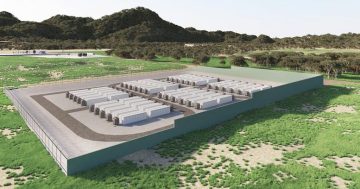
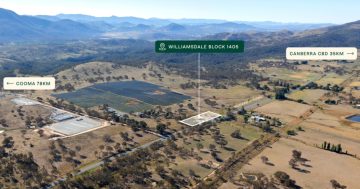
The new Williamsdale BESS is part of a renewable energy hub, with the solar farm next door. Photo: Eku.
The “big battery” at Williamsdale, now sending energy into the electricity grid, won’t be the last for the ACT.
Government and company officials gathered on site on Thursday (5 November) for a ceremony to mark the commissioning of Eku Energy’s 250 mW Battery Energy Storage System (BESS) after a two-year build.
Chief Minister Andrew Barr said a growing population, the shift away from gas to electric appliances, electric vehicle take-up and a warming climate all meant demand for electricity would also increase.
Mr Barr said Canberra was electrifying faster than any other place in the country, and it needed an energy system that met that challenge and was reliable, resilient and capable of supporting Canberra’s next stage of growth.
“This battery helps deliver exactly that,” he said.
“It provides Canberra with a substantial reserve of stored energy, strengthens the electricity network, and helps ensure that renewable energy generated here in the ACT and elsewhere is available when it is needed most in our energy market.”
Mr Barr said that, like previous generations, today’s generation had a responsibility to invest in the infrastructure that would support a sustainable future, by “not simply meeting today’s needs, but preparing for tomorrow’s opportunities”.
Part of the Canberra Big Battery network being established across Canberra, the Williamsdale BESS was an important project for the Territory, Mr Barr said.
“But I don’t think it’ll be the last major renewable energy storage site, nor will it be the last entity that’s trading in the national energy market as well,” he said.
Mr Barr believed there was still plenty of room in the ACT and beyond to accommodate such infrastructure.
The BESS switch-on comes amid ongoing debate in the regions about renewable energy development and the appropriateness of sites, including the giant Flat Rock proposal on Uriarra Station in the west of the ACT.
Mr Barr said Williamsdale, where a solar farm was already operating and transmission lines were nearby, was appropriate.
He said governments and proponents needed to be sensitive to community concerns and earn a social licence for such developments.


Eku Chief Operating Officer Tom Best said his company took an open-book approach.
“We’re not trying to push approvals through without everybody being aware of what we’re doing and the infrastructure that we’re looking to build,” he said.
He was not frustrated by the ongoing debate but said Australia needed to get on with the energy transition.
“Everybody has a view, and I think we have to be open to hearing those and responding to them in the right way,” he said.
But “there’s an absolute risk to energy security going forward if we don’t start to work further into the transition”.
The Williamsdale BESS can store enough electricity to power one-third of Canberra for two hours during peak demand periods, and will support the ACT electricity network, strengthening energy security and reliability for the ACT and NSW.
The system can also respond to grid changes within milliseconds, storing renewable energy and making it available when it is needed most. This will strengthen the reliability and resilience of Canberra’s energy system, especially during periods of high demand.
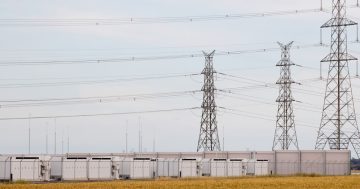
The facility includes 136 Tesla Megapacks 2 batteries arranged in 12 collector grids, each with 12 step-up transformers. The batteries are connected to the electricity network through a main transformer that is larger than an ACTION bus and weighs over 180 tonnes.

It was delivered through an Australia-first, 15-year revenue-sharing model in which the government had no upfront costs for the development and will receive an expected $20-25 million a year from revenue generated by the BESS’s participation in the National Electricity Market.
In return, the government will make a quarterly payment to Eku.
Mr Best said Eku hoped the Williamsdale BESS would be remembered as a project that demonstrated the power of collaboration – “a project that brought together the government, the industry, researchers, communities and local organisations behind a shared goal”.
Eku has distributed $1,000,000 in community benefits grants to local not-for-profit groups and the Centre for Energy Systems at the Australian National University to further their research into the most suitable energy system for the ACT.
Mr Barr said the Canberra Big Battery, along with smaller neighbourhood batteries, would play a big role in the ACT’s transition to net zero emissions by 2045.