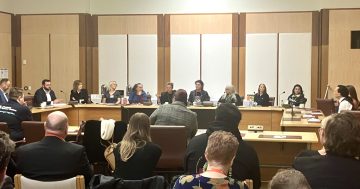
Assistant Productivity Minister Andrew Leigh has told a national tech conference that good policy improves the conditions under which more things get tried. Photo: Thomas Lucraft.
Failure is informative, but Australia’s tax system doesn’t see it that way, and innovative discovery is less lone genius and more about tinkering, working in teams and the trade of ideas.
Those were some key messages Assistant Productivity Minister Andrew Leigh delivered to the annual Agile Australia Conference on Tuesday (19 May), telling the huge technology audience that innovation begins with the permission to try.
“Anyone who has built software knows that experimentation has a rhythm. You test, you learn, you refine, you try again. The process is productive precisely because failure is informative,” Dr Leigh told the gathering.
“The problem is our tax system hasn’t seen it that way. Firms pay tax on profits immediately, while losses may sit unused until the firm becomes profitable later.
“The real value of those losses declines with time. That asymmetry especially disadvantages startups, growing firms, businesses attempting to pivot and established firms making a bold new investment.
“Large incumbents are more likely to have profits elsewhere in the business against which they can offset losses. Younger firms often lack that luxury.”
The Assistant Minister used his speech to try to connect his innovation theme to measures in last week’s Federal Budget, such as venture capital reform, changes to the R&D Tax Incentive, and the permanent $20,000 instant asset write-off for small business.
But he noted that some of the most useful policy reforms don’t pick what gets invented. They just improve the conditions under which more things get tried.
“This is what good innovation policy looks like. It asks where public support changes behaviour, then directs resources there,” Dr Leigh said.
“It rewards real experimentation. It reduces subsidies for activities that firms would likely have undertaken anyway. It recognises that young firms often have the greatest ideas and the thinnest cash buffers.
“In software terms, a feature’s longevity in the backlog is not proof of its value. You look at the evidence, learn from users, and improve the design.”
If tinkering is the first ingredient to innovative productivity, he said, then working in teams is the second.
While the myth of the lone inventor is powerful because it makes for a tidy biography, the most important innovation is collective.
“Thomas Edison did not create the practical light bulb alone. His Menlo Park laboratory employed scientists and craftspeople who tested thousands of materials for filaments,” Dr Leigh said.
“Bell Labs brought together engineers, physicists and chemists, and helped produce the transistor, the laser, the photovoltaic cell and the Unix operating system.
“A lot of important discoveries happen not at the microscope but in the argument afterwards, when someone asks why the result came out wrong.
“That’s also why venture capital is more than a cheque. A good VC brings contacts, hard-won pattern recognition, help with the difficult work of scaling and a willingness to sit in the room for the decisions that don’t have a manual yet.”
Dr Leigh stressed to his audience that innovation thrives when ideas travel between people, firms, universities and industry, as well as between countries.
Artificial intelligence will have its greatest economic impact, he insisted, as it moves beyond frontier companies and begins to improve ordinary workplaces across the country.
“Every technology enters a society with existing inequalities, existing institutions, existing incentives and existing habits,” he said.
“Artificial intelligence could improve medical diagnosis, speed up scientific discovery, help small businesses do more with less and give workers better tools.
“It could also be deployed in ways that leave workers with less say over their jobs, or that concentrate gains in a narrow set of firms.
“The right response combines curiosity with judgement. It is to build institutions that encourage useful innovation, spread its benefits, and give people a voice in how technologies are used…
“Some of the most important innovations in the next decade may come from frontier science, venture-backed firms, artificial intelligence labs or university research teams.
“Others may be humbler – a food rescue charity that finally gets its logistics right, a family violence service with safer records, a disability organisation whose clients can actually use its website, or a community legal centre that spends less time wrestling with its database and more time helping people.
“The test of an intelligent future is not how clever the tools become. It is how widely their benefits are felt.”