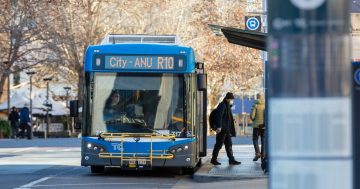
The report found that much could be done to improve the passenger experience. Photos: Ian Bushnell.
ACT public transport users can soon expect a program of changes across the network to make getting around the city easier and more enjoyable.
Transport Canberra is developing its first Customer Service Strategy in response to Public Transport Association of Canberra (PTCBR) research that identified gaps across the network and opportunities to improve the passenger experience.
Chair Amy Jelacic said the PTCBR report, Customer service and public transport in Canberra, didn’t cover operational issues such as frequency or reliability, but the more human elements of catching the bus or light rail.
“We have looked at elements including design, communications and technology use to present a very human-focused picture of using public transport in the ACT and how that experience can be improved,” she said.
“We have made recommendations that we believe will help passengers feel respected, confident, and valued as they use Canberra’s public transport.”
Transport Minister Tara Cheyne said many of the issues raised in the report align with or could be incorporated into areas for improvement that Transport Canberra was already progressing.
These included reviewing website navigation to improve the user experience, improving the consistency of customer-facing information, and identifying opportunities to enhance how service updates and disruptions are communicated to passengers.
“The timely release of this PTCBR report will ensure that community feedback is at the core of what shapes Transport Canberra’s inaugural customer service strategy, which is currently in development,” Ms Cheyne said.
“Transport Canberra will incorporate much of PTCBR’s report into this strategy and will continue to work closely with PTCBR as it designs and develops this work.”
Dr Jelacic said the verdict on Canberra’s public transport usability was not good.
She said the difficulty accessing service alerts was a good example of where the system was letting passengers down.
“As a confident everyday public transport user, I don’t know where I could go to get the most up to-date service alert information, and that’s pretty disturbing, that’s pretty concerning that if I, as a very confident user can’t do that,” she said.
“A casual or less confident user is probably definitely not going to feel confident finding that information.”
The report found that the Transport Canberra information centre in the city was not regularly staffed, and when staff were present, they were not informed or tech-savvy enough to assist passengers.

The new Woden Interchange. PTCBR wants information centres and real-time timetable screens at all interchanges.
It recommended establishing properly staffed and equipped centres in city and town centres that could provide hard copy timetables, sell MyWay cards, and have an electronic display with current information about service disruptions, as well as give advice.
The TC website was found to be hard to navigate, particularly on a phone and should be refreshed.
The report did not dwell on the ongoing problems with MyWay+ but noted that the mobile phone application still fell well below passenger expectations and provided information that was inappropriate and confusing.
Transport Canberra’s communications were also inconsistent and contradictory, with its website and Facebook pages often out of kilter.
PTCBR suggested emails would be a more efficient way to let passengers know about service disruptions than Facebook, whose role should be reassessed.
On-board Passenger Information Displays (PIDs) were very useful and well received but could be clearer. PTCBR suggested reverting to the easier-to-view 2018 format. It also said audio announcements on board were inconsistent.
The report calls for reinstating real-time PIDs at interchanges, which were deactivated after 2024, saying this issue was consistently raised with PTCBR by members and the general public.
It wants PIDs to be expanded to the new Woden Interchange and other high-use stops. All stops should have a minimum level of information, such as a QR code that passengers can scan to get real-time info.
Users found route and stop information to be inconsistent or inadequate. Abridged route timings may be appropriate as an initial view, but PTCBR recommended making more stop-level detail available.

Special events needed more attention, with clearer, more coherent information across the Transport Canberra website, information offices, and relevant stops.
PTCBR said tourists often needed help getting around the city and urged Transport Canberra to work with other key ACT tourism bodies to make information more readily available and prominent, with clearer signage and an interactive online map.
Transport Canberra’s 2023 slogan, Rethink your routine, should be dumped in favour of something more positive that instils confidence in the network.
PTCBR said PTCBR members and the general public perceived it poorly, feeling the message reads more like a caution or service alert than a call to use public transport.
“In this report, we aim to give the ACT Government a clear picture of what matters to public transport passengers and how the current system can be improved to better serve passengers,” Dr Jelacic said.
“We are glad that our feedback has been taken on board and translated into a clear plan to address the points we’ve raised.”
Ms Cheyne said PTCBR had provided Transport Canberra with a summary of minor and immediate issues for improvement.
She said several of these items align with work already underway to review and validate customer-facing information across the network, including maps, signage and stop and station information, to support a consistent and reliable passenger experience.