


ACT Policing Chief Police Officer Scott Lee apologised to the wrongfully arrested boy and his family, and promised to try to mend the relationship between the force and Canberra’s First Nations communities. Photo: Claire Fenwicke.
The arrest of a 17-year-old Indigenous boy at gunpoint from a Canberra bus wasn’t racially motivated – but the search of his belongings was illegal and breached standards.
Investigations by both the ACT Ombudsman and the AFP Professional Standards Unit led to these findings, which were made public today (25 August).
Police had been searching for a person armed with a knife who was accused of an aggravated robbery at Westfield Woden and several carjackings on 11 November 2025.
They had a description and images of the suspect, and received information from a Transport Canberra bus driver that a person matching the description was on board.
The bus was stopped and officers stormed the bus with guns drawn to arrest a boy at the back of the bus.
Referred to in the ombudsman’s report as Jay, he told police “I’ve done nothing”.
Once Jay was on the ground in handcuffs outside the bus, officers recognised him and realised he did not match the photos of the accused person.
One officer told Jay: “Sorry mate. I’m sorry. We got bad intel. Alright?” and another said, “I’m sorry, I’m so sorry, you’ve got the exact same outfit [as the person we’re looking for]”.
After this realisation, officers still searched his body and his bag, as they recognised Jay from a previous incident on Halloween when he had been carrying a costume knife and a pocketknife.
Jay was given a job card with an incident number in case he needed to contact them about what happened.
No one asked for his age or contacted his family to let them know what happened.
When the matter was made public, questions were raised about whether racial profiling influenced the officers’ decisions that day.
The ACT Ombudsman and AFP Professional Standards Unit (PSU) found this was not the case.
“We found no evidence to support the view that race led to increased, heightened or more extreme uses of force,” the ombudsman’s report stated.
“I consider the search of Jay, after he had been released from arrest, inappropriate as well as seemingly contrary to law.
“I consider that officers failed in their responsibilities to Jay as a young Aboriginal person who had just been through a traumatic experience at their hands. Shaken and scared, Jay only told his family what had happened days after the incident.”
The ombudsman praised Jay’s demeanour during the ordeal, as he complied with all officer requests and did not escalate the situation.
The PSU found Jay had been searched “in error” but “discrimination did not influence his mistaken arrest”.
“The AFP can confirm that there was no evidence to suggest race or other discriminatory factors influenced interactions between police and the young person, or that excessive force was used during the arrest,” the PSU stated.
“[It was] found the search was a serious breach of the AFP Code of Conduct.”
Five of the six PSU investigations have been completed, with one outstanding.
The ombudsman made eight recommendations in light of the investigation, all of which were either agreed to or agreed in principle by ACT Policing.

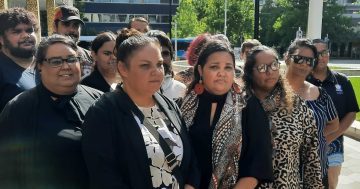
Jay’s family and supporters have previously called for police to make amends. Photo: Ian Bushnell.
Chief Police Officer Scott Lee expressed his regret at the distress this incident caused to both Jay and his family, and to the First Nations community.
“I acknowledge the compounding effect that an incident like this can have on members of our community who may be impacted by inter-generational trauma,” he said.
“I wish to assure the members of our community who have been impacted by this incident that ACT policing is committed to building and rebuilding trust and community confidence in our police force.”
No action has been taken against the six officers who were investigated, given the ongoing investigations, nor have debriefs about the incident been held.
CPO Lee said the lack of aftercare provided by his officers to Jay after the boy was released from custody was inconsistent with his expectations.
“There should have been greater immediate support provided to the young person, including considerations and care relevant to his First Nation status,” he said.
“There should have been better support to that young person; we should have obtained his details and spoken to him about getting him back to family.
“Our expectations were not met, and we should have done better in terms of support for that young person.”
CPO Lee was pushed by media about why it took Jay speaking up to spark investigations, rather than an officer bringing attention to the matter.
He responded there was a strong reporting culture within the force if something was amiss.
“In our reporting from last year … 66 per cent of reports were internally generated, so they’re actually internally generated by members who had concerns around conduct of their colleagues, and only 34 per cent of those were from outside ACT Policing,” he said.
“We have a very healthy internal reporting culture when you look at the number of reports that have been made by members internally where they are holding each other to account … I see that as a real positive.”
Just because a complaint is made doesn’t mean wrongdoing has occurred.
Findings aside, Jay’s family has to live with the fallout from that day.
In a statement included in the ombudsman’s report, they said what happened to him “still sits heavy with us”.
“We felt helpless. We felt scared. We felt like we couldn’t protect him in that moment, and that’s something no family should ever have to feel,” they said.
“What hurt the most was not just the incident itself, but how he was treated. It didn’t feel fair, it didn’t feel right, and it didn’t feel like he was seen or respected as a young Aboriginal boy, but also as a human being with rights and dignity.”
The family called for real action, rather than words, to repair the relationship between ACT Policing and First Nations communities.
“For our community, trust isn’t given lightly. It’s built through honesty, respect, and consistent action over time,” they said.
“Right now, that trust is broken.”














Frances Jane wow, that’s all you have huh View