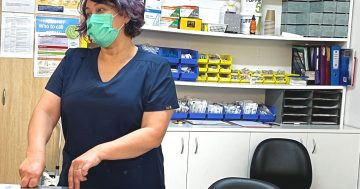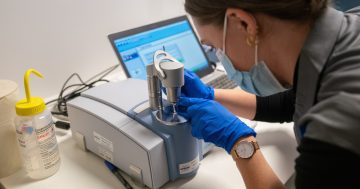

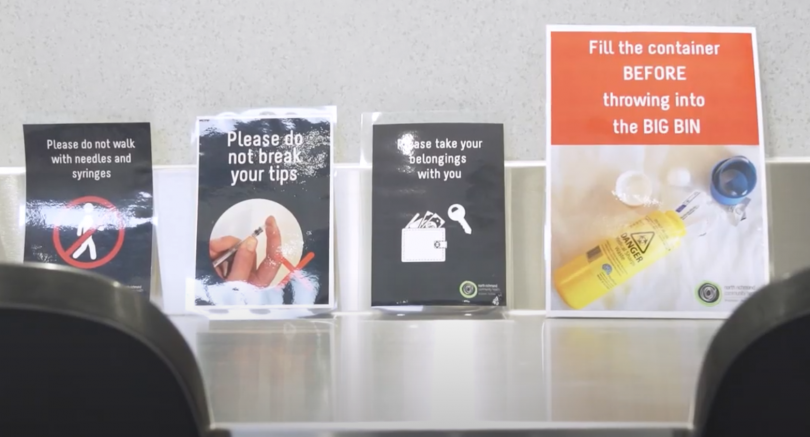
Both Melbourne and Sydney have established safe-injecting sites. Photo: File.
Economic benefits worth $250 million, 70 lives saved, 474 overdoses prevented and 215 diverted emergency responses: this is what analysis found could be achieved over four years if the ACT expanded its drug harm reduction measures.
Then-ACT Health contracted the Burnet Institute to estimate the economic benefits of averted health costs if interventions such as drug consumption rooms, needle-syringe programs, take-home naloxone, opioid agonist treatment, safer opioid supply, drug checking services and technological interventions were scaled up in the Territory.
It concluded that such interventions were likely to have a massive impact.
“Compared with no coverage, the current package of harm reduction interventions was estimated to cost $24.6 million over 2026–2030 and avert 454 (24 per cent) opioid and 20 (0.2 per cent) non-opioid overdoses, 70 (28 per cent) overdose-related deaths, 215 (17 per cent) emergency responses, 552 (117 per cent) hepatitis C infections and 199 (9 per cent) injection-related infections,” it stated.
“If circulation of drugs with higher overdose risks was greater in this region, this would increase the impacts of interventions to prevent overdose and associated harms.”
The cost-benefit ratio was estimated at 10:1, meaning such measures would return more than $10 in benefits for every $1 invested through reduced overdoses, deaths and injection-related harms.
It also found that a safe-injection room would be cost-effective, even in a smaller jurisdiction like the ACT.
“For every dollar invested, a drug consumption room could return up to nearly $3 in benefits through avoided overdose deaths, reduced ambulance callouts and shorter hospital stays,” said Burnet Program director of disease elimination Professor Paul Dietze.
“They are a proven, cost-effective tool that reduces preventable deaths and helps people engage with existing health services, while easing pressure on emergency services.”
It’s the second time the institute has carried out such research for the ACT, and supporters of safe-injecting facilities (SIFs) have urged the ACT Government to get on with the job.
“This modelling … demonstrates again that SIFs can and do save lives and significantly reduce health care costs for Governments,” Uniting NSW.ACT head of advocacy Alice Salomon said.
The researchers considered new interventions, like safe injecting spaces in the ACT, and found them “to be cost-effective, even in a smaller jurisdiction like the ACT”.
“It should be noted that the ACT already has enabling legislation to deliver SIFs in Canberra – legislation that has already been passed by the ACT Parliament,” Ms Salomon added.
It’s suspected that drugs were involved in the deaths of at least 16 people in Canberra in 2025, and it’s been confirmed that 37 people died as a result of drug overdose in 2024.
Ms Salomon said the need for safe-injecting rooms in Canberra – either as a large centre or several smaller co-located services – “has never been greater”.
“One simple, sensible, compassionate, and proven harm reduction measure is to get on with delivering appropriate safe injecting services in Canberra,” she said.
“Access to ACT-specific models of supervised injecting will save the lives of Canberrans.”
The ACT Legislative Assembly first passed a law in 1999 outlining a plan to trial a facility in Civic, but opposition and persistent delays meant it never proceeded.
It was put back on the agenda in 2024 by former ACT Greens MLA and Minister for Population Health Emma Davidson, who suggested one could be established in the next term of government.
ACT Greens leader Shane Rattenbury said the delay in setting up a self-injecting room was no longer about waiting for the evidence.
“The Greens are concerned that progress has been slowed by an overly cautious approach that treats SIFs as discretionary or optional, rather than as an essential harm-reduction response to a worsening overdose crisis,” he said.
“At this point, the Greens believe the question is no longer whether SIFs work, but when the Government will act.
“Canberra is already a national leader in drug law reform, but leadership requires completion, not just commitment. Every year of delay risks preventable deaths — and that is not acceptable.”
The Burnet Institute’s recently published research was based on the report it gave the ACT Government about six months ago.
An ACT Government spokesperson didn’t explain why there had been no movement in this space since, nor whether the community could expect any change in the near future.
“The Harm Reduction Review found that a drug consumption room would be comparatively expensive, but have broad benefits if coverage could be realistically achieved,” they said.
“There are a range of factors that would need further consideration, including the most appropriate model for the ACT, location, demand for the service, legislative requirements, potential integration with or pathways to other harm reduction services, and whether more cost-effective results could be achieved through other harm reduction programs.”
The spokesperson said the government would continue working with the community on drug policy and program priorities.
“Further work towards a drug consumption room or to establish or expand other drug harm reduction initiatives would be subject to future Budget consideration.”