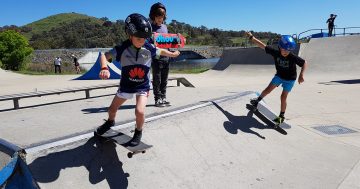
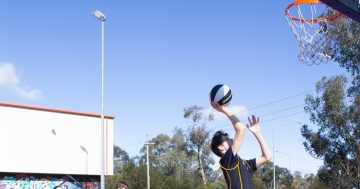
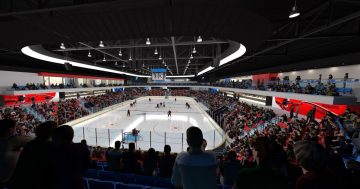
The committee inquiry considered what was holding Canberrans back from participating in community sport. Photo: Michelle Kroll.
The ACT Government should potentially look to how Wagga Wagga Council handles its community sports infrastructure as it tackles the challenge of boosting participation opportunities.
A committee inquiry has released its report into barriers and opportunities around Canberrans taking part in sports – an exercise which also absorbed several sports-related petitions.
As part of the probe, committee representatives travelled to Wagga Wagga.
“[This] served as a practical case study that provided members with on-the-ground evidence and examples of how another regional city manages common community sport challenges,” committee chair Taimus Werner-Gibbings told Region.
The committee took particular interest in the fact that the city had set up a branch of its council – called Wagga Leisure – to specifically focus on managing council-owned facilities.
“There is an app for making bookings, which allows swipe or QR code access to relevant facilities (with automatic lighting where necessary, such as for one specific tennis court),” the committee report noted.
“This reduces the need for on-site staffing, which is the highest cost of running the facilities.”
Wagga Leisure also provides catering services across all facilities, giving event-holders the chance to purchase a package that includes catering. The council is currently looking at extending its liquor licence to include the sporting venues to cover business, multicultural and other events.
“The council told the committee that owning and managing its own facilities meant the council didn’t always have to prioritise profit and was about a community focus in running the venues,” the report noted.
Many of the Wagga sports venues had upstairs or added-on event spaces with commercial kitchens, allowing business group bookings to help offset running costs.
During design and building stages of new facilities, council made sure the needs of sporting associations for their competitions was front-of-mind.
“The council found that state-level associations often had a broader view than local clubs,” the report noted.
“[For example at the Equex multi-purpose stadium] there is also a referees’ change room and a laundry. These facilities are required by some sporting associations to be able to host elite competitions.”
Mr Werner-Gibbings said the committee representatives walked away with some interesting ideas that could apply to Canberra.
“The committee highlighted Wagga Leisure as an interesting and potentially instructive model for the ACT Government to consider, particularly in how it manages bookings, accesses systems, catering services and venue operations across multiple facilities,” he said.
“The committee also noted the Wagga Wagga Council’s view that direct ownership and management enabled a stronger community focus.”
The committee report made 33 recommendations for the ACT Government to consider.
These included a call to reduce school hall and ground hire fees for volunteer-led organisations and to establish sport equipment libraries at suitable sporting venues.
It also supported the re-establishment of a recognised peak organisation to provide member services and a coordinated advocacy and one-stop communication stop for the community sport sector.
This role was fulfilled by ACTSPORT between 1985 and 2015, but was wound back due to changes in sports administration and loss of government funding.
“Evidence from many witnesses linked the lack of community sport peak organisation to the government’s inconsistent approach to sport and recreation matters,” the report stated.
“Witnesses [to the inquiry hearings] characterised the overall effect of not having a community sport peak organisation as a fractured sector, isolated from planning processes, with some groups feeling disadvantaged or ignored by inconsistent and uneven consultation pathways.
“The evidence is clear that the absence of [such an] organisation is a significant contributor to the shortcomings in the ACT’s sport and recreation policy and planning.
“While the committee appreciated [former Sports] Minister Berry’s assurance the sector is small enough for government to engage directly with individual organisations, the evidence suggests that this approach is unsatisfactory in practice.”
Dissatisfaction was also a key theme in regards to the six-year Next Move strategy that was launched in late 2022.
Submissions said its length was too short for proper investment and forward planning, its policy relationships were unclear and an absence of a long-term infrastructure and investment plan in the strategy was a “critical weakness”.
Ms Berry told the inquiry excluding specific infrastructure from the strategy was by design, to avoid community disappointment if an outlined project didn’t get funding.
Since the hearings, the ACT Government has published a list of sport and recreation infrastructure projects for the 2024-28 period.
An Assembly resolution from February also called for an independent Sport Report to “ensure the community has access to facilities required to stay active”. It’s due to be tabled by 24 March 2027.
The committee recommended the government use this report and develop a 10-year sports and recreation strategy by the end of 2027, co-designed with the community sports sector and reviewed every three years.
Independent Kurrajong MLA Thomas Emerson, whose supply-and-confidence agreement include a commitment regarding longer-term sports infrastructure planning and improvement, said this showed the government how to get sports back on track.
“Local sporting organisations have long called for a 10-year community sport infrastructure plan and a community sport peak body. This report turns these calls into clear recommendations to government,” he said.
“Hopefully with a new minister at the helm, we’ll see the ACT Government step up to the plate and start investing in sport at a level commensurate to its value for our community.”