
11 November 2025

Sneak peek: Qantas's ultra-long-range airliner breaks cover

| By Andrew McLaughlin
Join the conversation
8
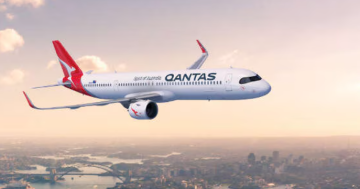
Qantas Airbus A350-1000ULR

Qantas’s first A350-1000ULR rolls out of its assembly building at Toulouse, France, headed for the factory’s completion centre. Photo: Airbus.

The first of 12 Airbus A350-1000ULR airliners on order for Qantas has been rolled out in a largely assembled state at the manufacturer’s Toulouse factory in southern France.

The A350ULR – for Ultra-Long-Range – will be the cornerstone of the airline’s ambitious ‘’Project Sunrise’’ plan to offer non-stop passenger flights from Sydney to London and to New York.

The -1000 is the longest variant of the popular A350 series, which began entering service nearly a decade ago, and features a fuselage stretch to 73.79 metres, more powerful 97,000-pound-thrust engines, and higher weights.

The ULR model adds a 20,000-litre rear-centre fuel tank in the aircraft’s belly, a stronger undercarriage and other system enhancements, allowing it to operate sectors of more than 18,000 kilometres over 22 hours. This brings almost every major airport in the world into range non-stop from Qantas’s major Sydney hub.

Currently, Qantas long-range passenger services to London use the 485-seat Airbus A380, which need to stop for fuel and a crew change in Singapore. Qantas services from Sydney to Paris and Rome operate with 236-seat Boeing 787-9 equipment via a stop in Perth.

On the airline’s services to New York, passengers can either connect with partner airlines via Los Angeles, Dallas-Fort Worth, or San Francisco, or fly all the way on a Qantas Boeing 787-9 via a tech stop in Auckland.

Major components of the A350-1000ULR are manufactured in Hamburg in Germany and in Wales in the UK, before being flown to Toulouse for final assembly. The first Qantas aircraft was rolled out of the final assembly hall at Toulouse to be taken to a nearby completion centre, where it will receive engines and pylons, and flight deck and interior fittings.

The aircraft will then be painted at Toulouse before conducting a comprehensive flight test and airline acceptance campaign early next year, with delivery later in 2026.

For Qantas, the A350-1000ULR will be delivered with a spacious seating configuration, comprising six First Class suites, 52 Business suites in a 1-2-1 abreast configuration, 40 Premium Economy seats in a 2-4-2 configuration, and 140 Economy seats in a 3-3-3 configuration.

The cabins have been developed from the ground up in collaboration with Australian industrial designer David Caon and experts from the University of Sydney’s Charles Perkins Centre, which includes sleep scientists looking to minimise jetlag using customised lighting design and timed meal services.

Other features will include a dedicated ”Wellbeing Zone” for Premium passengers to move around, refreshments, high-speed Wi-Fi and Bluetooth audio, and a spacious overhead storage area.

READ ALSO It’s smooth air on Qantas’s new single-aisle airliner

Qantas says the Project Sunrise name celebrates the airline’s historic ”Double Sunrise” endurance flights during World War II, which remained airborne long enough to see two sunrises.

CEO Vanessa Hudson said the reveal brought the airline’s Project Sunrise ambitions one step closer to reality.

“Given Australia’s position in the world, Qantas has a long history of breaking aviation barriers,” she said.

”Project Sunrise will not only overcome the tyranny of distance, it will fundamentally change the way our customers travel the world.

“These flights will cut up to four hours off the journey and transform how people experience ultra-long-haul travel, through science-backed design to minimise jetlag and maximise wellbeing.”

The A350-1000ULR is expected to be delivered in mid-to-late 2026 and enter service on long-haul services in early 2027.

In other Qantas news, the airline has launched a domestic Economy Plus seating configuration for its new A321XLR, A220 and refreshed Boeing 787-800s.

Offering up to 40 per cent more legroom, the Economy Plus seat will initially be available to high-tiered Qantas Frequent Flyers as an upgrade, but will likely be available for a premium as it is rolled out across more aircraft.

The A321XLR and A220s already have some Economy Plus seats, and these will be rolled out on the 737s and officially offered to passengers from February 2026.

Original Article published by Andrew McLaughlin on PS News.

Free Daily Digest

Want the best Canberra news delivered daily? We package the most-read Canberra stories and send them to your inbox. Sign-up now for trusted local news that will never be behind a paywall.
Loading
By submitting your email address you are agreeing to Region Group's terms and conditions and privacy policy.

Join the conversation

8
All Comments
  • All Comments
  • Website Comments
LatestOldest
Capital Retro2:51 pm 11 Nov 25

The new carbon taxes will kill long haul airline business.

That’s what it’s designed to do, but not just long haul airlines

Not just yet. They’ve all got to fly back from COP30 first, but mainly in private jets of course.

Speaking of, we haven’t heard much from Belem, hope everything’s okay over there. Maybe without the USA, India, China and Russia the volume’s been turned down. To zero.

Glad you mentioned it, Penfold. Here is one report from yesterday: “India used the summit in Belém last week to remind the world that half of its electricity demand can now be met by wind, solar, and hydropower and that it reached its 2030 targets for pivoting to cleaner energy sources under the Paris Agreement five years early.”

While the U.S., China, Europe are failing to reach their emissions targets, the rest of the world has taken off with renewables and even those recalcitrant countries are making inroads. For example, America is continuing to disinvest in coal power despite Trump’s fantasies, and China already generates over half its electricity from renewables and is continuing to build out the capacity faster than any other technology.

At Paris the projection was for a 3.3 to 3.8C warming by the end of the century. Despite some major countries failing their ambitions, current projections are for 2.5 to 2.9°C. While this is still not sufficient, it shows that action can and already has changed the trajectory. Further investment will achieve net zero but the real problem is to drive down the trajectory further, below 2°C. We currently risk hitting 1.5°C by 2030 and already effects of warming are seen in increased frequency and severity of floods, storms and fires. Australians under 50 understand these issues and are voting for action. While this government is unfortunately unadventurous, the alternative is worse.

China will continue to act despite the US because that is exactly how they are entrenching power among other nations, at the Americans’ expense.

Hi Axon – great to hear someone is paying attention to COP30. There’s been nothing in any of the mainstream media here, i was starting to wonder if all those climate champs had fallen over a cliff and wouldn’t be heard from again.

https://www.abc.net.au/news/2025-11-07/cop30-moral-guterres-climate-change/105982176

But at least the UN is there, demanding huge cheques be signed and trying to scaremonger their way to relevance. Haven’t heard about global boiling yet but it can’t be far away.

Speaking of relevance, where’s Greta ? Is she still stuck in Israel ? Would have thought the focus would be COP30, but it’s so hard to juggle all these competing socialist priorities.

Could you let us know the latest Axon ? The Aussie media is ignoring it all. Are people more worried about their hip pockets ?

Capital Retro6:32 pm 11 Nov 25

Residential and commercial electricity rates have been increased in several areas of India, with some states like Delhi and Maharashtra seeing increases between 8% and 20% in the last couple of years.

Renewable ideals cost.

Penfold, you appear to be following it closely to know all of those wholly irrelevant things about other people. COP will do whatever it does. My interest is in what I see countries and people doing, and how little you, CIS/IPA/Sky/ and the Nationals can cope with the reality of cheaper renewables being implemented here and world-wide.

Gosh, prices have gone up somewhere have they Capital Retro? Not like the old days of sixpence for a packet of chips, is it?

These days people dealing with newer technologies understand the demonstrated fact that renewables are cheaper which is why they are being implemented world wide, regardless of inflation, polluting and unreliable coal power, expensive nuclear options, or wars driving up external prices for oil and gas.

Have a cup of tea, a Bex and a good lie down. You know it is from your era of thought.

Daily Digest

Want the best Canberra news delivered daily? Every day we package the most popular Region Canberra stories and send them straight to your inbox. Sign-up now for trusted local news that will never be behind a paywall.

By submitting your email address you are agreeing to Region Group's terms and conditions and privacy policy.